Mapping to the NZQF Without Losing the Learner
30 August 2026 · 7 min read

The instructional designer who treats this remapping cycle as a race to get compliant will finish fast and hand over something worse than what they started with. NZQA's framework reset is asking for a different kind of design thinking, not a quicker version of the old one — and the teams doing it short-staffed are the ones most likely to mistake speed for progress.
Why this hits your desk
This isn't a terminology refresh you can run through find-and-replace. The updated New Zealand Qualifications and Credentials Framework (NZQCF) took effect on 1 July 2025 with new level descriptors and qualification-type descriptions, and NZQA recommends any new programme development use them — even though programmes already underway could still be approved under the old descriptors until the end of 2025. If you're mapping outcomes right now, you're deciding which version of the framework logic your programme will carry for years.
At the same time, unit standards are progressively giving way to skill standards, and the two are built on genuinely different premises. Under the Programme Approval, Recognition, and Accreditation Rules 2026, effective 19 January 2026, external evaluation and review is being replaced by self-review and monitoring — which means the evidence proving your programme is sound now has to be built and owned inside your own team, often by you. And all of this is landing on ITP design teams that have already been cut back ahead of Te Pūkenga's disestablishment. None of it excuses cultural competency as an afterthought — the Pastoral Care Code makes it a binding design obligation, not a slide in the course intro.
From assessment checklist to learner journey
Unit standards were built around assessment: define the task, define the evidence, tick it off. Skill standards, as defined in the Education and Training Act 2020, specify skills, performance levels, and the learning outcomes tied to them — but the intent behind the shift is to describe a learner's journey toward the standard's purpose, not just the endpoint you assess against.
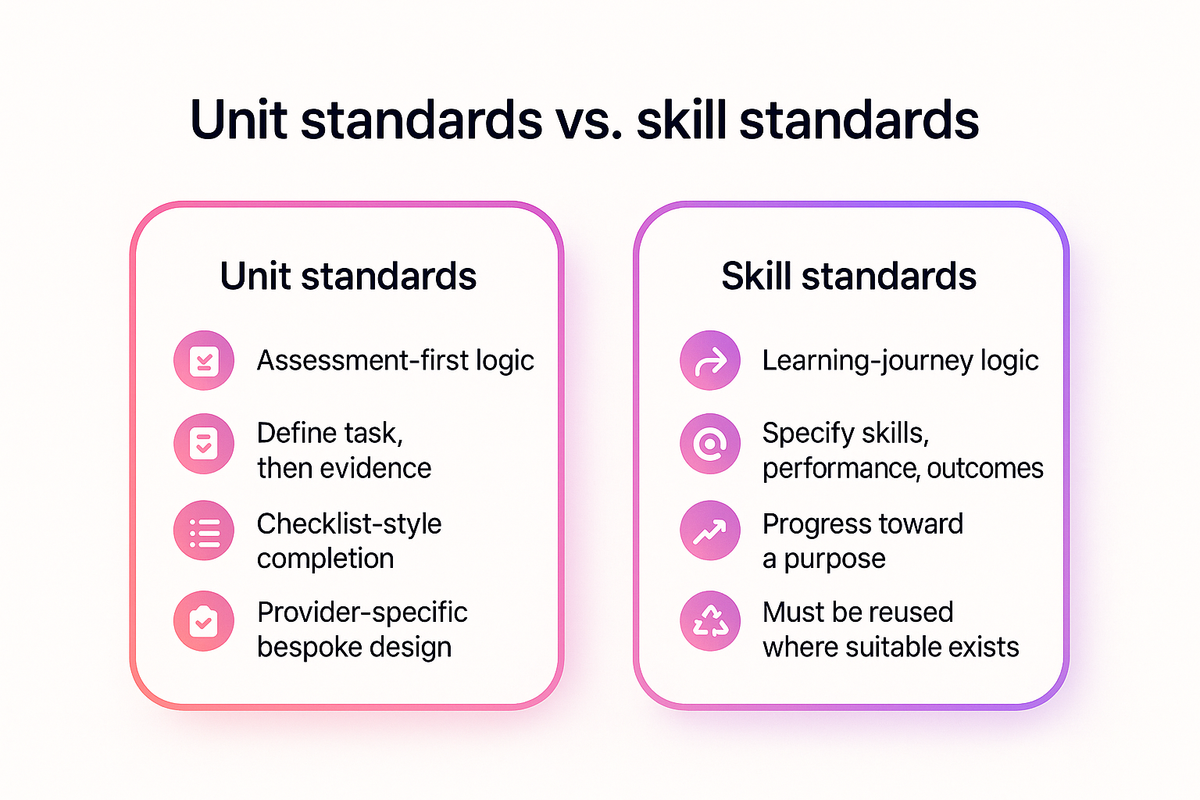
That's a genuine redesign task. A programme mapped to a skill standard needs to show how a learner progresses toward competence, not just what evidence proves they arrived. If your current unit-standard-based programme reads like a checklist with learning bolted around it, remapping it onto a skill standard by substituting terms will produce a document that technically complies and pedagogically limps.
There's a constraint worth naming plainly: NZQA rules require that where a suitable skill standard already exists for your qualification or micro-credential's purpose and outcome statement, you must use it. That's less bespoke design work for you — the Tertiary Education Commission has framed the broader unit-to-skill-standard shift, alongside its push toward single national programmes, as a deliberate effort to cut duplicated design effort across the sector. But it also means less room for provider-specific judgement calls. Your value shifts from writing the standard's language to designing the experience that gets a learner there.
The evidence trail is now yours to build
External evaluation and review used to be an outside check on whether your programme held up. Under the Programme Approval, Recognition, and Accreditation Rules 2026, that role largely disappears in favour of self-review and monitoring. Consistency reviews are discontinued too.
Practically, that means the quality-assurance story — why this sequence of learning outcomes, why this assessment approach, why this level of scaffolding — needs to be documented and defensible from inside your programme, not validated by an external reviewer after the fact. If you're not already keeping a design rationale alongside the programme document itself, this is the moment to start, because you may be the one producing it under scrutiny later.
Redesigning with fewer hands on deck
The Vocational Education and Training System Amendment Act 2025 disestablished Te Pūkenga, set up NZIST as a two-year transitional entity, re-established 10 regional polytechnics, and stood up 8 Industry Skills Boards from 1 January 2026, replacing the Workforce Development Councils. That's a genuine change in who sets standards and who you report programme alignment to.
Ahead of disestablishment, ITPs including Wintec, Whitireia, WelTec and Toi Ohomai cut jobs. The Tertiary Education Union has noted that duties from unfilled roles fall to remaining staff — which, for instructional design teams, means the remapping workload is landing on fewer people at the exact moment it's grown more complex. There's no clean answer to this beyond naming it honestly: rushed remapping under thin staffing is a quality risk worth flagging upward, not absorbing silently.
Cultural competency is a design spec, not a values slide
The Education (Pastoral Care of Tertiary and International Learners) Code of Practice 2021 requires provider staff training to cover Te Tiriti o Waitangi and appropriate cultural competencies. That's a binding obligation on the provider, and it shapes what a defensible programme design looks like — not a paragraph to add once the outcomes are locked in.
Tātaiako's five competencies — Wānanga, Whanaungatanga, Manaakitanga, Tangata Whenuatanga, and Ako — are widely used across the sector as a reference point for what culturally responsive design actually does in practice, from how learning is sequenced to how relationships and context show up in assessment. The NZQCF itself is positioned to help advance mātauranga Māori. If your remapping treats cultural competency as a line item to check off after the learning outcomes are set, you've missed the point of the framework you're mapping to.
Key takeaways
- The NZQCF's updated level descriptors took effect 1 July 2025; NZQA recommends new programme development use them even though transitional approvals under the old descriptors ran until end of 2025.
- Skill standards describe a learner's journey toward a standard's purpose, not just assessable checkpoints — remapping is a redesign task, not a terminology swap.
- Where a suitable skill standard exists, NZQA rules require you use it, narrowing (not eliminating) the scope for bespoke design judgement.
- The Programme Approval, Recognition, and Accreditation Rules 2026 (from 19 January 2026) replace external evaluation and review with self-review, shifting the quality-assurance evidence burden onto your own documentation.
- Cultural competency obligations under the Pastoral Care Code 2021, and reference frameworks like Tātaiako, are compliance-relevant design inputs, not optional additions.
Our take
The sector narrative around this transition leans heavily on efficiency — fewer duplicated programmes, less bespoke design, a shared national approach. That's a reasonable policy goal, but it puts pressure on instructional designers to treat remapping as a paperwork exercise rather than a design opportunity. The two aren't the same thing, and conflating them is how you end up with programmes that pass approval but don't actually teach anyone anything differently.
The designers who come out of this transition well will be the ones who use the enforced pause — new descriptors, new standard types, a fresh evidence obligation — to genuinely rebuild learner-centred, culturally grounded programmes, rather than just porting old content into new headings. That's harder with a smaller team and a tighter clock. It's also the only version of this work that's actually worth doing.
FAQ
Do I need to remap existing programmes to the updated NZQCF descriptors immediately? NZQA allowed programmes already in development under the old descriptors to be approved under them until the end of 2025, but recommends new development use the updated NZQCF, effective 1 July 2025. Check your programme's development status against that timeline rather than assuming a blanket deadline.
Can I still design a bespoke programme if a skill standard already covers my qualification's outcome statement? NZQA rules require you use a suitable existing skill standard where one exists for the qualification or micro-credential's purpose and outcome statement. Your design effort shifts toward how learners progress through that standard, not whether you can write your own.
Who reviews my programme's quality now that external evaluation and review is gone? Under the Programme Approval, Recognition, and Accreditation Rules 2026 (effective 19 January 2026), self-review and monitoring replace EER and consistency reviews. The provider — including the instructional design team — carries more of the ongoing evidence responsibility.
Does the Te Pūkenga disestablishment change who I report programme alignment to? Yes. The Vocational Education and Training System Amendment Act 2025 re-established 10 regional polytechnics and, from 1 January 2026, replaced Workforce Development Councils with 8 Industry Skills Boards, alongside NZIST as a two-year transitional entity — reshaping the standard-setting and reporting relationships around programme design.