NZQF Review: Assessment Update for Skill Standards
13 October 2026 · 6 min read
Skill standards are replacing unit standards, and the new Industry Skills Boards (ISBs) now own them. Because one skill standard often replaces several unit standards, an assessment bank can't just be relabelled. It needs rebuilding, consolidating and re-mapping, ideally well before the many 31 December 2027 expiry dates.
What changed, and who owns the standard now?
The short answer: the owner changed. TEC says ISBs were formally established from 1 January 2026, with a core role of setting standards for vocational education in their sectors. The work-based learning divisions of NZIST (Te Pūkenga) transferred to the ISBs on that date.
NZQA moved with them. It updated its Rules with effect from 19 January 2026, aligning them with the integrated Quality Assurance Framework and the wider changes to the vocational education and training system. The re-issued Directory of Assessment and Skill Standards (DASS) Listing and Operational Rules reflect the Education and Training (Vocational Education and Training System) Amendment Act 2025. That includes the shift from Workforce Development Councils to ISBs.
If you're doing an NZQF review assessment update across your portfolio, start with this question: which body now owns each standard my assessments map to?
Why can't you just relabel the bank?
Because the replacement is rarely one-for-one. The Food and Fibre ISB says a skill standard may replace several unit standards rather than being a straight swap. NZQA's guidelines for listing skill standards on the DASS say the same thing: skill standards generally replace several unit standards, carry larger credit values and are less prescriptive.
In practice, that means three things for your bank:
- Consolidation. Several unit-standard assessments may need to become one coherent assessment design.
- New criteria. Old performance criteria can't be copied across, because the standard itself is written differently.
- Fresh mapping. You need to show how each task covers the new standard, not the ones it replaced.
A relabelled bank looks tidy and proves nothing. That's the risk.
How long do you have?
Longer than a year, shorter than it feels. NZQA's guidelines expect standard-setting bodies to set transition periods of two years for superseded unit standards. Each ISB sets its own schedule, so there's no single national calendar.
Toitū te Waiora gives one concrete example. First aid unit standards 6400–6402 expire on 31 December 2027, and providers must move to skill standards 41051–41053 before then. An older Ministry of Education source, written before the legislation, also pointed to the end of 2027 as the end of the transition.
Many expiries cluster at that date. If your portfolio spans several sectors, you may be facing a pile-up of rebuilds in the same year. Check the timeline on each relevant ISB's site rather than assuming.
Does consent carry over, and what about approval?
Consent can carry over. Approval of your assessment tools may still apply.
In the first aid example, providers with consent to assess against the old standards are automatically granted consent for the replacements. That removes one hurdle. It doesn't remove the need for sound assessment materials.
The MAEISB guide to assessment writing for skill standards (July 2026) advises internal pre-moderation of assessment materials. You then submit an assessment and assessor guide to MAEISB for final approval. That's one ISB's process, and others may differ. Pre-moderation expectations vary by ISB, so read the guidance for each sector you serve.
What's different in the regulatory settings?
Two shifts matter for assessment teams.
First, NZQA's programme rules reduce requirements where a programme approval relates to a qualification made up entirely of skill standards. That's a lighter touch at programme level.
Second, the DASS rules no longer carry a 5-year maximum for reviews. Standards may be revised on less predictable cycles. A bank built for a fixed five-year rhythm will need a way to absorb change as it arrives.
There's also an interpretation worth flagging, and it's ours rather than a regulator's. With less prescriptive standards, and external evaluation and review replaced by self-review and monitoring under the PTE Rules 2026, the proof of coverage sits in your own records. Useful evidence includes mapping back to the standard and a version trail from the old unit standard to its replacement. Treat that as good practice, not a stated rule.
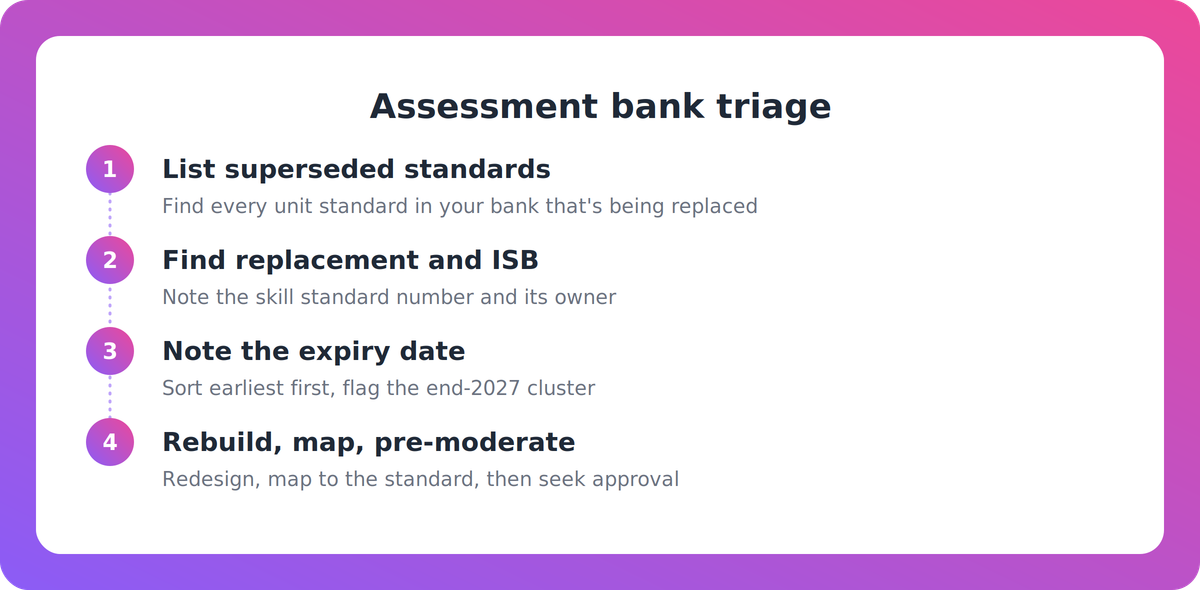
A four-step triage for your assessment bank
Where do you start when the bank runs to hundreds of assessments? Triage by expiry.
- List what's superseded. Identify every unit standard in your bank that has been or will be replaced.
- Find the replacement and its ISB. Note the skill standard number and who owns it.
- Note the expiry date. Sort by the earliest, and flag the 31 December 2027 cluster.
- Rebuild, map and pre-moderate. Redesign the assessment, map it to the new standard, run internal pre-moderation, then submit if the ISB requires it.
Step four is where the hours go. It's also where context matters: an assessment for an ESOL learner in a workplace setting isn't the same as one for a classroom cohort, even against the same standard.
Key takeaways
- ISBs were established on 1 January 2026 and now own skill standards. NZQA's Rules were updated from 19 January 2026.
- One skill standard often replaces several unit standards, so banks need restructuring and re-mapping, not relabelling.
- Transition periods are around two years, set by each ISB. Many expiries fall on 31 December 2027.
- Consent to assess can carry over, but approval of assessment tools and assessor guides may still be required, and the process varies by ISB.
- Keep your own coverage evidence: mapping to the standard and a version trail from old to new.
Our take
The temptation will be to treat this as a clerical update: swap the numbers, move on. We think that's the expensive mistake. Less prescriptive standards hand providers more design freedom and more responsibility, and the providers who use the next two years to rebuild assessments properly will be easier to moderate and easier to defend. Start with the earliest expiries, and don't wait for your ISB's deadline to find out how big the job is.
Which standards in your bank expire first, and do you know who owns their replacements?
FAQ
What is replacing unit standards in New Zealand vocational education?
Skill standards are replacing unit standards. According to NZQA's DASS listing guidelines, they generally replace several unit standards, carry larger credit values and are less prescriptive. ISBs now own and set them.
Who owns skill standards now?
Industry Skills Boards. TEC says ISBs were formally established from 1 January 2026, with a core role of setting standards for vocational education in their sectors.
When do the old unit standards expire?
It depends on the sector. NZQA's guidelines expect transition periods of two years, and each ISB sets its own schedule. Toitū te Waiora lists first aid unit standards 6400–6402 as expiring on 31 December 2027, and many expiries cluster at that date.
Do we need to re-apply for consent to assess against the new standards?
Not necessarily. In the first aid example, providers with consent for the old standards are automatically granted consent for the replacements. Check your own ISB's guidance, as arrangements may differ by sector.
Do assessments still need pre-moderation under skill standards?
Pre-moderation expectations vary by ISB. MAEISB's July 2026 guide advises internal pre-moderation, then submission of the assessment and assessor guide to MAEISB for final approval. Other ISBs may set different requirements.