Ofsted SEND Evidence in FE: The New Non-Negotiable
15 July 2026 · 7 min read

Ofsted SEND Evidence in FE: The New Non-Negotiable
Since the renewed Education Inspection Framework took effect for further education and skills from 10 November 2025, Ofsted no longer accepts a confident narrative about SEND and disadvantage as sufficient evidence. Inspectors now triangulate what they see on site against Department for Education-fed data, and a provider that can't show a live, defensible link between its data and its actual decisions risks an inadequate judgement — with the bar rising again in September 2026.
What actually changed on 10 November 2025
Ofsted's own education blog, published 7 November 2025, sets out the shift plainly: inspection now runs on two parallel evidence streams. One is the traditional on-site picture — observation, conversations, sampling. The other is data, drawn through tools like the Inspection Data Summary Report (IDSR) and the Further Education and Skills Information Tool (FESIT), both fed continuously from provider data via the Department for Education.
That second stream isn't background reading for inspectors. It's used to cross-check whatever a provider tells them on the day. If a leadership team describes robust support for disadvantaged learners but the DfE-sourced figures don't match that account, the mismatch is visible before the inspector has finished the visit.
Which learner groups are inspectors sampling
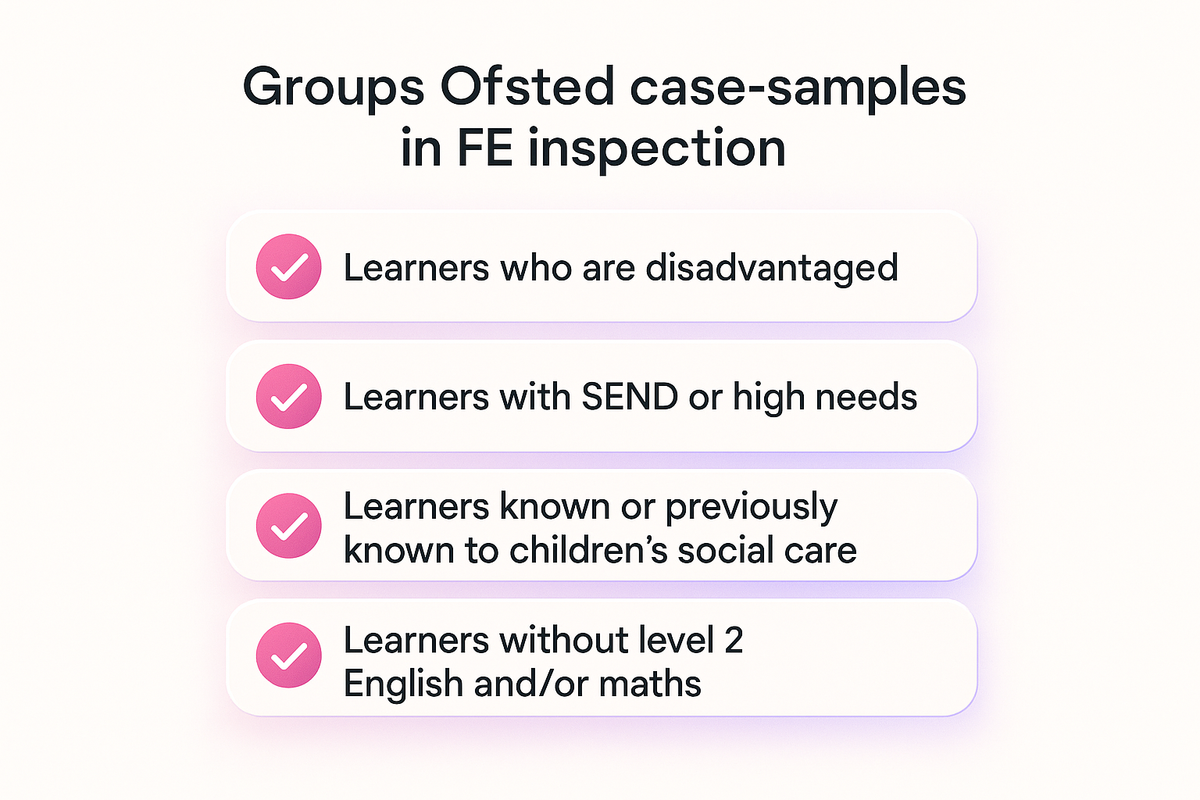
Ofsted's further education and skills FAQ, published 8 January 2026, names the groups that inspection activity and case sampling are built around. These aren't new categories in principle, but they are now the explicit spine of the evidence request:
- Learners who are disadvantaged
- Learners with SEND or high needs
- Learners known, or previously known, to children's social care
- Learners without level 2 English and/or maths
For each group, inspectors aren't auditing a provider's internal data system directly. They're testing whether leaders can show, with evidence, how that data changed a curriculum decision, a support intervention, or a funding allocation for a specific learner or cohort.
Why a well-written narrative no longer works
The published FE and skills inspection toolkit is explicit on where this goes wrong. Leaders who cannot account for the needs of disadvantaged, SEND, high-needs or social-care-involved learners — or who misuse dedicated funding such as high-needs allocations — are marked as demonstrating inadequate practice. That's not a soft steer. It's a binding grading criterion.
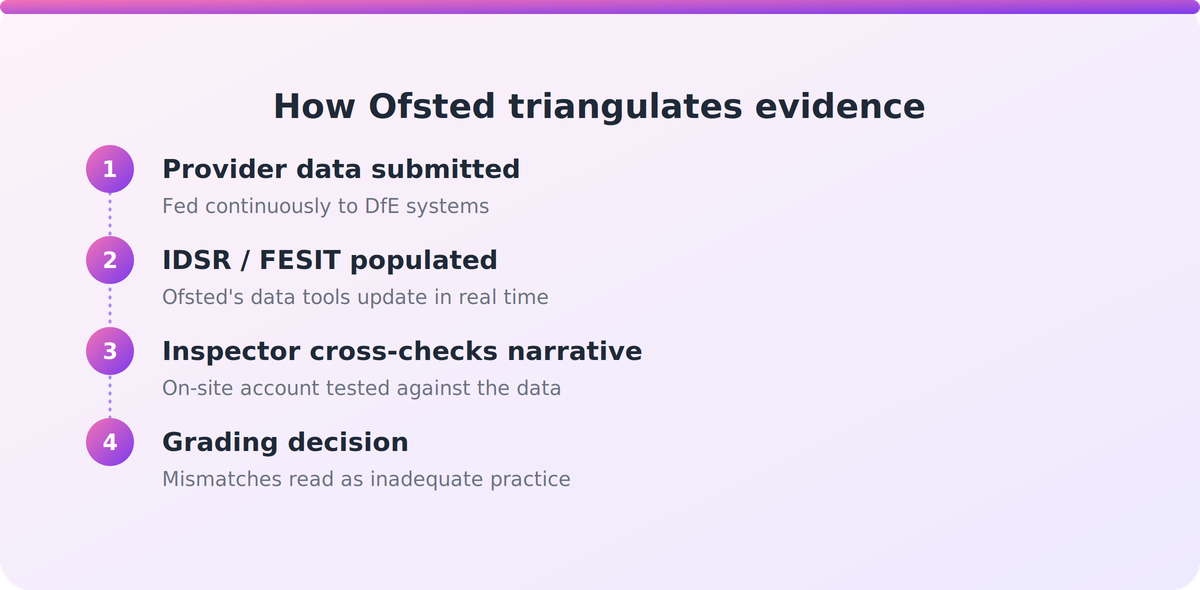
What this rules out is the traditional fallback: a policy document and a confident answer in the interview room. Inspectors are looking for a chain that holds together — assessment data on a named learner, the decision leaders made in response, and the outcome that followed. If any link in that chain is reconstructed after the fact rather than held as it happened, it tends to show.
The goalposts are already moving again
Providers who treat this as a settled requirement to comply with once are reading it wrong. GOV.UK and Ofsted have both confirmed further toolkit wording updates effective from September 2026, including broadened inclusion expectations and additional safeguarding evidence requirements. The evidencing bar is on an annual cycle, not a fixed target.
That matters for how providers build their evidence systems. A response designed around the current wording of the toolkit will need rework again within a year. A response built around the underlying principle — live, joined-up, learner-level data that can withstand cross-checking — travels better across each revision.
What this means for how providers hold evidence
The practical challenge is less about collecting the right data and more about keeping it current and connected. A few patterns are already visible across the sector:
- Data that's accurate at the point of collection but stale by the time of inspection creates the same risk as data that was never collected properly.
- Evidence spread across separate systems — assessment records here, support plans there, funding allocations somewhere else — makes it hard to show the chain inspectors are looking for.
- Retrospective evidence assembly, however well-intentioned, is now a visible risk in itself, because DfE-fed figures are already sitting alongside whatever a provider presents.
This is precisely the gap that a wave of UK compliance-technology vendors, including Bud and Coursecheck, are now building tools around — a clear signal that FE and apprenticeship providers across the market are treating this as a live operational problem, not a theoretical one.
Key takeaways
- Since 10 November 2025, Ofsted formally triangulates on-site evidence with DfE-fed data via IDSR and FESIT — provider narrative alone is no longer sufficient.
- Case sampling focuses on four groups: disadvantaged learners, those with SEND or high needs, those known to children's social care, and those without level 2 English and/or maths.
- The FE and skills inspection toolkit treats a failure to account for these learners' needs, or misuse of dedicated funding, as inadequate practice — a hard grading trigger, not guidance.
- Further toolkit changes land in September 2026, so the evidencing standard is moving annually rather than settling.
- Because data is fed continuously to Ofsted, gaps surface before inspection day — there's no window for after-the-fact evidence reconstruction.
Our take
What's really changed here isn't the categories of learner Ofsted cares about — disadvantage and SEND have long been part of FE inspection. What's changed is that a provider's internal record now has to survive being checked against an external, continuously-updated data feed it doesn't control. That turns evidence-holding from a documentation exercise into something closer to a live systems problem, and small IQA and curriculum teams doing this by spreadsheet are the ones most exposed when the next toolkit update lands. Providers who treat September 2026 as another one-off deadline will be back here in twelve months; the ones who build for continuous, connected evidence now will simply absorb the next revision rather than scrambling for it.
If your provider is still assembling SEND and disadvantage evidence in the weeks before an inspection rather than holding it as it happens, it's worth asking what that gap would look like the day an inspector cross-checks your numbers against the Department for Education's.
FAQ
What exactly did Ofsted change from 10 November 2025? Ofsted's renewed Education Inspection Framework for further education and skills formalised a two-stream evidence model: on-site observation alongside data drawn from tools like IDSR and FESIT, which are fed continuously from provider data via the Department for Education. Providers are now expected to demonstrate, not just describe, how they act on that data.
Which learner groups does Ofsted specifically sample for? Ofsted's 8 January 2026 FAQ confirms four groups: disadvantaged learners, those with SEND or high needs, learners known or previously known to children's social care, and those without level 2 English and/or maths.
Can a strong verbal explanation at inspection cover a data gap? No. The published FE and skills inspection toolkit sets a failure to account for these learners' needs, or misuse of dedicated funding such as high-needs allocations, as inadequate practice. Because DfE-fed data is already visible to inspectors, a mismatch between what's said and what the data shows tends to be caught rather than accepted.
Is this requirement final, or will it change again? It will change again. GOV.UK and Ofsted have confirmed further toolkit updates from September 2026, including broadened inclusion expectations and added safeguarding evidence requirements — so providers should expect the standard to keep moving on roughly an annual cycle.
Why are compliance-technology vendors building tools around this now? Because the pain is already live across the sector. Vendors including Bud and Coursecheck are marketing Ofsted-readiness tools built specifically around these inclusion categories, which reflects genuine demand from FE and apprenticeship providers struggling to hold defensible, current evidence rather than a speculative market.