Process Debt: The Hidden Margin Cost for NZ PTE COOs
5 October 2026 · 7 min read
Operational process debt never appears in a PTE's accounts, which is why it survives. It lives in manual workarounds, double entry and knowledge held in one person's head, and it is paid for in headcount and attention. With subsidies frozen and TEC warning of reduced 2027 investment, that quiet cost is now a margin question.
Why this lands on your desk
You answer for accurate, on-time reporting, and the funding environment has made that harder to treat as back-office hygiene. RNZ's Budget 2026 headline said tertiary subsidies were frozen. The Budget also includes $284.021 million to fund 99% of forecast Level 3–10 volume across 2026 and 2027. Either way, revenue per learner is not where your upside is.
TEC has also told the sector that 2027 investment planning is happening in a very challenging fiscal environment and that most providers will see reduced investment. It says its decisions will rest on evidence of improved pass rates, financial performance and contribution to the national network of provision. It also expects to actively disinvest where requirements are not met.
When revenue is capped, the lever left is the cost and scalability of how you run. That is where process debt sits.
What operational process debt actually looks like
Let's be clear about the limits first. We found no authoritative source that puts a dollar figure on process debt, reporting effort or margin erosion in NZ PTEs. Anyone quoting you a percentage is guessing. Treat it as a lens, not a metric.
Through that lens, operational process debt in a training provider tends to show up as three things:
- Manual workarounds. The spreadsheet that reconciles two systems because they don't share a learner record.
- Duplicate entry. The same enrolment details keyed into the student management system, the finance system and a compliance register.
- Person-dependent knowledge. The one person who knows why a field is coded a certain way, or which report to run before the return.
Each is cheap to live with in a given week. Together they mean your cost base grows with enrolments, because people absorb the friction. You pay the interest in overtime, error correction and slow decisions, and you never see an invoice.
The calendar that exposes it
The TEC Single Data Return (SDR) is the NZ reporting standard. TEC describes it as the data items the Ministry of Education and TEC require for funding, monitoring performance, publishing performance information and statistical reporting. So data quality is tied to money and to the performance picture TEC will use when it decides who to back.
The 2026 rhythm, per TEC's submission dates:
- March: the IND.
- April: an SDR, with forecast EFTS.
- August: an SDR, with forecast EFTS.
- December: an SDR, with forecast EFTS and the Workforce Questionnaire. The window is 1–31 January the following year.
Then stack the rest on the same team. The PTE Rules 2026 came into force on 19 January 2026, replacing the 2025 Registration Rules and the 2022 PTE Enrolment and Academic Records Rules. They remove the annual fee and reflect the removal of external evaluation and review, aligning with a new integrated Quality Assurance Framework. Non-funded PTEs provide annual financial returns biennially unless NZQA notifies otherwise.
The Pastoral Care Code adds its own cycle: self-review and attestations due 1 November for PTEs and wānanga. TEO Profile upkeep and NZQA fees, including credit-reporting and qualification-completion fees, sit alongside.
Ask of each date whether it runs on a repeatable process or on a person. If it's a person, that's the debt.
Why integration is now a practical question
TEC publishes Data Specifications for SDR 2026 v3.1 and an API portal for submitting to its Data Exchange Platform. That doesn't mean you must build anything. It does mean that how your systems hold and move learner data is a legitimate operations decision, not an IT curiosity.
If your return is assembled by exporting from one system, patching in another and eyeballing the gaps, the quality of your data depends on who is in the building that week. That's fragile when funding performance is read from it.
Reform raises the stakes on scalability
The VET legislation passed in October 2025. It disestablished Te Pūkenga, now NZIST as a transitional entity, and established 10 regional polytechnics and Industry Skills Boards from 1 January 2026. All Industry Skills Board programmes and enrolments must move to polytechnics, PTEs or wānanga by 1 January 2028. Connexis was registered as a PTE on 13 July 2026.
For you, that means possible growth, new partnerships and new competitors, all landing on the same operations team. The question is whether you can take on 2028 volume without headcount rising in step. If the answer depends on heroic effort from the same five people, you have your answer.
Three moves for this quarter
Map the people-dependence, not the process
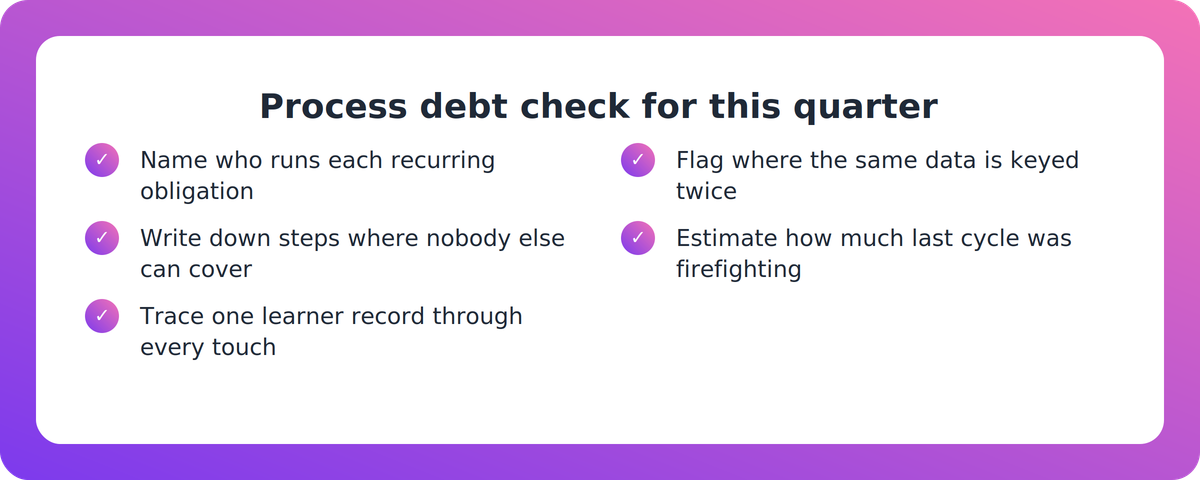
For each recurring obligation, name who actually does it and who could do it if they were away for the return window. Where the answer is "nobody", write the steps down this quarter. It's unglamorous and it's the cheapest risk reduction available.
Count the touches
Pick one learner record and trace how many times the same data is keyed or copied between enrolment and the next SDR. You're not after a statistic for the board. You're finding the handful of places where one fix removes several touches.
Separate the recurring from the reactive
List the work that returns every year, then ask how much of last cycle was firefighting. Recurring work is where improvement pays back repeatedly, because the 1 November attestation and the next April SDR are coming regardless.
Key takeaways
- Operational process debt is a lens, not a measured figure. No source we found quantifies it for NZ PTEs, so don't invent a benchmark.
- With subsidies frozen per RNZ and TEC warning most providers of reduced 2027 investment, operating cost and scalability are your remaining levers.
- The IND, three SDRs, the Workforce Questionnaire, the 1 November Code self-review and the PTE Rules 2026 all land on one team.
- Person-dependent knowledge is the highest continuity risk because every one of these cycles has a fixed date.
- The 2028 transfer of work-based learning to polytechnics, PTEs or wānanga makes "scale without adding headcount in step" a planning question now.
Our take
Most PTEs treat reporting load as a fixed tax on being funded. We think that's the wrong frame. The dates are fixed. The effort behind them is not, and a lot of it is habit.
The uncomfortable part is that process debt is rarely anyone's failure. It accumulates because capable people kept things running. The cost is that you can't tell from the accounts how much of your team's capacity goes on holding the workarounds together.
Our view: in a year when TEC is explicit about disinvesting, "it works because Sam knows how" should be treated as a risk entry, not a compliment.
We can't tell you the size of your debt, and neither can anyone else without looking at your own operation. What you can do is look.
FAQ
Is there a benchmark for how much process debt costs a PTE?
No. We found no authoritative source that quantifies process debt, reporting effort or margin erosion in NZ PTEs. Use it as a diagnostic lens and measure your own touches, hours and dependencies.
Which TEC reporting dates should operations plan around in 2026?
TEC's calendar has a March IND, an April SDR, an August SDR and a December SDR, with the December window 1–31 January the following year. The Workforce Questionnaire is due with the December return, and forecast EFTS with the April, August and December returns.
Why does data quality matter more now?
TEC describes the SDR as the data used for funding, monitoring performance and publishing performance information. TEC has said most providers will see reduced 2027 investment and that it will base decisions on pass rates, financial performance and contribution to the national network. It expects to actively disinvest where requirements are not met.
What changed with the PTE Rules 2026?
They came into force on 19 January 2026, replacing the 2025 Registration Rules and the 2022 PTE Enrolment and Academic Records Rules. They remove the annual fee and reflect the removal of external evaluation and review, aligning with a new integrated Quality Assurance Framework.
One question to sit with
If your most reliable operations person were unavailable for the whole of the next SDR window, what would actually break first? Start there.