Pre-Moderation Assessment NZ: A Head of Training's Guide
19 October 2026 · 7 min read
Moderation is usually treated as a checkpoint at the end of the pipeline. NZQA's own framing says otherwise: internal moderation includes checking assessment materials before they're used. The cheapest place to find a flawed assessment is before any learner sits it. Whether that happens in your team is a design decision, and it's yours.
Why this lands on your desk
You own assessment quality across every trainer. When national external moderation results come back, they reflect on your delivery team, not on the one assessor who wrote the task.
There's also a compliance angle. NZQA states that internal moderation must be embedded in every TEO's quality management system, and that it covers both pre-assessment moderation of materials and post-assessment moderation of learner work (NZQA, *National external moderation for TEOs*). A pre-delivery check is part of the stated expectation. A late or patchy one is an exposure, not just an inefficiency.
Then there's the time. Every assessment fixed after learners have sat it costs trainer hours, re-marking, re-assessment and delayed progress. That comes straight out of delivery time.
What NZQA says about timing
The sequence in NZQA's materials is clear. A provider needs consent to assess before offering assessment against standards. Once it holds consent, it must carry out internal moderation and engage with the national external moderation system (NZQA, *Assessment of standards*).
Consent is granted on evidence that the provider can assess fairly, equitably, consistently and with authenticity (NZQA, *Consent to assess guidelines*). Try demonstrating those four qualities when materials are only reviewed after use. You can show that you found problems. It's harder to show you prevented them.
Each standard on the Directory of Assessment and Skill Standards also carries Consent and Moderation Requirements. These cover the skills and knowledge required of assessors, resources, practical experience and national external moderation. That gives you a ready-made checklist for testing a task before it reaches a learner.
Why 2026 makes late checking riskier
Three things are moving at once.
- NZQA updated its Rules, effective 19 January 2026, to align with the new integrated Quality Assurance Framework. The 2026 programme rules require an effective system for moderation of assessment materials and decisions.
- Industry Skills Boards were formally established from 1 January 2026 and are responsible for standard setting. NZQA and the ISBs are co-designing skill standards and national curricula, intended to support greater consistency in assessment.
- Skill standards are gradually replacing unit standards. We found no provider-facing timeline for that, so plan for change without assuming dates.
For you, that means mappings and materials will need revisiting, and not all at once. Some of your portfolio will sit on unit standards while other parts move. Version-control drift across trainers is the likely failure mode: two people delivering the same unit from different copies, with different assumptions about what the standard requires.
The pressure on teams is real too. The Spinoff reported in July 2025 that Te Pūkenga lost over $80m in funding and one in ten staff before its split into polytechnics. We didn't find public evidence on trainer shortages across the wider sector, so treat that as context, not a finding. The point stands, though: teams are being asked to hold assessment quality while the structures around them change.
A pre-delivery gate in five steps
This is practical thinking, not an NZQA prescription. Adapt it to your own quality management system.
- Check against the standard. Test the task against the standard and its Consent and Moderation Requirements.
- Test the four qualities. Ask whether the task is fair, equitable, consistent and authentic for this learner group and delivery mode.
- Get a second pair of eyes. Someone other than the author reviews it before release.
- Lock the version. One approved copy, with a clear date and owner. Trainers don't deliver from personal copies.
- Record the decision. Note what changed and why. This is your evidence that moderation is embedded, and it helps when a standard is replaced.
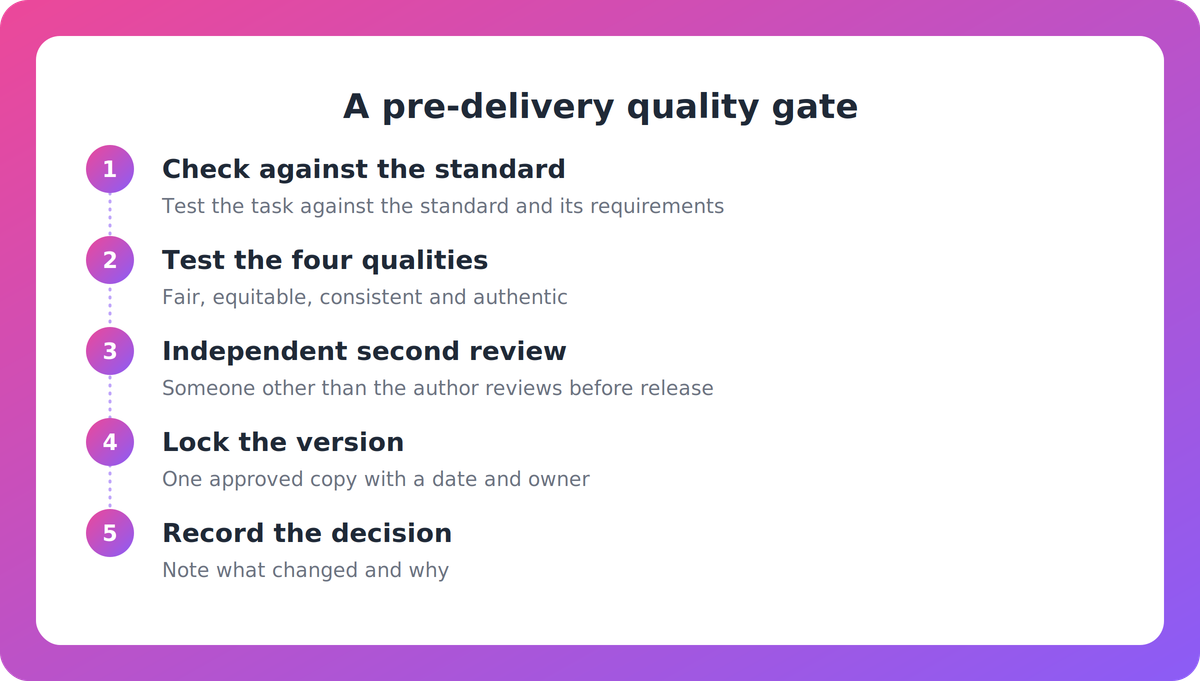
The gate doesn't need to be heavy. It needs to be unavoidable. If trainers can bypass it when they're busy, it'll be bypassed exactly when quality is most at risk.
What the data does and doesn't tell you
Education Counts data for 2025 shows apprentice five-year completion fell 3 percentage points to 40%. First-year retention rose from 66% to 71%, and just under 17% of apprentices withdrew without completing.
That data doesn't link moderation to completion, and public data doesn't show that earlier moderation lifts completion. Don't tell your board it does. What it does show is a workplace-based sector with little room for avoidable friction. Rework caused by a flawed assessment is friction you can design out.
Key takeaways
- NZQA expects internal moderation to include pre-assessment moderation of materials, embedded in your quality management system.
- Checking before delivery is the cheapest point to fix a problem, and it supports the fair, equitable, consistent and authentic assessment that consent to assess depends on.
- The 2026 rules, ISB-led standard setting and the gradual move to skill standards raise the risk of version drift across trainers.
- Each standard's Consent and Moderation Requirements give you a ready-made test for materials before release.
- No public data shows earlier moderation improves completion. Argue for it on compliance, consistency and rework, not on completion.
Our take
Most providers don't skip moderation. They schedule it late, and then call the result assurance. A check that happens after learners have sat the assessment tells you what went wrong. It doesn't stop it.
We think the Head of Training should treat the pre-delivery gate as the main event and post-assessment moderation as the confirmation. That's not a claim that post-assessment work matters less. NZQA expects both. It's a claim about where your effort buys the most. When standards are being rewritten and materials remapped, an unmoderated task is also an unversioned one, and that's where inconsistency starts.
The honest trade-off is that a gate adds a step before delivery. If your team is stretched, that'll feel like one more thing. But the alternative is paying the same cost later, with interest, in re-assessment and learner delay.
FAQ
Does NZQA require pre-assessment moderation?
NZQA states that internal moderation must be embedded in every TEO's quality management system and includes both pre-assessment moderation of assessment materials and post-assessment moderation of learner work. So checking materials before use is part of the stated expectation.
What changed in NZQA's rules in January 2026?
NZQA updated its Rules, effective 19 January 2026, to align with the new integrated Quality Assurance Framework and the vocational education changes. The programme rules require an effective system for moderation of assessment materials and decisions. Consent-to-assess guidelines now point to the Quality Assurance of Tertiary Education Providers Rules for maintaining consent.
When will skill standards replace unit standards?
We found no provider-facing timeline. ISBs are responsible for standard setting from 1 January 2026, and skill standards are gradually replacing unit standards. Plan for change, keep your mappings current, and don't assume dates.
Does pre-delivery moderation improve completion rates?
Public data doesn't show that. Education Counts figures for 2025 don't link moderation to completion. The defensible case for a pre-delivery gate is compliance, consistency across trainers and less avoidable rework.
A useful first step this week: pick one unit you deliver and trace which version each trainer is using. What you find will tell you how much a gate would matter.