Pre-Moderation NZQA: Why It's Now Essential
3 August 2026 · 7 min read

Pre-Moderation NZQA: Why It's Now Essential
New Zealand's moderation system is mid-handover, and waiting on post-delivery feedback to catch quality gaps is no longer a safe bet. National moderation authority moved from the disestablished Workforce Development Councils to eight new Industry Skills Boards on 1 January 2026, just as NZQA's tightened Programme Approval, Recognition, and Accreditation Rules 2026 came into force. For PTEs, ITPs, wānanga and other providers, that combination makes internal pre-moderation checks a practical necessity rather than a nice-to-have.
What actually changed on 1 January 2026
Three structural shifts landed at almost the same time, and each one adds friction to a system providers already relied on running smoothly.
- New accreditation evidence requirements. NZQA's Programme Approval, Recognition, and Accreditation Rules 2026 took effect on 19 January 2026. Providers seeking accreditation for standards outside their existing consent must now demonstrate upfront that they can meet moderation requirements — before a single learner is enrolled.
- A full handover of moderation authority. From 1 January 2026, national external moderation, consent-to-assess endorsement and standards development transferred from the outgoing Workforce Development Councils to eight newly formed Industry Skills Boards.
- A body ceasing operations mid-cycle. Muka Tangata, one of the outgoing Workforce Development Councils, ceased operations on 19 December 2025. Moderation applications already in progress were handed over to the incoming Industry Skills Boards without a guarantee of seamless completion.
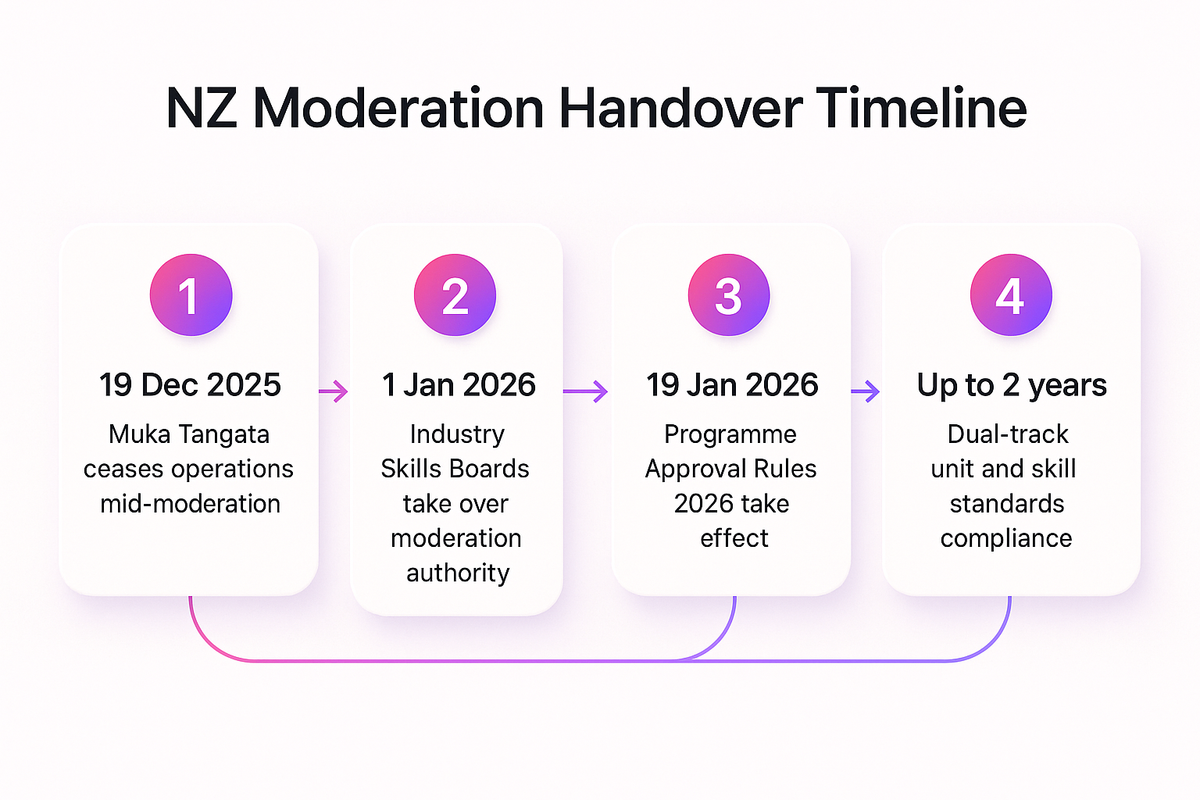
Each of these is manageable on its own. Stacked together in the space of three weeks, they represent a genuine disruption to established moderation relationships and turnaround expectations — right as providers are meant to be tightening, not loosening, their evidence base.
Why post-moderation alone is riskier now
Here's the structural problem: moderation of both unit standards and the newer skill standards remains risk-based and sampling-driven. It was never designed to catch every gap — it was designed to catch enough to manage system-wide risk. That's a reasonable model when moderation panels are stable and well-established.
It's a much shakier model during a transition year, for three reasons:
- New panels, new expectations. Eight Industry Skills Boards are working out consent-to-assess endorsement and moderation processes that Workforce Development Councils had already bedded in. Providers can't assume the same turnaround times or the same interpretation of evidentiary requirements.
- Dual-track compliance. NZQA's transition guidance requires providers to run unit standards and skill standards side by side for up to two years as one is progressively superseded by the other. That effectively doubles moderation exposure during the crossover, since assessment quality has to hold up against two frameworks at once.
- Continuity gaps are now documented, not hypothetical. Muka Tangata's wind-down shows what happens when moderation work is mid-stream during a body's closure. If it happened once, providers should assume it could recur elsewhere in the sector during 2026.
Put together, a provider relying solely on after-the-fact panel feedback is more likely than usual to find out about an alignment problem only once delivery has already happened — the point at which fixing it is slowest and most expensive.
Where pre-moderation fits in
NZQA already offers a mechanism for exactly this situation: free pre-assessment moderation cover sheets, available to providers ahead of delivery. The tool exists. The gap is in how much it's actually used relative to the risk now sitting in the system.
Pre-moderation, in practice, means checking three things before an assessment ever reaches a learner:
- Does the assessment map cleanly back to the relevant unit standard or skill standard, clause by clause?
- Is there an assessor guide that shows how judgement will be applied consistently?
- Does the assessment context — classroom, workplace, distance, ESOL, or LLN-adapted — still meet the standard's requirements once it's been adapted for the learner?
That third point matters more than it might look. A provider adapting the same unit standard for a workplace cohort and a classroom cohort, or building an ESOL-friendly version alongside the original, is effectively creating multiple assessment instruments from one standard. Each version needs its own alignment check. Multiply that across a full portfolio of standards, and manual pre-moderation stops being a quick task — it becomes a resourcing problem in its own right.
What providers can do before submission
Given the current handover conditions, a practical pre-submission routine should cover:
- Mapping every assessment task directly to the relevant unit standard or skill standard clauses, not just the standard as a whole.
- Completing the NZQA pre-assessment moderation cover sheet before delivery, not after.
- Producing an assessor guide alongside each assessment, so judgement criteria are documented, not implicit.
- Checking coverage separately for each delivery mode and learner group — workplace, distance, ESOL, LLN — rather than assuming one version covers all.
- Confirming current consent-to-assess status directly with the relevant Industry Skills Board, given the recent handover from Workforce Development Councils.
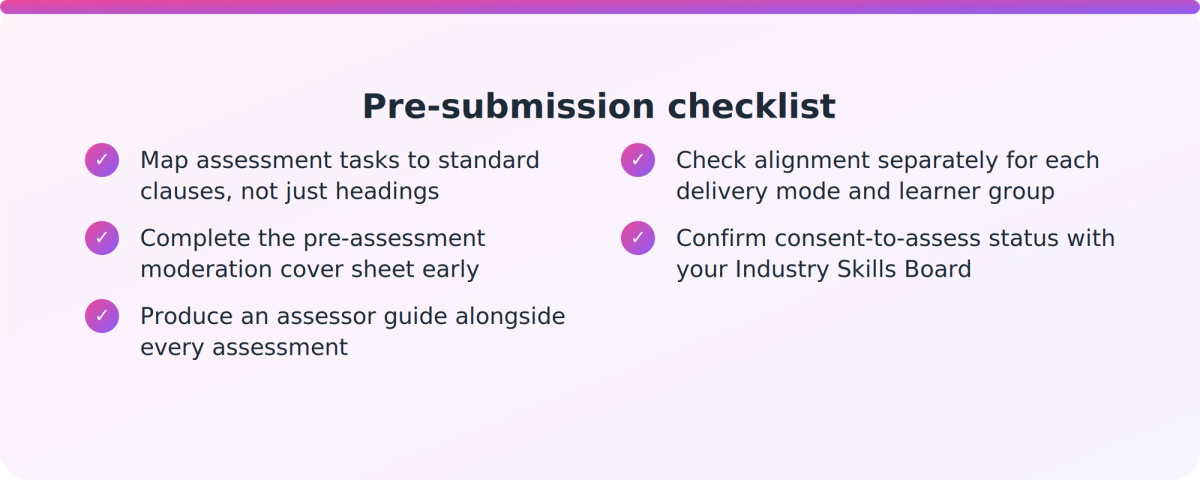
None of this is new practice. What's new is the cost of skipping it, at a moment when the panels on the other end of a moderation submission are themselves newly established.
Key takeaways
- NZQA's Programme Approval, Recognition, and Accreditation Rules 2026 (in force 19 January 2026) raised the evidentiary bar for accreditation outside existing consent.
- National moderation, consent-to-assess endorsement and standards development moved from Workforce Development Councils to eight new Industry Skills Boards on 1 January 2026.
- Muka Tangata's closure on 19 December 2025 left in-progress moderation applications handed over without guaranteed continuity — a real example of panel disruption during transition.
- Post-assessment moderation stays risk-based and sampling-driven, so gaps can surface only after delivery, when they're hardest to fix.
- The unit standard to skill standard transition runs up to two years, forcing dual-track compliance and doubling moderation exposure for affected programmes.
Our take
The sector has treated pre-moderation as a discretionary quality step for years, largely because post-moderation panels were stable enough to catch most problems eventually. That assumption doesn't hold in 2026. When the panels themselves are new, the rules just tightened, and providers are running two standards frameworks at once, the cost of finding a gap after delivery goes up sharply — in remediation time, in learner outcomes, and in the provider's standing with its new Industry Skills Board. Pre-moderation isn't a hedge against bad assessment design anymore. It's a hedge against a moderation system that's still finding its feet.
FAQ
What is pre-moderation in the NZQA context? Pre-moderation is an internal check of assessment materials against unit standard or skill standard requirements before delivery, distinct from NZQA's post-assessment external moderation, which samples completed learner work after the fact.
Why did moderation authority change in January 2026? The Workforce Development Councils, which previously held national moderation authority, consent-to-assess endorsement and standards development responsibilities, were disestablished. Those functions transferred to eight newly formed Industry Skills Boards from 1 January 2026.
What happened with Muka Tangata? Muka Tangata, one of the outgoing Workforce Development Councils, ceased operations on 19 December 2025. Moderation applications that were still in progress at that point were handed over to the incoming Industry Skills Boards without a guarantee of seamless completion.
Do providers have to run unit standards and skill standards at the same time? Yes. NZQA's transition guidance allows for a period of up to two years during which unit standards are progressively superseded by skill standards, meaning providers may need to maintain compliance across both frameworks concurrently.
Are pre-assessment moderation cover sheets free to use? Yes. NZQA makes pre-assessment moderation cover sheets available to providers at no cost ahead of delivery, though the brief notes they remain underused relative to the risk now present in the system.
If your programmes are due for reaccreditation or sitting across the unit standard to skill standard transition this year, it's worth asking how confident your pre-submission checks really are — before an Industry Skills Board asks first.