Board-Ready Numbers: PTE Reporting Cadence in NZ for 2026
26 August 2026 · 8 min read

Three Single Data Return cycles a year. A two-month clock on every QE1 completion. Fourteen days to report Student Services Fees to TEC. None of that is new for 2026 — what's new is that TEC increasingly reads the accuracy of that data as a signal about your PTE's financial viability, not just an audit outcome, at exactly the moment the frameworks and institutions on the other end of every data exchange are being rebuilt.
Why this lands on your desk
You don't own the compliance calendar. You own whether the organisation can hit it without heroics.
Every SDR window, every QE1 deadline, every Student Services Fees report is really a test of whether enrolment, academic and finance data move through a repeatable process — or whether they depend on someone remembering to chase academic staff for completion records before the deadline hits. When that person is on leave, sick, or has moved on, the gap doesn't show up until TEC or NZQA checks.
That's no longer a purely academic risk. TEC's financial viability monitoring explicitly looks at how reliant a PTE is on TEC funding as a share of income, how consistent delivery volumes are against SDR reporting, and how accurate historical financial and delivery forecasting has been. Reporting accuracy has become an input to how TEC assesses whether your PTE stays viable — which puts it on your desk, not just your compliance manager's.
The reporting calendar you can't outrun
The core cadence hasn't moved, but it's worth restating because it's the backbone everything else sits on:
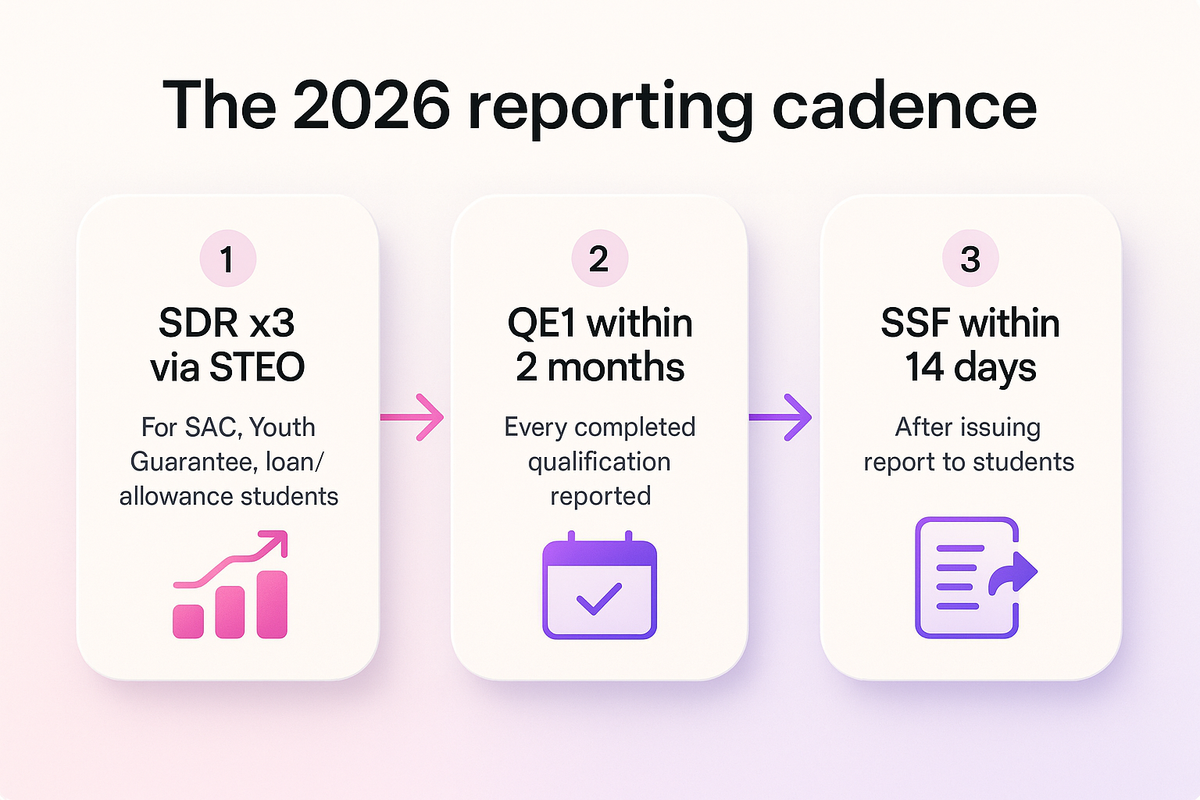
- SDR, three times a year via the STEO system — required from any tertiary education organisation receiving Student Achievement Component or Youth Guarantee funding, or with students on Student Loans or Allowances.
- QE1, within two months of a qualification being completed.
- Student Services Fees reporting, within 14 days of issuing the report to students.
None of these are soft targets. They're hard deadlines that expose a process gap the moment someone checks — and 2026 adds three reasons more people will be checking.
Three shifts hitting the same pipeline
1. The PTE Rules 2026 trade a form for a standing obligation
The Private Training Establishment Rules 2026 come into force on 19 January 2026. They move financial statement submission from annual to biennial and remove the separate Annual Financial Return to NZQA — on the surface, less paperwork.
But they also add an explicit obligation for PTEs to maintain adequate internal financial controls. That's not a form you fill in once every two years. It's a standing systems requirement you need to be able to demonstrate at any point, not just when a return is due. For operations, that shifts the work from "get the annual return in" to "keep the controls audit-ready year-round."
2. Two quality frameworks, running in parallel
NZQA is replacing the Evaluative Quality Assurance Framework with the new integrated Quality Assurance Framework (iQAF) for PTEs and ITPs in 2026. At the same time, Immigration New Zealand has said it will keep relying on existing External Evaluation and Review ratings for 12 months from early 2026, to keep the visa experience consistent for students while the transition happens.
That means for at least a year, you're managing evidence and reporting against two frameworks that don't fully line up — one for NZQA, one that Immigration NZ still leans on. If your evidence base for quality assurance lives in one place that maps cleanly to both, that's manageable. If it's scattered across spreadsheets and inboxes, you're doing double the reconciliation work under two deadlines that don't match.
Enrolment mix: heavier compliance load per international learner
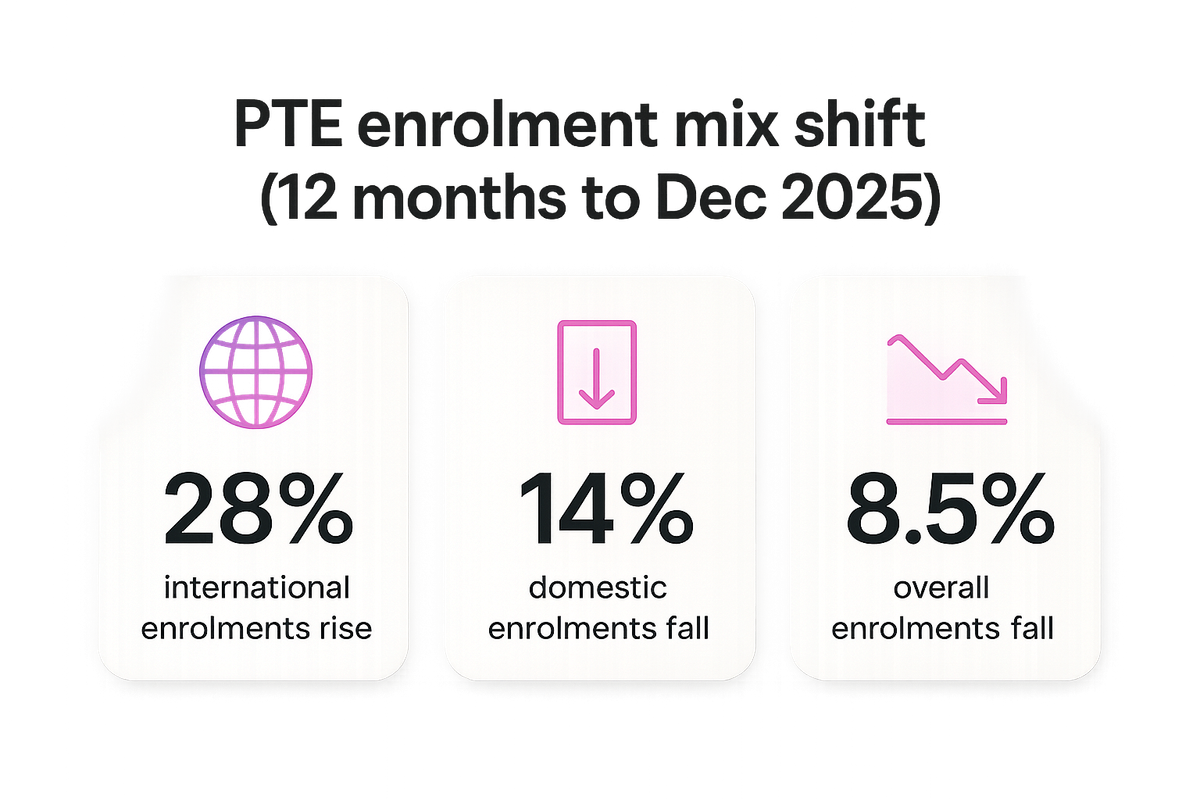
Education Counts data for the 12 months to the end of December 2025 shows PTE domestic enrolments down 14%, international enrolments up 28%, and overall enrolments down 8.5%. Government-funded PTE international enrolments rose 33% to 12,060 over the January–August 2025 period.
Every one of those international enrolments carries Code of Practice and fee-protection reporting obligations that domestic Student Achievement Component-funded students don't. So even as total enrolments shrink, the compliance load per enrolment is going up — because the mix is shifting toward the learner group that requires the most reporting.
What the TEC audit finding actually tells you
A recent TEC audit found a training organisation hadn't reported unfunded students enrolled in micro-credentials as part of its SDR submission. It wasn't falsified data. It was a gap in the process — one that surfaced the moment someone checked.
That's the pattern worth sitting with. Most reporting failures in this sector aren't dishonesty. They're the predictable result of a process with an undocumented edge case, sitting quietly until an audit, a funding review, or a new staff member trips over it. The fix isn't a stricter compliance officer. It's a process that doesn't rely on one person's memory to catch the edge cases in the first place.
The staffing math doesn't work in your favour
Tertiary provider staff headcount fell 1.1% to 49,700 in 2024, with full-time equivalents down 0.5% to 35,460. That's the backdrop against which enrolment mix is getting more complex and reporting obligations are getting heavier per learner.
Meanwhile, the vocational education restructure means the organisations you exchange enrolment and cross-crediting data with have changed. The legislation disestablishing Te Pūkenga and establishing the New Zealand Institute of Skills and Technology, regional institutes of technology and polytechnics, and industry skills boards took effect from 1 January 2026. If your PTE cross-credits with, or receives referrals from, any of these bodies, the contact points and processes on the other end of those data exchanges are themselves new.
None of this is an argument for adding headcount in line with enrolment growth — that math doesn't work when domestic enrolments are shrinking and workforce numbers are flat. It's an argument for making sure the reporting pipeline doesn't need more people to hold it together as the pieces around it multiply.
Key takeaways
- SDR (three times a year via STEO), QE1 (two-month completion window) and Student Services Fees reporting (14-day deadline) are unchanged in 2026, but TEC now reads SDR accuracy as part of financial viability monitoring, not just audit compliance.
- The PTE Rules 2026 (in force 19 January 2026) move financial statements to a biennial cycle but add a standing obligation to maintain adequate internal financial controls — a systems requirement, not a once-off form.
- iQAF and existing EER ratings will run in parallel for at least 12 months from early 2026, so evidence needs to map to both frameworks during the transition.
- International PTE enrolments rose 28% while domestic fell 14% in the year to December 2025, shifting the compliance load per learner even as total enrolments shrink 8.5%.
- Tertiary staffing is flat to declining (down 1.1% to 49,700 in 2024), so the answer to a heavier reporting load can't be more headcount — it has to be fewer places for gaps to hide.
Our take
The organisations that will walk into 2026 board meetings with numbers they trust aren't the ones with the most compliant intentions — they're the ones whose SDR, QE1 and financial data move through a process that doesn't depend on any single person's memory or availability. The TEC audit finding on unreported micro-credential students is a useful reminder: gaps aren't usually dishonesty, they're what happens when a process has an edge case nobody documented. With two quality frameworks running in parallel, a heavier compliance load per international learner, and staffing that isn't growing, 2026 is the year that gap gets found by someone other than you, if it hasn't already been found and fixed.
FAQ
Does the PTE Rules 2026 change mean less reporting overall? Less frequency on financial statements — biennial instead of annual, with the separate Annual Financial Return to NZQA removed — but the Rules add an explicit, ongoing obligation to maintain adequate internal financial controls. That's a standing requirement you need to be able to demonstrate at any time, not a lighter compliance load.
What's actually changing with the iQAF in 2026? NZQA is replacing the Evaluative Quality Assurance Framework with the integrated Quality Assurance Framework (iQAF) for PTEs and ITPs. Immigration New Zealand has said it will continue relying on existing External Evaluation and Review ratings for 12 months from early 2026, so PTEs will be managing evidence against both frameworks during the transition.
Does TEC's SDR data really affect funding decisions, or is it just an audit matter? TEC's financial viability monitoring considers factors including high reliance on TEC funding as a share of income, low delivery values within SDR reporting, and a track record of inaccurate financial and delivery forecasting. SDR data quality is now a direct input into how TEC assesses ongoing viability, not just a compliance record.
How does the international enrolment shift change reporting obligations? Education Counts data for the year to December 2025 shows PTE international enrolments up 28% while domestic fell 14%. International students carry Code of Practice and fee-protection reporting obligations that domestic Student Achievement Component-funded students don't, so the reporting load per enrolment rises even where total enrolment numbers are flat or falling.