The Board Pack Problem: What NZ PTE CEOs Lose Now
28 July 2026 · 7 min read

NZQA has quietly removed the external yardstick PTE boards have used for over a decade to gauge how the business is really doing, replacing it with a self-review report that only proves what your own data can show. If your board pack can't stand on its own, you're not less scrutinised. You're more exposed.
Why this lands on your desk
You answer to a board or owners for growth, margin and regulatory standing, and until now you could point to an independent, graduated rating as third-party assurance that the business was sound. That rating is going away at the exact moment your enrolment mix is shifting under you, sub-contracting rules are tightening your legal exposure, and there is no public sector benchmark for margin, cost per student or staff turnover to fall back on. The question for 2026 isn't whether NZQA is watching less closely. It's whether your own reporting can now carry the weight that an external rating used to carry.
The rating you used to hand your board is gone
The Evaluative Quality Assurance Framework, in place since 2009, has been replaced by NZQA's integrated Quality Assurance Framework (iQAF). From 1 January 2026, NZQA is not starting any new external evaluation and review (EER) processes. Instead, providers submit an annual self-review summary report and meet with NZQA to discuss an improvement plan.
That's a structural change, not a paperwork tweak. NZQA's original iQAF proposal was a simple compliant/non-compliant judgement rather than the old four-category public rating, and while consultation submissions pushed for something more graduated, the direction of travel is clear: less externally-generated nuance, more reliance on what the provider itself can demonstrate.
There is a transition wrinkle worth knowing. Immigration New Zealand will keep using existing EER ratings for international student visa purposes for 12 months from early 2026. But for most students, EER ratings don't directly affect visa processing — which tells you the old rating is being phased out as a reference point across the system, not just for boards.
The enrolment mix underneath you has moved
Whatever your board pack says about compliance, it also has to explain the pipeline — and the pipeline has changed shape. PTE international enrolments sit at roughly 14,300 students, only marginally above 2019 levels and far below the sector's mid-2010s peak of around 43,000. Meanwhile universities have taken share: their proportion of foreign students has risen to 41% in 2025, up from 29% in 2019.
Domestically, the picture is uneven rather than uniformly weak. Level 4 certificate enrolments fell 20% in 2025, to 14,290 students, and Level 3 was down 1%. But diplomas and certificates at Levels 5–7 grew 4.8%, and government-funded PTEs recorded the strongest year-on-year enrolment growth of any subsector in 2024, at 59%. Growth exists. It's just not evenly distributed, and assuming a sector-wide trend applies to your institution is exactly the kind of error a good board pack should prevent.
Sub-contracting now makes you the guarantor
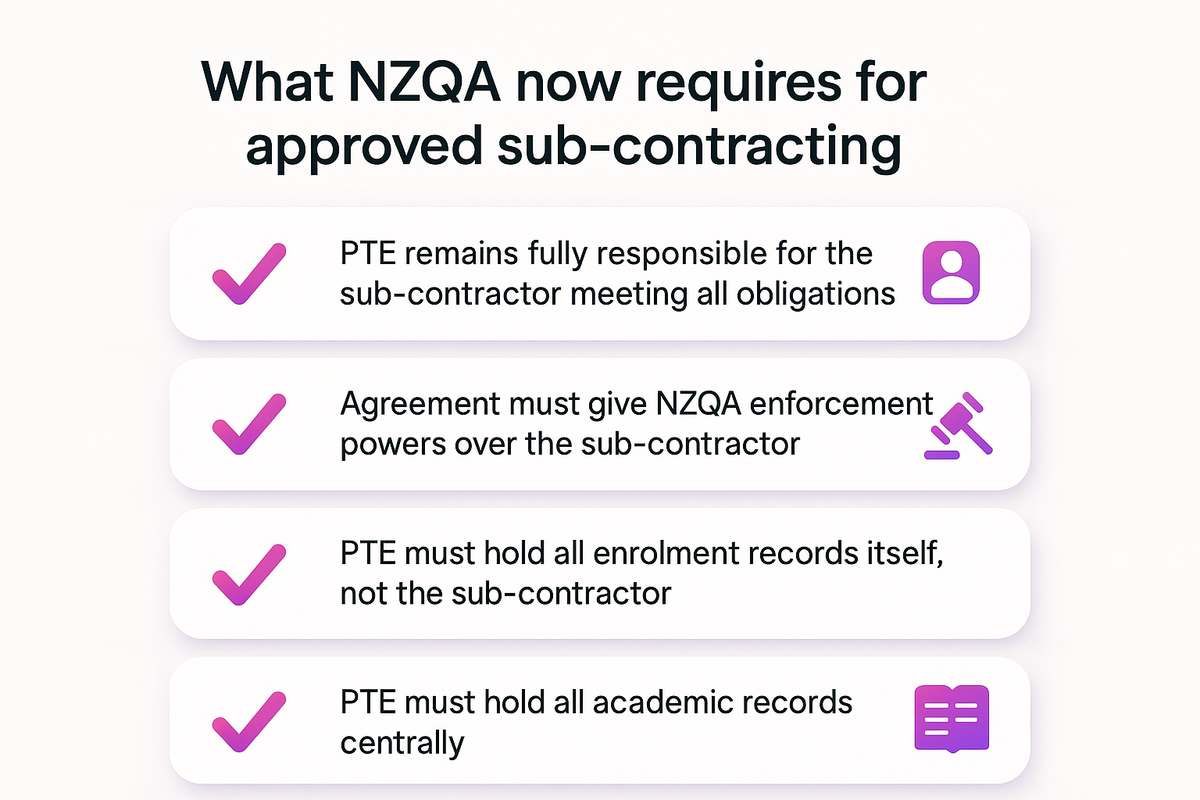
If you sub-contract any delivery, the Private Training Establishment Rules 2026 raise your exposure directly. NZQA will only approve a sub-contracting arrangement if it is satisfied that the PTE remains fully responsible for the sub-contractor meeting all obligations, that the agreement gives NZQA enforcement powers over the sub-contractor, and that the PTE itself holds all enrolment and academic records.
That last point matters for key-person risk. If you can't produce, on demand, a single defensible view of who is teaching, who is assessing, and where those records actually live, you are carrying governance risk that used to sit partly with an external evaluator's judgement. Now it sits with you.
The reporting gap nobody benchmarks for you
There's a small compliance easing to note: the Private Training Establishment Rules 2026 remove the annual PTE registration fee and move non-funded PTEs to biennial (rather than annual) financial reporting, unless NZQA specifically requires otherwise. That's genuine relief on one cost line.
But it doesn't offset the bigger structural gap. There is no publicly available PTE-sector benchmark for operating margin, cost per student, or staff turnover. You are being asked to prove performance to funders, your board and NZQA using only your own internal management information. A credible internal reporting capability isn't a nice-to-have anymore — it's the only evidence you have.
Key takeaways
- iQAF has replaced the four-category EER rating with an annual self-review report and an improvement-plan meeting; from 1 January 2026 no new EER processes are starting, and boards lose the external, graduated benchmark they previously relied on.
- Immigration New Zealand keeps using existing EER ratings for visas for 12 months from early 2026 only as a transition measure — for most students, ratings don't drive visa decisions, and the old benchmark is being retired system-wide.
- PTE enrolment growth is real but concentrated: international numbers remain well below the mid-2010s peak while universities' share of foreign students has climbed from 29% to 41%, and government-funded PTEs grew 59% in 2024 even as Level 4 certificates fell 20%.
- The Private Training Establishment Rules 2026 tighten sub-contracting accountability — you remain fully responsible for a sub-contractor's compliance and must hold all enrolment and academic records centrally — while easing fees and financial-reporting frequency for non-funded PTEs.
- With no public benchmark for margin, cost per student or turnover, your own board pack is now the primary evidence of performance for funders, your board and NZQA alike.
Our take
The sector conversation about iQAF has mostly focused on compliance burden — is self-review harder or easier than the old EER cycle. That's the wrong frame for a CEO. The real shift is that the assurance function has moved from an external party to you. Boards that governed by reading NZQA's rating now have to govern by reading your numbers, and that only works if your numbers are current, granular and trustworthy enough to survive a hard question from a director or a funder.
The uneven enrolment data makes this sharper, not softer. A board that assumes the whole PTE sector is either growing or shrinking will misread its own institution's position. The CEOs who come out ahead in 2026 will be the ones who can show, in real time, exactly where their enrolment mix sits against these subsector trends — not the ones with the tidiest fee schedule.
FAQ
What exactly replaces the four-category EER rating under iQAF? NZQA's integrated Quality Assurance Framework (iQAF) has replaced the Evaluative Quality Assurance Framework that had been in place since 2009. From 1 January 2026, NZQA is not starting new external evaluation and review processes; providers instead submit an annual self-review summary report and meet with NZQA to discuss an improvement plan, rather than receiving a public four-category rating.
Does this change affect international student visa processing? Immigration New Zealand will continue using existing EER ratings for visa purposes for 12 months from early 2026 as a transition measure. However, for most students EER ratings do not directly affect visa processing, so this is a short-term bridge rather than a long-term reliance on the old rating.
What do the Private Training Establishment Rules 2026 change for financial reporting? The rules remove the annual PTE registration fee and move non-funded PTEs from annual to biennial financial reporting, unless NZQA specifically requires more frequent reporting. It reduces one compliance cost even as other obligations, particularly around sub-contracting, tighten.
What do the new sub-contracting rules require of a PTE? NZQA will only approve a sub-contracting arrangement if the PTE remains fully responsible for the sub-contractor meeting all its obligations, the agreement gives NZQA enforcement powers over the sub-contractor, and the PTE itself holds all enrolment and academic records rather than leaving them with the sub-contractor.