PTE Consolidation Strategy NZ: The CEO's Buy-Partner-Build Call
29 September 2026 · 8 min read
Consolidation in New Zealand's PTE sector isn't a boardroom theory anymore — it's stated government policy, a regulatory approval gate, and a live redistribution of work-based learners, all happening at once. The real strategic question on your desk isn't whether to buy, partner or build. It's whether your compliance and delivery infrastructure can survive any of the three without concentrating risk in two or three key people.
Why this hits your desk
You've probably seen a summary of Education New Zealand's PTE Sector Strategic Roadmap, if not the document itself. It states plainly that New Zealand is "too small" for PTEs to keep operating alone, and it calls for succession planning, mentoring for the next generation of owners, and exploration of franchising models for providers that have proven their delivery model works. That's not sector colour commentary — it's a policy signal pointed straight at your growth plan.
Three forces are converging on that plan right now:
- Under the Private Training Establishment Rules 2026, in force from 19 January 2026, you need NZQA approval before any ownership change takes place, and you must notify NZQA of new material conflicts of interest. That turns deal timing into a compliance dependency, not just a legal one.
- The disestablishment of Te Pūkenga has created 10 regional polytechnics and Industry Skills Boards from 1 January 2026. Industry Skills Boards can only keep enrolling new learners where no alternative work-based programme exists through a PTE, polytechnic or Wānanga — a capability test that rewards providers who can already prove delivery readiness.
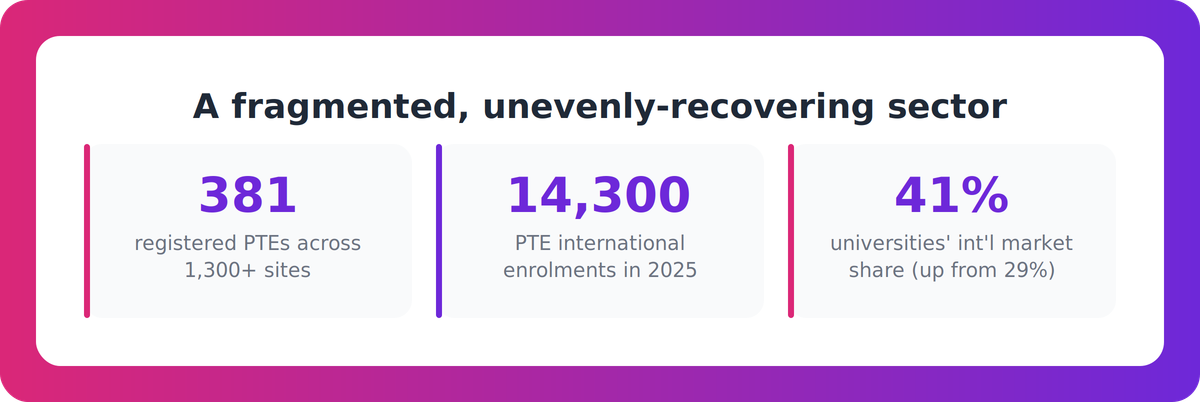
- International enrolments are growing in aggregate — 92,580 in 2025, up 11% year on year — but PTEs are catching a shrinking share of it: around 14,300 against a mid-2010s peak of roughly 43,000, while universities' share of the international market has climbed from 29% in 2019 to 41% in 2025.
None of this is abstract. It's the backdrop your board has in mind when they ask what growth looks like over the next three years, and whether the answer involves acquiring someone, partnering with someone, or building organically — and whether the business can actually absorb whichever answer you give.
A fragmented sector the Roadmap wants thinner
The scale of fragmentation the Roadmap is reacting to is worth sitting with: 381 registered PTEs operating across more than 1,300 sites, with ITENZ representing over 140 of them. That's a lot of small, independently-run compliance functions doing broadly the same regulatory work in parallel, at a time when the sector's own strategic document is asking whether that's sustainable.
It also means that whichever path you choose — buy, partner or build — you're not choosing in a vacuum. Plenty of other CEOs are weighing the same three options right now, against the same shrinking pool of international enrolments and the same regulatory settings.
Buy: the deal clock now runs on NZQA time
Acquisition used to be a commercial negotiation with a legal sign-off at the end. Under the 2026 Rules, it's a commercial negotiation with a regulatory approval sitting in the middle of it. You need NZQA's sign-off before ownership actually changes hands, and you need to notify NZQA of any new material conflicts of interest that arise from the deal.
That has practical consequences for how you structure an acquisition: settlement timelines need to build in approval time, not assume it away, and the price you're prepared to pay should reflect the risk of a deal stalling mid-approval, not just the target's current enrolment book.
Partner: the sub-contracting rules just tightened
If partnership rather than ownership is your route to scale, the same 2026 Rules changed the ground under you too. They relocate and update sub-contracting requirements, and sector commentary has flagged this as needing immediate attention from any PTE that delivers through partner organisations. If your growth model depends on sub-contracted delivery arrangements, your compliance position on those arrangements is now a gating factor, not paperwork you tidy up later.
Build: the Te Pūkenga window is real, but it isn't open forever
The redistribution of work-based learners to Industry Skills Boards, polytechnics and PTEs creates a genuine organic growth opportunity — but only for providers who can demonstrate delivery capacity when the question is asked. Industry Skills Boards are only meant to keep enrolling new learners where no PTE, polytechnic or Wānanga alternative exists.
That's a capability test, and it cuts both ways. The same reform has put close to a thousand jobs at risk across the polytechnic sector, and the legislation allows for mergers or closures of polytechnics that can't demonstrate long-term financial viability. Scale and financial resilience aren't just commercial preferences anymore — they're now things the system is explicitly checking for.
Due diligence in a regime that's still bedding in
Here's the wrinkle that catches people out: the yardstick you're measuring any target against is changing at the same time as the deals are happening. NZQA's integrated Quality Assurance Framework (iQAF) replaces the Evaluative Quality Assurance Framework from January 2026, removes External Evaluation and Review for PTEs and institutes of technology and polytechnics, and shifts non-funded PTEs from annual to biennial financial reporting unless NZQA advises otherwise.
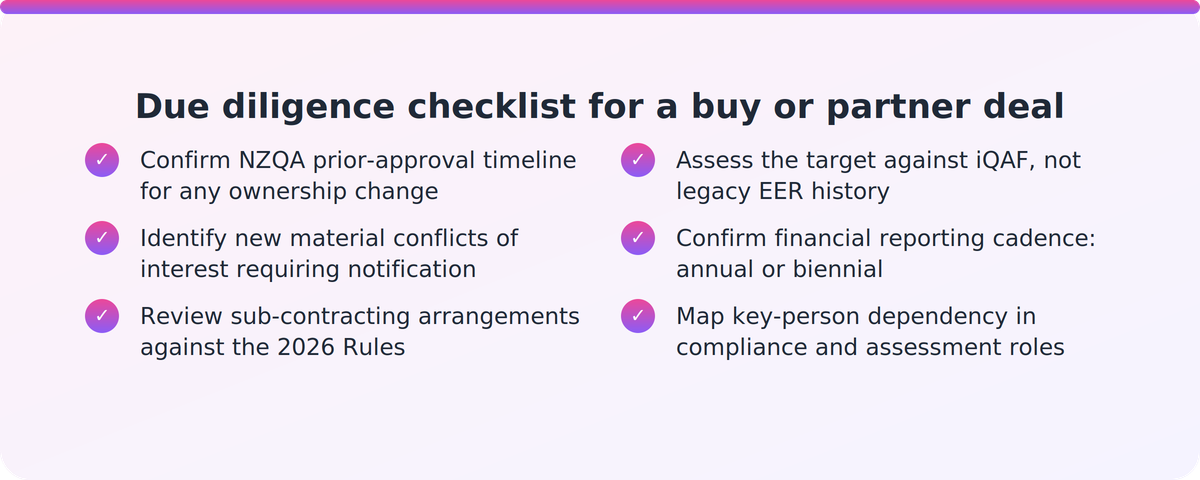
A target's clean EER history doesn't map neatly onto how iQAF will assess them going forward. If you're doing due diligence on a buy or partner target this year, you need to understand what iQAF actually measures — not just what the last EER report said.
Key takeaways
- Education New Zealand's PTE Sector Strategic Roadmap treats consolidation as policy, not just market drift — explicitly calling for succession planning and franchising models across a sector of 381 PTEs and 1,300+ sites.
- The Private Training Establishment Rules 2026 require prior NZQA approval for ownership changes and notification of new conflicts of interest, making regulatory timing a core deal variable for any "buy" strategy.
- Updated sub-contracting requirements in the same 2026 Rules directly affect any "partner" growth model — sector commentary flags this as needing immediate attention.
- The Te Pūkenga break-up and new Industry Skills Boards open a capability-tested growth channel for work-based learners, but the wider reform also carries real financial-viability and job-loss risk across the system.
- The shift from EER to the integrated Quality Assurance Framework changes how compliance standing is measured, so due diligence needs to test against iQAF, not legacy assessment history.
Our take
The CEOs who come out ahead in this cycle won't necessarily be the fastest movers. They'll be the ones whose assessment quality, moderation and compliance record don't depend on two or three specific people who happen to hold the institutional knowledge. NZQA's 2026 settings reward providers who can show delivery capability and clean regulatory standing on demand — at short notice, during a deal, or when an Industry Skills Board is deciding whether an alternative work-based programme already exists.
That's an infrastructure question as much as a strategy question, and it's worth answering honestly before you're mid-negotiation. If it helps, we build compliance and assessment tooling for PTEs at Supahuman, which is part of why this shift has our attention — but the diligence questions above are worth working through regardless of what tools you end up using.
FAQ
Does NZQA approval apply to every ownership change, or only large transactions? The Private Training Establishment Rules 2026 require PTEs to seek NZQA approval before any ownership change takes place, alongside notifying NZQA of new material conflicts of interest. The Rules themselves are the authoritative source for scope and process; treat approval as a required step for any ownership transfer rather than assuming a size threshold applies.
What actually changes under the integrated Quality Assurance Framework compared with EER? From January 2026, the integrated Quality Assurance Framework (iQAF) replaces the Evaluative Quality Assurance Framework and removes External Evaluation and Review for PTEs and institutes of technology and polytechnics. Non-funded PTEs also move from annual to biennial financial reporting unless NZQA advises otherwise, changing the rhythm of regulatory oversight, not just its content.
Is the Te Pūkenga break-up actually creating a growth opportunity for PTEs, or just disruption? Both. Industry Skills Boards established after Te Pūkenga's disestablishment can only keep enrolling new learners where no alternative work-based programme exists through a PTE, polytechnic or Wānanga — a real, capability-tested opening. At the same time, the reform has flagged close to a thousand jobs at risk in the polytechnic sector and allows for mergers or closures where financial viability can't be demonstrated, so the same restructuring carries genuine downside for providers who can't show delivery capacity.
Should sub-contracting arrangements be reviewed even if we're not planning a deal this year? Yes. The 2026 Rules relocate and update sub-contracting requirements regardless of whether you're actively pursuing a partnership or acquisition, and sector commentary has flagged this as needing immediate attention from PTEs already delivering through partner organisations. Treating it as a live compliance item now avoids it becoming a blocker later.
If consolidation is coming to the sector whether you initiate it or not, the more useful question isn't which path — buy, partner or build — looks best on paper. It's whether your organisation could pass a capability and compliance test tomorrow, under the rules that now apply, without leaning on any one person to hold it together.