PTE Differentiation Strategy NZ: Win on Outcomes, Not Price
4 October 2026 · 7 min read
The EER category is gone, and with it the easiest proof of quality a PTE could put in a brochure. What replaces it isn't a new badge. It's evidence you generate yourself: what your graduates can do, what employers say, and how you know. Price is a weak place to compete from here.
Why this lands on your desk
You answer to the board or owners for three things: regulatory standing, competitive position and margin. The end of EER touches all three at once.
NZQA's design document says no new EERs have been conducted since 1 January 2026. The Quality Assurance of Tertiary Education Providers Rules 2026 replaced the 2022 rules and came into force on 19 January 2026. A familiar external signal is being retired, and the rules limit how you can talk about the old one.
At the same time the system around you is being rebuilt. Te Pūkenga has been disestablished, and 10 regional polytechnics and Industry Skills Boards (ISBs) started on 1 January 2026. The ISBs set training standards, endorse programmes, moderate assessments and advise the TEC on investment. Nobody has quantified what that does to who you compete with, and I'm not going to pretend otherwise.
The label is retired, the obligation isn't
A provider holding an old EER category may refer only to its latest categorisation, state the year it was received, and say the EER system is no longer in operation. NZQA's published material doesn't point to a replacement public rating. That's what the research found, so treat it as "not found" rather than "doesn't exist".
What has replaced it is the iQAF. Every tertiary education organisation submits a self-review summary report and takes part in an annual conversation with NZQA. The rules require an up-to-date quality management system and annual self-reviews, and QA activity is informed by risk assessments.
The weight has moved to evidence you hold. The same evidence also makes your market story. If your annual NZQA conversation and your sales pitch draw on different facts, that's a problem worth fixing.
If you recruit international students, there's a further wrinkle. Immigration NZ will keep using existing EER ratings for 12 months from early 2026 during the transition. The sources I found don't say what replaces them for visa purposes afterwards. Ask now rather than in month eleven.
Why price is the weakest place to defend margin
The funding signals pull in different directions. Budget 2025 supports domestic enrolments. But the TEC's draft 2026 worked examples show a net 7% decrease for work-based delivery and no rate change for provider-based delivery. They're draft, so check your own final rates before you model anything.
The Government also expects value for money from the tertiary system. The TEC has tightened investment plan settings for poor performers. Its monitoring shows under half of PTE-sector providers rated medium or high risk, and the highest-risk providers hold only 10% of PTE funding. Margin and performance are now tied together.
There is some relief on cost. The PTE Rules 2026 remove the annual fee, and financial statements are now due every second year unless NZQA directs otherwise. The registration deposit rose from $750 to $1,500 including GST. If you deliver with another organisation, sub-contracting rules have moved into the new QA rules, and SAARA advises checking your QMS.
So you have modest compliance savings, uncertain work-based funding and a regulator watching performance. Cutting price in that mix means giving away margin you can't easily rebuild. Competitors with a larger cost base or a funded polytechnic behind them can usually go lower than you.
Build differentiation from evidence you own
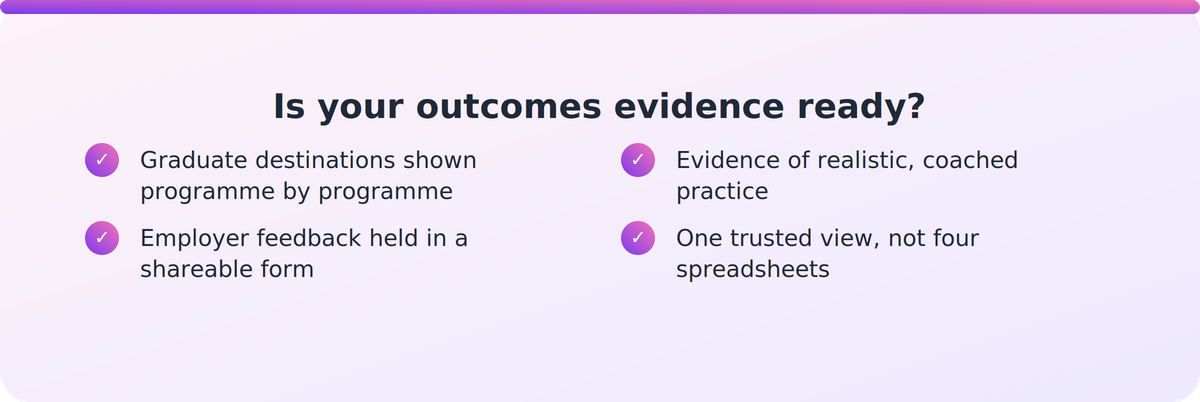
An outcomes claim is only as strong as the data behind it. Four questions will tell you where you stand:
- Can you show, programme by programme, what graduates went on to do?
- Do you hold employer feedback in a form you could hand to an NZQA analyst or a prospective partner?
- Can you show how learners practise the hard parts of the job before they face them for real?
- Is that evidence in one place, or in four spreadsheets and one person's head?
The third question is where I think most providers are underinvested. Content coverage is easy to prove and easy to copy. Capability is harder. A learner who has rehearsed a difficult customer conversation, a safety escalation or a client disclosure several times, with feedback, is a different graduate from one who has read about it.
Realistic practice with coaching has always worked, but it has been expensive. It needs facilitators, role-play partners, and time that margin doesn't allow. That's the reason it's rare, and so the reason it can differentiate.
NZQA's AI guidance gives you a basis to look at this. It encourages providers to help staff understand how generative AI can be used in teaching, learning and assessment, and to review academic integrity policies regularly. Doing that thinking deliberately matters more than which tools you try. Practice is where emerging technology has the most to offer, and assessment integrity is where you need the tightest controls. Keep those two clearly separate in your own head and your policies.
Key takeaways
- EER is retired. No new EERs have been conducted since 1 January 2026, and old categories can only be cited in the way NZQA prescribes.
- Under the iQAF, the evidence you generate (self-review, annual NZQA conversation) is now the quality signal.
- Funding is steering towards value for money. Draft 2026 examples show a net 7% decrease for work-based delivery, so check your final rates.
- Price competition erodes margin when TEC settings tighten for poor performers and system restructuring may change your competitors.
- Provable capability, built through realistic, coached practice, is a harder position to copy than content coverage.
Our take
Most PTEs will respond to the EER gap by writing a better self-review. That's necessary and not enough. A self-review satisfies the regulator. It doesn't give an employer, a learner or an ISB a reason to choose you.
The providers who come out ahead will treat outcomes evidence as a product. They'll know what their graduates can do, they'll have the employer voice on file, and they'll be able to explain how their practice design produced the result. I can't point to research showing that employers or learners pay a premium for this. What I can say is that it's the one position price-cutters can't copy by cutting.
It also needs a single, trustworthy view of performance, which is a management problem before it is a technology problem. If that view depends on one compliance person's memory, you have a key-person risk before you have a differentiation strategy.
FAQ
Can we still quote our EER category in marketing?
Only in the way NZQA allows. You may refer to your latest categorisation, state the year it was received, and say the EER system is no longer in operation. Check the current QA rules page before reprinting anything.
What does the iQAF ask of a PTE each year?
Every tertiary education organisation submits a self-review summary report and takes part in an annual conversation with NZQA. The rules also require an up-to-date quality management system and annual self-reviews. QA activity is informed by risk assessments.
How should we plan for the 2026 funding changes?
Treat the TEC's worked examples as draft. They show a net 7% decrease for work-based delivery and no change for provider-based delivery. Confirm your own final rates, then stress-test your margin against them. Tighter investment plan settings for poor performers also mean delivery quality now affects funding.
Does NZQA allow AI in teaching and assessment?
NZQA's guidance encourages providers to help staff understand how generative AI can be used in teaching, learning and assessment. It also asks them to review academic integrity policies regularly. Practice use and assessment use need different controls, so set your policy accordingly.
A good first step this month is to pull your last NZQA self-review next to your current marketing claims. If the second isn't backed by the first, you've found where to start.