PTE Enrolment Growth Strategy for New Zealand's 2026 Reset
10 August 2026 · 7 min read

New Zealand's Private Training Establishments are losing domestic enrolments faster than any other part of the tertiary system, just as NZQA rewrites how it checks their quality. Treat these as two separate problems in 2026 and you'll lose on both fronts. Treat them as one reset, and the same regulatory year that's squeezing your pipeline can also open one.
Why this hits your desk
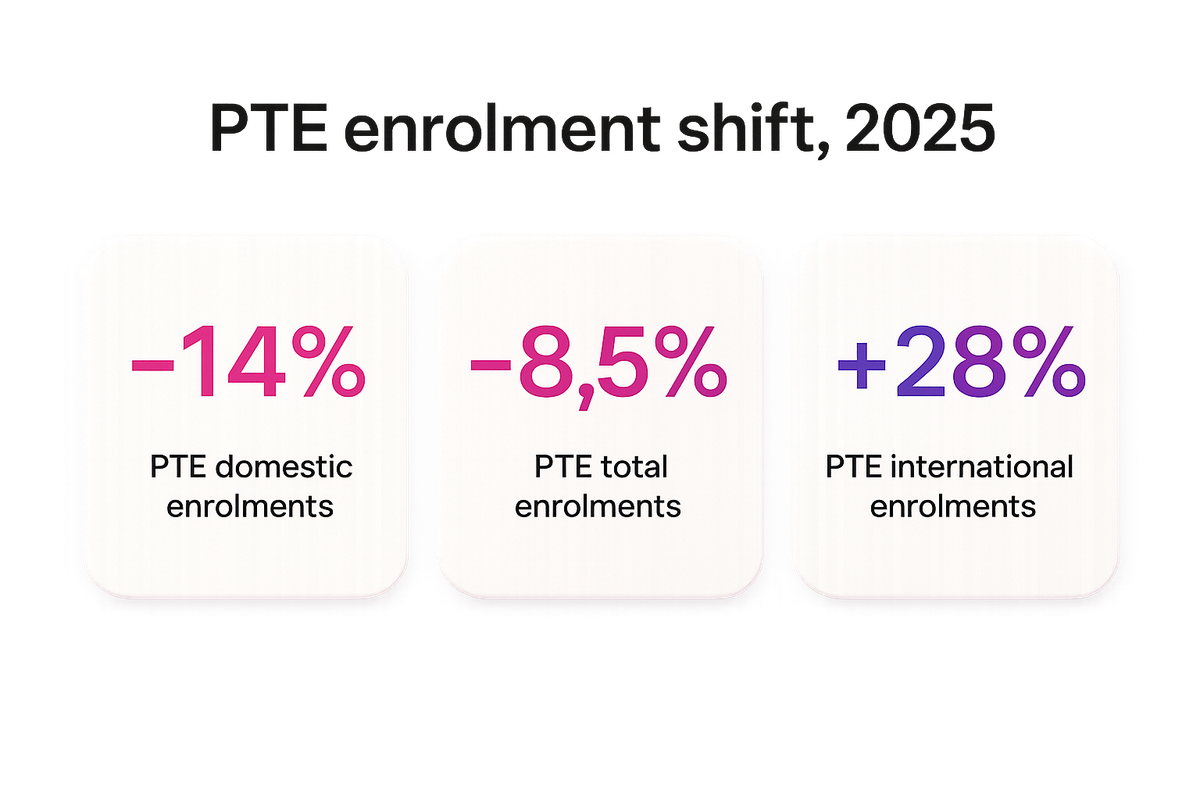
Start with the pipeline. Education Counts data for 2025 shows domestic PTE enrolments down 14%, with total PTE enrolments down 8.5% once international growth of 28% is netted in. That's a sharper domestic contraction than the rest of the system is absorbing — ITPs fell 5.1% domestically (4.3% overall), and universities actually grew domestic enrolments 1.5% (3.7% overall). You're not managing a sector-wide soft patch you can wait out. You're managing a PTE-specific structural shift in where domestic learners are choosing to study.
At the same moment, the compliance ground you stand on is moving. NZQA stopped starting new External Evaluation and Review processes from 1 January 2026, category ratings tied to EER are ceasing, and the Quality Assurance of Tertiary Education Providers Rules 2026 hand every provider a hard deadline for a compliant quality management system. Add the Tertiary Education Commission's expectation that providers run surpluses, and you've got margin pressure, regulatory reset and pipeline contraction landing in the same twelve months. None of these are new problems in isolation — but planned separately, in separate meetings, owned by separate people, they compound rather than cancel out.
The reset isn't optional: what changes from 1 January 2026
The EER model you've built processes around for years is gone. In its place: an annual self-review summary report, submitted to NZQA, followed by a meeting to discuss an improvement plan. Category ratings tied to EER are ceasing, though NZQA guidance notes Immigration New Zealand may continue to grandparent existing ratings for international recruitment purposes — worth confirming directly if your international pipeline leans on that rating.
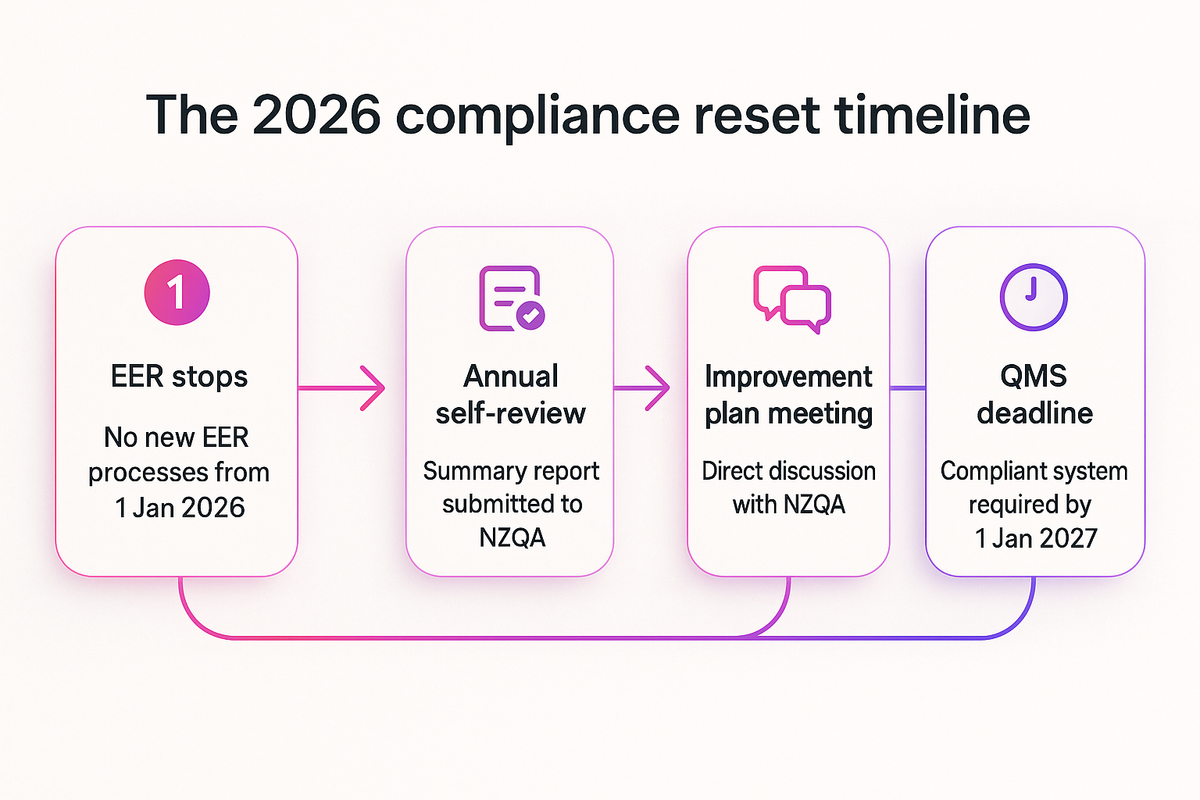
Running alongside this, the Quality Assurance of Tertiary Education Providers Rules 2026 come into force on 19 January 2026 and formalise mandatory annual organisational self-review as an ongoing obligation, not a periodic project. If you don't already have a compliant quality management system in place, you have until 1 January 2027 to build one.
The practical shift for you as CEO or GM: compliance stops being episodic. It was a cycle you resourced up for every few years. It's now a continuous, annual cadence that needs a standing owner, standing evidence, and a governance rhythm that doesn't rely on one compliance manager holding the whole picture in their head. That's the key-person risk NZQA's own EER reports have already flagged at individual providers — tutor and support staff attrition, with new hires needing real time to build context expertise. A continuous self-review regime makes that risk more visible, not less.
The time-bound pipeline: Industry Skills Boards and the end of Te Pūkenga
Here's where the same reset year creates upside. The Education and Training (Vocational Education and Training System) Amendment Act disestablishes Te Pūkenga, re-establishes ten regionally governed polytechnics, and creates eight Industry Skills Boards from 1 January 2026 to temporarily manage work-based training. Learners are actively transitioning to polytechnics, PTEs and Wānanga during this period, and the Industry Skills Boards themselves cease managing training on 31 December 2027.
That's a genuine, bounded window. Work-based learners displaced by the unwind of Te Pūkenga need a provider, and PTEs with the right programme approvals, delivery capacity and employer relationships are a legitimate destination for that volume. But the window closes at the end of 2027, and positioning for it — programme approvals, capacity, employer partnerships — takes longer to build than it takes to announce. If this pipeline sits on next year's strategy agenda instead of this year's, you'll be positioning for a door that's already closing.
Margin discipline meets key-person risk
TEC's mandate for provider surpluses isn't a suggestion — it's a stated expectation that pressures providers to right-size operations against fixed costs and enrolment shortfalls. That's straightforward P&L discipline. What's less straightforward is doing it at the same time your regulatory obligations are becoming more continuous and your workforce is thinner than it was.
Zoom out and the wider system numbers can mislead you. Total tertiary EFTS grew 4.7% in 2024 — a headline that looks healthy — but that growth masked real sub-sector pain, including job losses exceeding 160 at individual institutions and campus closures. If your board is benchmarking your performance against sector-level growth figures, push back. Aggregate numbers hide provider-level distress, and PTEs are disproportionately the ones absorbing it.
Where differentiation still wins
Not every PTE niche is contracting. PTEs remain the largest single source of first-time early childhood education students — 59% in 2025 — and produced 64% of ECE graduates in 2024. That's evidence that a differentiated, well-defended niche can keep outperforming even while the broader domestic pool tightens.
The growth strategy question for 2026 isn't "how do we grow everywhere." It's "where does our structure genuinely beat the alternatives, and are we defending that ground while we chase the Industry Skills Board pipeline elsewhere." Those are two different plays, and conflating them wastes resource you don't have spare right now.
Key takeaways
- Domestic PTE enrolments fell 14% in 2025 — sharper than ITPs (-5.1%) or universities (+1.5%) — so pipeline mix needs a deliberate plan, not passive reliance on international growth.
- From 1 January 2026, EER and its category ratings stop; an annual self-review summary report plus an NZQA improvement-plan meeting is now your recurring compliance cadence.
- If you don't already have a compliant quality management system, the Quality Assurance of Tertiary Education Providers Rules 2026 give you until 1 January 2027 to build one — decide ownership and resourcing now, not late 2026.
- Industry Skills Boards stop managing work-based training on 31 December 2027 — a real but time-bound growth channel for PTEs positioned to take on transitioning learners.
- TEC's surplus mandate and documented staff attrition in NZQA's own EER reports mean margin risk and key-person risk belong on the same board agenda, not separate ones.
Our take
Most providers are still running growth strategy and compliance strategy through different meetings, different owners, and different reporting lines. That made sense when EER was a once-every-few-years event you prepared for in isolation. It doesn't make sense now that self-review is continuous and your pipeline is under structural pressure at the same time.
The CEOs who come out ahead in 2026 won't be the ones with the best compliance officer or the sharpest sales pitch. They'll be the ones who read the QMS deadline, the Industry Skills Board timeline and the enrolment numbers as one calendar — and who build governance that gives them a single, current view of standing and pipeline, rather than relying on one person's memory of where things stand. That's not a technology decision first. It's a decision about how you want to run the business this year.
FAQ
What replaces External Evaluation and Review for PTEs from 2026? From 1 January 2026, NZQA stops beginning new EER processes. Providers instead submit an annual self-review summary report and meet with NZQA to discuss an improvement plan. Category ratings tied to EER are ceasing, though Immigration New Zealand may continue to grandparent existing ratings for international recruitment purposes.
What's the deadline for a compliant quality management system? Under the Quality Assurance of Tertiary Education Providers Rules 2026, in force from 19 January 2026, providers without a compliant quality management system in place by 1 January 2026 have until 1 January 2027 to build one.
How long will Industry Skills Boards manage work-based training? The eight Industry Skills Boards established from 1 January 2026 are a temporary arrangement. They cease managing training on 31 December 2027, with learners transitioning to polytechnics, PTEs and Wānanga before that date.
Are domestic enrolments falling across all of tertiary education, or just PTEs? PTEs are hit hardest — domestic enrolments fell 14% in 2025 and total PTE enrolments fell 8.5% despite a 28% rise in international enrolments. ITPs fell 5.1% domestically (4.3% overall), while universities grew domestic enrolments 1.5% (3.7% overall).