PTE Operations Management NZ: Beyond the Firefighting Trap
10 August 2026 · 7 min read

Three separate clocks are converging on your desk in 2026, and none of them care that your reporting process still lives in someone's head. The Private Training Establishment Rules 2026, a re-platformed Single Data Return, and TEC's financial-viability risk framework are landing in the same window as a sector-wide restructure of vocational education — and the gap between providers who can absorb that and providers who can't will be operational, not strategic.
Why this lands on your desk
Compliance teams read new rules and ask what they mean. You have to ask what they mean for Tuesday's enrolment upload, Thursday's board report and next quarter's forecast. The Private Training Establishment Rules 2026 come into force on 19 January 2026, replacing the 2025 Registration Rules and the 2022 Enrolment and Academic Records Rules. That's not a compliance footnote — it's a trigger to rebuild your reporting calendar, because the financial return requirement for non-funded PTEs shifts from annual to biennial unless NZQA specifies otherwise (NZQA).
At the same time, TEC's Financial Monitoring Framework produces a formulaic risk rating for every PTE, and that rating explicitly weighs SDR reporting volume and forecasting accuracy (TEC). Reporting reliability isn't back-office housekeeping any more — it's an input to how closely your organisation gets watched. And because TEC and NZQA have reciprocal arrangements to share financial viability concerns, a gap that starts as a missed deadline or a dodgy forecast can become a conversation happening at two regulators at once (TEC).
What's actually changing under the 2026 Rules
The headline changes are administrative, but they touch process design directly:
- The annual PTE fee is removed.
- Non-funded PTEs move from annual to biennial financial returns, unless NZQA directs otherwise.
- Enrolment records must be retained for at least two years after a student completes their programme.
- Assessment materials — including anything produced by sub-contractors — must be retained for at least 12 months.
That last point is the one operations teams underestimate. If you use contracted trainers, assessors or delivery partners, their records are your retention obligation. If that data sits in someone else's inbox or personal drive, you don't have a data governance system — you have a hope.
The SDR platform shift you've already absorbed
Worth saying plainly: New Zealand's reporting regime is the Single Data Return, run jointly by TEC and the Ministry of Education. It is not AVETMISS — that's an Australian standard, and conflating the two is a fast way to build the wrong reporting workflow. PTEs receiving TEC funding, or with students on Student Loans or Allowances, complete the SDR. Non-funded PTEs still complete the annual RS20 census (TEC, Ministry of Education).
From August 2025, SDR and Indicative Enrolment Collection specifications moved off the old SDR Manual format and onto a new file/upload structure, submitted through the DXP Ngā Kete data exchange platform (Ministry of Education). If your extract processes, validation scripts or manual reconciliation steps were built around the old manual, they may already be quietly wrong. This is the kind of change that doesn't announce itself until a submission bounces or a return looks thinner than it should.
Reporting quality is now a financial-viability signal
Here's the mechanism that should change how you prioritise: TEC's risk rating isn't just watching your bank balance. It's watching whether your SDR reporting is complete, timely and accurate, and whether your delivery and financial forecasts have historically held up (TEC). Low reporting volume or a pattern of missed forecasts raises your risk rating — which means more scrutiny, not less, at the exact moment you can least afford it.
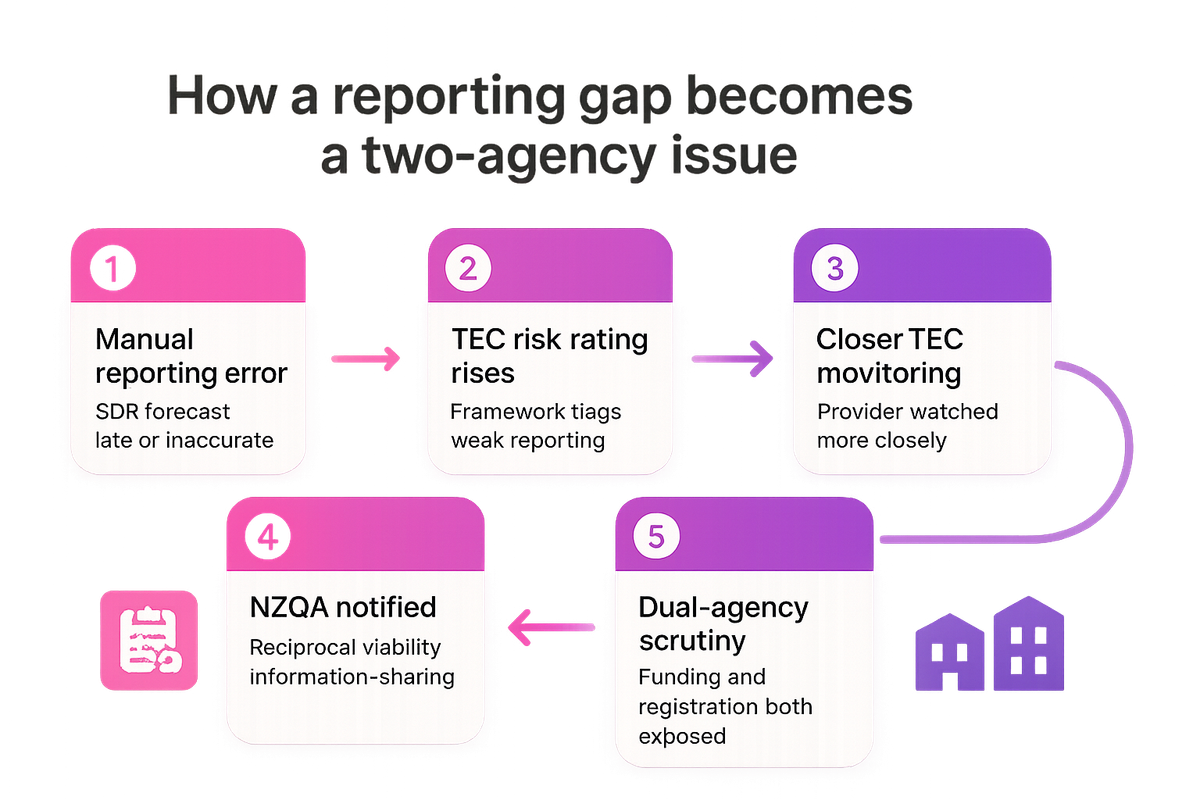
And because TEC can share viability concerns with NZQA, an internal reporting weakness can surface as a registration conversation, not just a funding one. NZQA's monitoring approach also expects PTEs to run an adequate quality management system — which is regulator language for having your processes documented and repeatable rather than dependent on one person remembering how it's done (NZQA).
The sector reset happening around you
None of this is occurring in a stable environment. The Education and Training (Vocational Education and Training System) Amendment Bill, passed in October 2025, disestablished Te Pūkenga, established ten regional polytechnics, and replaced Workforce Development Councils with Industry Skills Boards from 1 January 2026 (Ministry of Education, Beehive.govt.nz). In the lead-up, ITPs including Wintec, Whitireia, WelTec and Toi Ohomai carried out significant restructures and job cuts to meet government right-sizing targets (The Spinoff).
PTEs sit alongside this system, not inside it — but you're funded and monitored within the same environment, by the same agencies, under the same financial-viability lens now being applied more visibly across the whole sector. Regulators under pressure to demonstrate system-wide financial discipline are unlikely to be more forgiving of weak reporting from PTEs. If anything, expect less patience for 'we'll tidy it up next quarter.'
Key takeaways
- The Private Training Establishment Rules 2026 (in force 19 January 2026) change financial return frequency for non-funded PTEs and require two-year enrolment record retention and 12-month assessment record retention, including sub-contractor records.
- The Single Data Return, not AVETMISS, is New Zealand's reporting regime — jointly run by TEC and the Ministry of Education, with specifications now delivered through the DXP Ngā Kete platform since August 2025.
- TEC's Financial Monitoring Framework treats SDR reporting quality and forecasting accuracy as financial-viability risk factors, directly affecting how closely your PTE is monitored.
- TEC and NZQA's reciprocal information-sharing means an internal process gap can become a cross-agency compliance issue faster than it used to.
- NZQA's monitoring model expects documented, repeatable processes — not knowledge held in individual staff members' heads.
Our take
The temptation in a year like this is to treat each change as its own project: a rules briefing here, a platform migration there, a board paper on financial risk somewhere else. That's how operations teams end up permanently behind — reacting to each deadline in isolation instead of building one reporting discipline that serves all of them at once.
The providers who come out of 2026 ahead won't be the ones with the newest system. They'll be the ones who treated reporting accuracy as a financial-risk control years before a regulator asked them to prove it — because by the time TEC's framework flags you, the fix is reactive, not preventive.
FAQ
Do the Private Training Establishment Rules 2026 apply to all PTEs, including non-funded ones? Yes. The Rules replace the 2025 Registration Rules and the 2022 Enrolment and Academic Records Rules and apply across registered PTEs, though specific requirements — such as the shift to biennial financial returns — apply to non-funded PTEs unless NZQA states otherwise (NZQA).
Is the Single Data Return the same as AVETMISS? No. AVETMISS is an Australian reporting standard. New Zealand's tertiary reporting regime is the Single Data Return, run jointly by TEC and the Ministry of Education, with non-funded PTEs instead completing the annual RS20 census (TEC, Ministry of Education).
How exactly does poor reporting affect our TEC risk rating? TEC's Financial Monitoring Framework produces a formulaic risk rating that factors in low SDR or fund reporting volumes and a history of inaccurate financial or delivery forecasting — meaning reporting quality directly influences how closely your organisation is monitored (TEC).
Can a reporting issue with TEC actually affect our NZQA registration? TEC and NZQA have reciprocal arrangements allowing them to share financial viability information confidentially where either agency has concerns, so a reporting or forecasting weakness identified by one regulator can prompt scrutiny from the other (TEC).