PTE Operations Planning: Firefighting to Forecasting
3 September 2026 · 7 min read

Every PTE operations leader is currently running three government reporting clocks that don't share a calendar, absorbing a quality assurance regime that just changed its name and its expectations, and watching the sector structure they report into get rebuilt from underneath. The instinct is to work harder each cycle. The better move is to stop treating compliance as an event and start treating it as infrastructure.
Why this lands on your desk
You own the mechanics, not the policy. Someone in your team is responsible for the Tertiary Education Commission's Single Data Return and Indicative Enrolment Collection if you receive Student Achievement Component funding or have students on Student Loans or Allowances — and for the RS20 census instead, if you're a non-funded PTE with only domestic students. Those are two different regimes, on two different clocks, both now migrating toward new .csv-based submission formats as TEC modernises its own systems. That migration isn't optional and it isn't your fault when it slips — but the rework lands on your desk.
At the same time, NZQA's integrated Quality Assurance Framework has replaced External Evaluation and Review with a new standing obligation: an annual self-review summary report, followed by a meeting to discuss an improvement plan. That's not a lighter compliance touch — consultation feedback pushed NZQA away from a simple compliant or non-compliant rating toward a more graduated assessment mechanism, which means documentation standards persist even as the label changes. Someone has to own that cycle end to end, every year, not just whoever remembers when the last EER happened.
Then there's the calendar itself. The Private Training Establishment Rules 2026, in force from 19 January 2026, replace both the 2025 Registration Rules and the 2022 Enrolment and Academic Records Rules. They remove the annual fee and shift non-funded PTEs to biennial financial reporting unless NZQA specifies otherwise. That's a direct change to your finance and operations calendar — one you need to plan around now, not discover in January.
Three clocks, one operations calendar
Line them up and the shape of the problem is obvious: SDR and IND run on TEC's funding-year clock, RS20 runs on its own annual census date, iQAF's self-review and improvement-plan meeting run on NZQA's annual cycle, and your financial return cadence has just changed from annual to biennial for many non-funded providers. None of these clocks were designed with each other in mind.
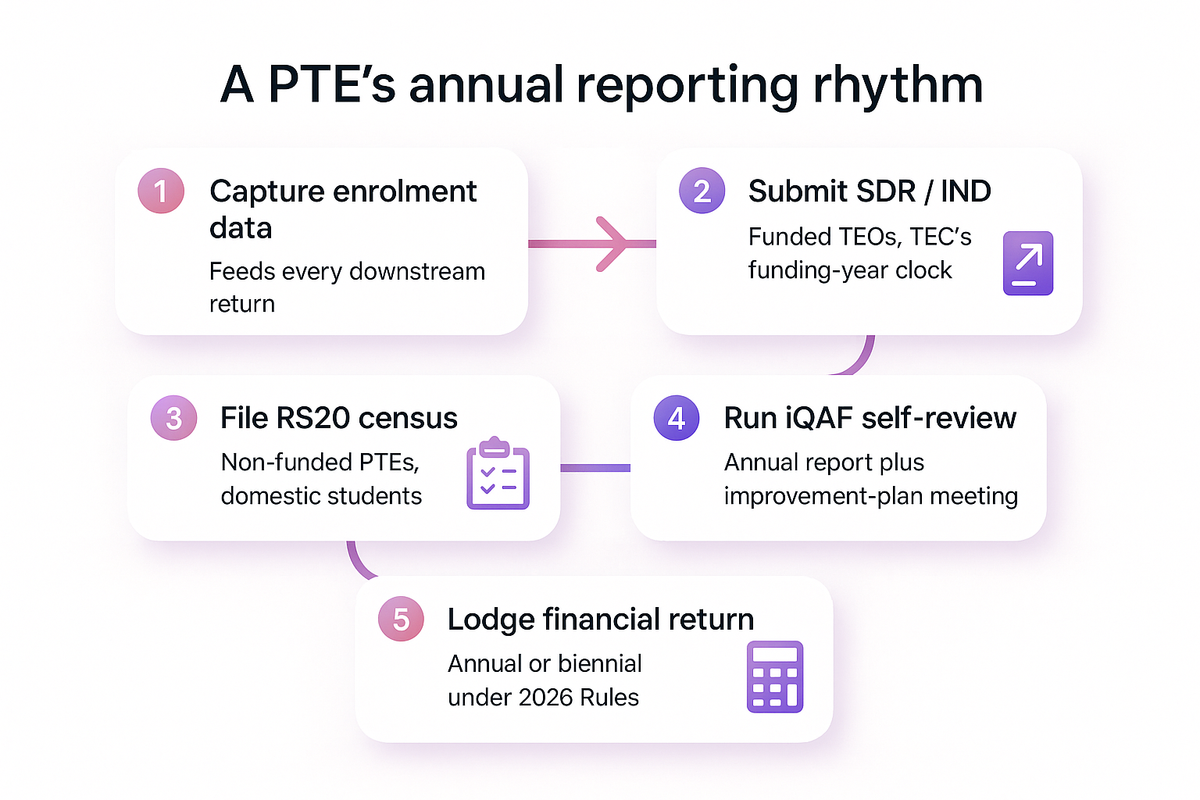
The fix isn't heroics during return season. It's a single compliance calendar that maps every obligation — SDR, IND, RS20, iQAF self-review, financial returns, programme and micro-credential delivery requirements — to a named owner, a lead time, and the systems that feed it. If that calendar lives in one person's head, you don't have an operations process. You have a dependency.
The ground is shifting under the reporting lines
Layer the wider reform on top and the calendar problem gets harder before it gets easier. The Vocational Education and Training legislation passed in October 2025 disestablishes Te Pūkenga, transitioning its functions through NZIST for up to two years, establishes ten new regional polytechnics, and replaces Workforce Development Councils with Industry Skills Boards from 1 January 2026.
If you're a work-based or industry-facing PTE, that's not background noise. It changes who you contract with, who you report progress to, and potentially who signs off on programme relevance. Your operations function needs to know, well before January, which of your funding, partnership and reporting relationships sit with an entity that's about to be replaced.
Revenue forecasting on a moving floor
Fees Free has been revised twice in quick succession — shifted from first-year to final-year eligibility in January 2025, then confirmed for removal in the 2026 Budget — while Budget 2025 allows providers to lift tuition and training fees by up to 6% in 2026. Both changes hit the same line on your forecast: expected revenue per enrolled learner.
On top of that, registration itself carries a delivery-continuity test. PTEs must deliver at least one NZQA-approved programme or micro-credential every year or risk their registration lapsing. That's not just a curriculum decision — it's a compliance metric with your name on it, and it belongs in the same forecasting model as your fee and funding assumptions.
From firefighting to forecasting
A repeatable operations rhythm isn't a bigger team. It's four habits, applied consistently:
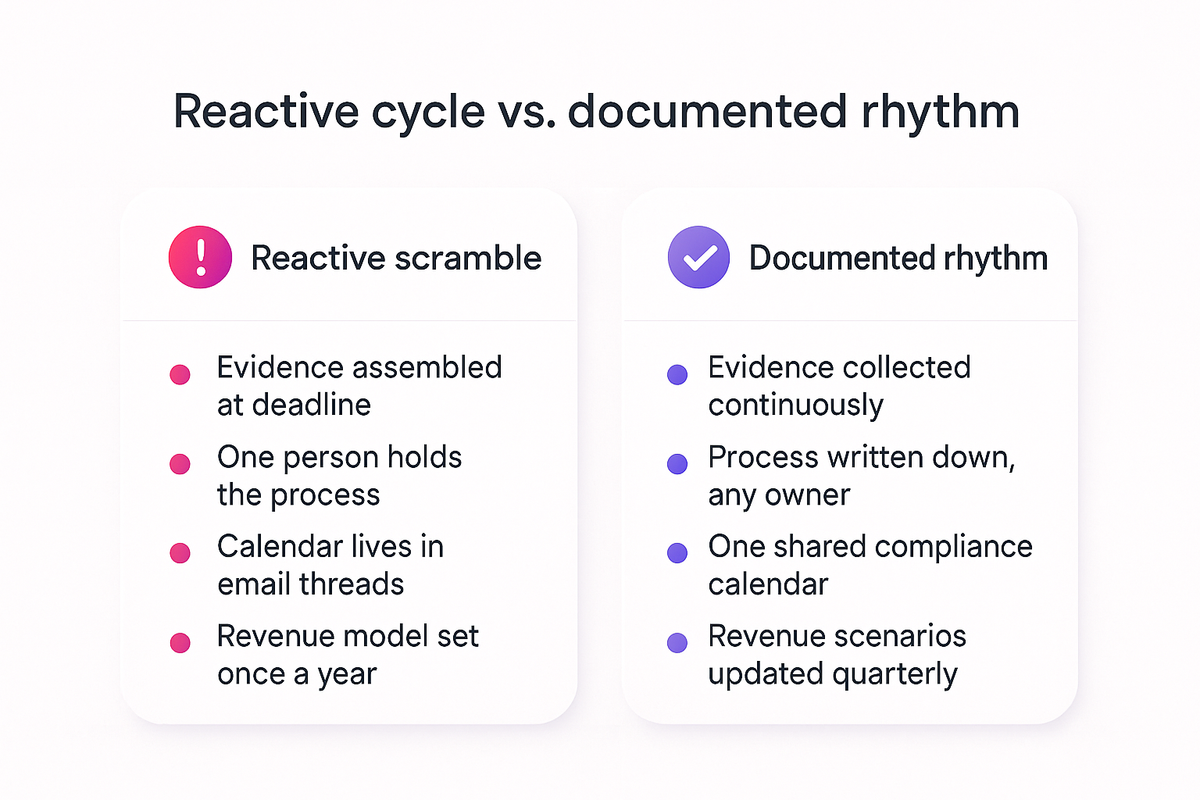
- One compliance calendar, one owner per obligation. SDR/IND, RS20, iQAF self-review, financial returns and delivery-continuity checks all go on it, with lead times built backwards from the actual due date, not the date someone remembers it.
- Evidence collected continuously, not assembled annually. If your iQAF self-review report is a scramble every year, the process is broken. Build the evidence trail — enrolment data, assessment outcomes, learner feedback — as delivery happens, so the annual report is a compile, not a project.
- Documented process, not tribal knowledge. Every reporting task that only one person can run is a risk to your registration, not just your team's workload. Write it down before the next system change forces you to.
- Revenue scenarios that flex with policy, not around it. Model fee settings, Fees Free eligibility and funded-versus-non-funded enrolment mix as variables you update quarterly, not assumptions you set once a year.
Key takeaways
- PTE operations leaders are now running SDR/IND, RS20 and iQAF's annual self-review on three separate clocks, with the Private Training Establishment Rules 2026 changing financial-reporting cadence from 19 January 2026.
- iQAF ends new External Evaluation and Review processes but keeps a graduated assessment mechanism — treat it as a new standing workflow to design, not a lighter compliance touch.
- The 2025 legislation disestablishing Te Pūkenga, standing up ten regional polytechnics, and replacing Workforce Development Councils with Industry Skills Boards from 1 January 2026 changes who work-based PTEs report and contract with.
- Fees Free changes and a proposed 6% fee-increase allowance for 2026 add real volatility to revenue forecasting, alongside the ongoing requirement to deliver at least one approved programme or micro-credential a year to keep registration.
- The operational answer is a documented, repeatable reporting rhythm — one calendar, named owners, continuous evidence collection — not a harder push each return season.
Our take
The real risk in this stretch of reform isn't any single new obligation — it's that each one gets solved in isolation, by whoever's closest to the deadline, using whatever spreadsheet is fastest. That's how process knowledge ends up trapped in one person's head and why reporting cycles keep eating whole weeks instead of shrinking. The providers that come through this transition well won't be the ones with the least regulatory change to deal with. They'll be the ones who treated the last eighteen months as a forcing function to document what they do once, map it to every regulator that needs it, and stop rebuilding the same process from scratch each cycle.
FAQ
Does iQAF remove the risk of a poor quality rating? No. NZQA moved away from a simple compliant or non-compliant outcome after consultation feedback, but a graduated assessment mechanism remains under the integrated Quality Assurance Framework, alongside the new annual self-review summary report and improvement-plan meeting.
Do all PTEs need to file the Single Data Return? Only those receiving Student Achievement Component funding or with students on Student Loans or Allowances. Non-funded PTEs with only domestic unfunded students file the annual RS20 census instead — the two obligations run in parallel, not as substitutes for each other.
What changes under the Private Training Establishment Rules 2026? From 19 January 2026, the new rules replace the 2025 Registration Rules and the 2022 Enrolment and Academic Records Rules, remove the annual registration fee, and move non-funded PTEs to biennial financial reporting unless NZQA specifies a different cadence for a particular provider.
How does the Workforce Development Council to Industry Skills Board change affect us? From 1 January 2026, Industry Skills Boards replace Workforce Development Councils. Work-based and industry-facing PTEs should confirm now which funding, endorsement or partnership relationships currently sit with a Workforce Development Council, since those lines are being redrawn as part of the wider disestablishment of Te Pūkenga.