PTE Reporting Systems NZ: A COO's Fix for Month-End
13 October 2026 · 6 min read
The month-end scramble isn't a people problem. It's a design problem. The same learner record gets typed into several systems, and nobody sees the differences until the TEC's validation rules do. Adding more people to reconcile it treats the symptom. The fix is a process that is documented and repeatable, and that doesn't live in one person's head.
Why this lands on your desk
You own the systems and people behind enrolment, delivery, Single Data Return (SDR) submissions and board reporting. When one learner's details are re-keyed between a student management system, a spreadsheet and the finance system, the discrepancy surfaces in your reporting week. It rarely surfaces where it started.
Three things have made this harder to carry in 2026:
- NZQA's 2026 Rules took effect on 19 January 2026.
- Funding is tighter and rebalanced.
- The vocational education and training (VET) system is being restructured around you.
None of these is a reason to panic. Together, they are a reason to stop treating reconciliation as a heroic monthly effort.
The pipeline to the TEC was built for systems, not spreadsheets
The TEC runs the SDR and the Indicative Enrolment Collection (IND) through its Data Exchange Platform (DXP). It publishes Data Specifications (SDR 2026 v3.1 is the current one in our research) and offers an API portal for integrating with the TEC to submit data to the DXP.
Read that plainly. The regulator's side of the pipeline is designed for system-to-system exchange. If your side still depends on someone exporting, cleaning and re-uploading files by hand, the mismatch is yours to solve. It isn't the TEC's.
I can't tell you from the TEC pages we reviewed how often SDR rounds run, so check your own funding calendar. What is clear is the shape of a round. The December 2025 SDR opened on 1 January 2026 and closed at 5.00pm on 31 January 2026, with validation rules applied to all mandatory fields.
What a fixed window and automatic validation really tell you
A fixed window plus automatic validation means errors are found at the deadline unless the data is clean upstream. That is the real reason the scramble feels like a scramble. You aren't reconciling data. You're doing late quality control on data that was never controlled at the point of entry.
A useful diagnostic is to look at where your corrections actually originate. If most fixes trace back to enrolment or assessment records edited in two places, the problem is process ownership. A better export won't help.
The rules moved under you
NZQA's updated Rules came into force on 19 January 2026 to align with the integrated Quality Assurance Framework and the VET changes. The PTE Rules 2026 replace the PTE Registration Rules 2025 and the PTE Enrolment and Academic Records Rules 2022. Any process built around the old rule set deserves a re-check.
The record-keeping obligations are specific. PTEs must keep student assessment materials for at least 12 months from completion, including those from sub-contractors. They must also keep records of qualifications or awards achieved as a permanent record. The operational question is simple: where does that evidence sit, and who other than one long-serving administrator can find it?
Then there's the deadline that should focus your minds. Under the Quality Assurance of Tertiary Education Providers Rules 2026, providers without a quality management system on 1 January 2026 must have one before 1 January 2027. Documenting the processes that currently depend on individual knowledge is now a regulatory task as well as an efficiency goal.
Headcount is the wrong lever
The funding picture makes linear hiring hard to defend. Budget 2026 includes $407 million in operating funding over four years. That includes $284.021 million for the TEC to fund 99% of forecast Level 3–10 volume over two calendar years, and a 2% subsidy increase for foundation education. RNZ reports tertiary subsidies as frozen, and the TEC's 2026 rate examples show a 10% decrease for all work-based delivery as part of a rebalancing within VET.
If enrolments grow and every extra hundred learners needs another person on reconciliation, margin disappears. Scaling by headcount is the least forgiving response available.
The system is also changing around you. Industry Skills Boards (ISBs) became operational on 1 January 2026. They set standards, endorse programmes and quality-assure assessments, and a TEC consultation document says a programme will not be funded without ISB endorsement. Te Pūkenga is due to be disestablished in early 2027, although RNZ earlier reported 31 December 2026. We don't yet know the full scope of any ISB charges to providers, because the consultation text we reviewed was truncated. Expect your evidence and reporting flows to shift as these relationships settle.
A first-quarter checklist that doesn't need new headcount
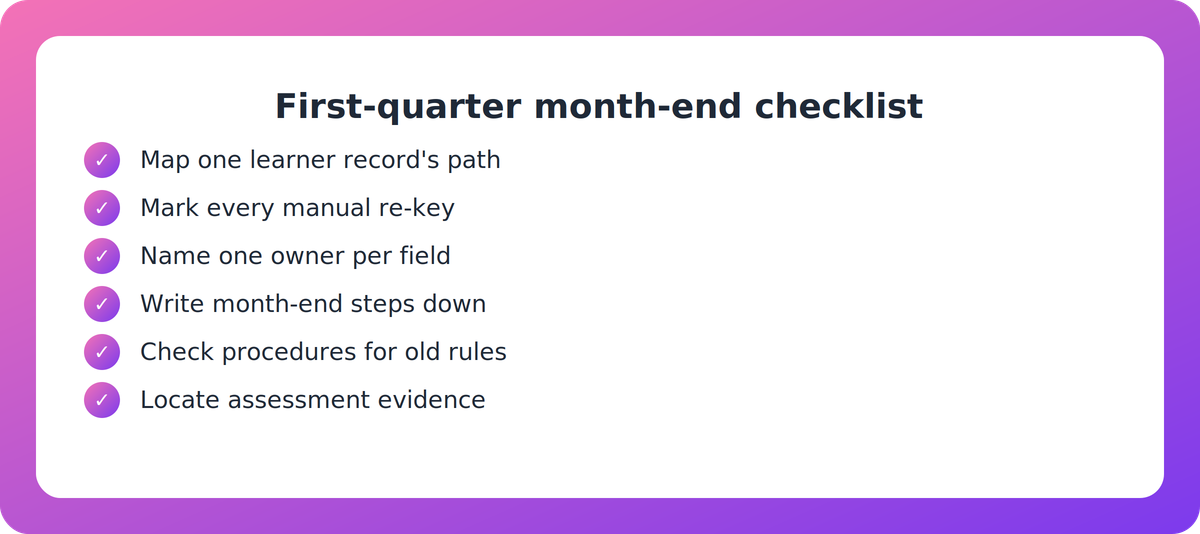
You can start this week with a pen and a whiteboard:
- Map the path of one learner record. Draw every system it passes through, from enrolment to SDR to finance.
- Mark each re-key. Every point where a person retypes a field is a defect waiting for a validation rule.
- Name one owner per field. The enrolment source of truth should be a decision, not a habit.
- Write down the month-end steps as someone else would need to run them. This is your quality management system's first draft.
- Check the old rules. Find any procedure still citing the 2025 registration rules or the 2022 enrolment and academic records rules.
- Ask your teams where assessment evidence lives, including sub-contractor material.
Key takeaways
- Month-end reconciliation is a symptom of how data moves between enrolment, delivery, assessment and finance, not a staffing shortfall.
- The TEC's SDR and DXP process applies validation to mandatory fields and offers an API route, so errors surface at the deadline unless upstream data is clean.
- NZQA's 2026 Rules took effect on 19 January 2026, and providers without a quality management system must have one before 1 January 2027.
- With Budget 2026 funding 99% of forecast Level 3–10 volume and a 10% decrease in work-based delivery rates in the TEC's examples, adding people in line with enrolments is hard to justify.
- ISBs and the Te Pūkenga disestablishment will change evidence flows, so documented processes are your protection.
Our take
Most providers treat the month-end scramble as a badge of diligence. We think it's a risk register entry. A process that works only because one capable person remembers the workarounds will fail on the day that person is away, or the day the rules change.
The 2027 quality management deadline is a gift if you read it correctly. It forces you to write down what you already do, and writing it down is where the duplicate entry becomes visible. Fix the design first, then decide what, if anything, needs automating.
Here is a question worth sitting with before your next reporting week. If your most experienced operations person were unavailable for a month, which steps would nobody else know how to run?