Reassessment Variants Done Right for NZQA Compliance
21 September 2026 · 7 min read
When a learner doesn't achieve competency first time, NZQA's assessment principles are clear: they're owed a genuine reassessment opportunity, not a re-run of the same questions. In practice, that leaves assessors choosing between reusing a compromised tool or hand-building an equivalent version — then having to prove, at moderation, that the two are actually comparable.
The reassessment trade-off nobody wants
Ask any assessor who's carried a full caseload through a reassessment period and they'll tell you the same thing: it's one of the most time-consuming parts of the job, and it happens unit standard by unit standard, cohort by cohort.
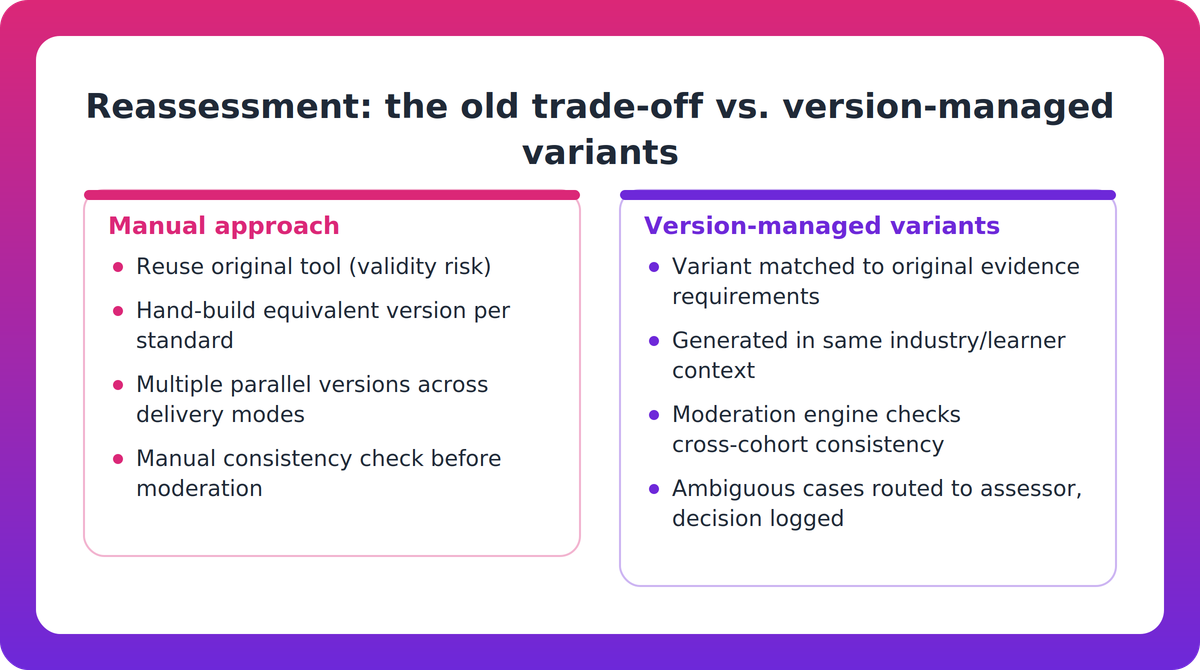
The problem shows up in a few predictable ways:
- Reusing the original tool is fast but risky — the learner has already seen the questions, so the result doesn't reliably show competency.
- Building a genuinely different version by hand takes hours per unit standard, and doing it well means matching the evidence requirements exactly, not just changing surface details.
- Mixed delivery modes make it worse. An assessor running the same unit standard across workplace, classroom and distance learners — or supporting ESOL and LLN cohorts — often ends up maintaining several parallel reassessment versions with no easy way to check they're pitched at the same standard.
- Moderation adds a second layer of work. Before external moderation, PTEs and ITPs need to show assessor judgement was consistent across cohorts and variants. That cross-check is manual, it eats into already tight moderation cycles, and if a discrepancy surfaces late, it becomes an audit finding rather than a quiet fix.
None of this is optional. It's the cost of doing reassessment properly under NZQA's principles — it's just a cost that's fallen almost entirely on assessor overtime.
How version-managed reassessment variants close the gap
VETos treats reassessment as a version-management problem rather than a rebuild-from-scratch problem. Its Version Management capability generates reassessment variants within the same industry and learner context as the original assessment — so a workplace-based hospitality assessment gets a workplace-appropriate variant, and an ESOL cohort's assessment gets a variant pitched at the same evidence requirements without the language load changing the difficulty.
Because the variant is built against the same standard, the assessor isn't starting from a blank page. They're reviewing and adjusting a draft that already carries the coverage of the original — which is where most of the manual hours were going.
Alongside variant generation, a moderation and QA engine does the cross-cohort checking that used to be manual:
- Compares assessor judgements for consistency across different cohorts.
- Flags discrepancies against NZQA moderation principles, rather than leaving them to surface at external moderation.
- Generates moderation-ready validation reports as a documented output, not a spreadsheet someone assembles the week before.
- Feeds ongoing calibration feedback to assessors, aimed at reducing judgement variance over time rather than catching it after the fact.
Critically, this is decision support, not decision replacement. Ambiguous items are routed back to a qualified assessor, and that human decision is logged. The sign-off — the thing that makes an assessment tool compliant and defensible — stays with the assessor. The AI output is a draft; the assessor's judgement finishes it.
The same logic extends to mapping. When a reassessment variant is adapted, the assessment mapping matrix updates with it automatically, and version history is retained as an evidence trail. That means pre-use validation doesn't mean redoing the mapping exercise from zero every time a variant is created.
What's actually shipped, and what it's grounded in
This isn't a roadmap promise. Supahuman's VET service description specifies Version Management with reassessment variants generated for moderation and fairness, framed explicitly against NZQA's Principles of Assessment and external moderation expectations. The same document details a QA engine that compares assessor judgements across cohorts, flags discrepancies against NZQA moderation principles, produces moderation-ready validation reports, and provides ongoing assessor calibration feedback.
VETos' own NZ buyer's guide is upfront about the boundary: the feature is positioned as support for human moderation, not a substitute for it, with ambiguous items routed back to a qualified assessor and the decision logged. It states plainly that AI output on its own is a draft, not a finished, compliant instrument — the qualified assessor still validates and signs off.
The mapping side is documented separately: the mapping matrix updates automatically when a task is adapted, can be exported for pre-use validation, and keeps version history as an evidence trail.
On the wider efficiency point, a documented New Zealand PTE case (Mast Academy) reports course-creation work that previously took weeks now taking minutes, with educators still central to reviewing and finalising content before it goes to learners. That's a vendor-reported outcome worth treating as directional rather than universal — but it's consistent with the shape of the reassessment problem this piece is about: the drafting effort shrinks, the review and sign-off stays human.
Key takeaways
- NZQA's assessment principles require a genuine reassessment opportunity, but hand-building an equivalent, non-duplicate version per unit standard is one of the biggest hidden time costs in a training organisation's assessment workload.
- Mixed delivery modes and diverse learner cohorts (ESOL, LLN, workplace, classroom, distance) multiply the number of reassessment versions an assessor has to maintain and keep consistent.
- VETos generates reassessment variants in the same industry and learner context as the original assessment, so evidence requirements carry across without a full re-author.
- A companion moderation engine checks assessor judgement consistency across cohorts, flags discrepancies against NZQA moderation principles, and outputs moderation-ready validation reports.
- Ambiguous cases are always routed back to a qualified assessor with the decision logged — the tooling removes duplicated drafting, not the assessor's sign-off.
Our take
Fairness in reassessment has always been treated as a judgement problem, which is partly why it's been so hard to systematise — you can't automate away professional discretion, and shouldn't try. But a good chunk of what makes reassessment slow isn't judgement at all; it's repetitive drafting and manual cross-checking that happens to sit next to judgement. Separating those two things — letting tooling handle version consistency and evidence tracking while the assessor handles the actual call — seems like the more honest way to scale reassessment across a growing portfolio without quietly lowering the bar on either fairness or workload.
FAQ
Does NZQA require a different reassessment tool, or can the same tool be reused? NZQA's Principles of Assessment call for a genuine reassessment opportunity. Reusing the identical tool the learner has already seen undermines the validity of the result, which is why a distinct but equivalent version is generally expected.
How does VETos generate a reassessment variant that's actually equivalent to the original? The variant is generated within the same industry and learner context as the original assessment, keeping the standard's evidence requirements intact, so the assessor is reviewing and adjusting a matched draft rather than building a new instrument from scratch.
Does the moderation engine replace the assessor's decision-making? No. It's positioned as support for human moderation, not a substitute. Ambiguous items are routed back to a qualified assessor, and that decision is logged — the AI output is treated as a draft, not a finished, compliant instrument.
What happens to assessment mapping when a reassessment variant is created? The mapping matrix updates automatically when the task is adapted, and version history is retained as an evidence trail, so pre-use validation doesn't require remapping from zero for every variant.
Is this only useful for large PTEs and ITPs with big cohorts? The workload problem scales with the number of unit standards and delivery modes a training organisation runs, not just headcount — a smaller PTE juggling workplace, classroom and distance delivery for the same standard can face the same variant and consistency pressure as a larger provider.
If reassessment variants and moderation cross-checks are eating into your team's capacity, it's worth looking closely at how version management could sit alongside your existing assessor workflows — take a closer look at what VETos' Version Management and moderation engine actually do before your next moderation cycle.