RPL Evidence Gaps: Why Validation Keeps Failing
15 July 2026 · 7 min read

Recognition of Prior Learning keeps failing validation because too many RTOs still treat it as a shortcut rather than an assessment bound by the same rules of evidence as any other unit of competency. ASQA's 2025–26 data puts RPL audit compliance at just 62%, with more than 200 serious matters under investigation and tribunal decisions now backing large-scale qualification cancellations tied directly to weak RPL evidence.
Why ASQA is treating RPL as a top compliance risk now
RPL isn't a new concern for ASQA, but it's now a named, standing risk priority. On its risk priority page, updated 31 July 2025, ASQA states it has ongoing concerns that inadequate RPL practices "exploit vulnerable students and compromise the integrity of qualifications," and directs RTOs to review their RPL systems and policies given its heightened regulatory focus.
That's a deliberate shift in language. ASQA isn't flagging a process gap — it's flagging harm to students and to the credibility of the AQF qualifications RTOs issue. Under the Standards for RTOs 2025, an RPL decision has to meet the same evidentiary bar as any other assessment judgement: it has to be defensible, traceable and specific to the individual candidate.
What the audit numbers show
Workshop notes from ASQA's March 2026 sector update give the clearest picture yet of how widespread the problem is:
- 62% compliance rate across 89 performance reviews (audits) conducted between July 2025 and January 2026.
- 212 serious matters under active investigation by ASQA's enforcement team.
- More than 43,000 qualifications and statements of attainment cancelled as at 31 March 2026, spanning sectors including early childhood education and care, disability support and aged care.
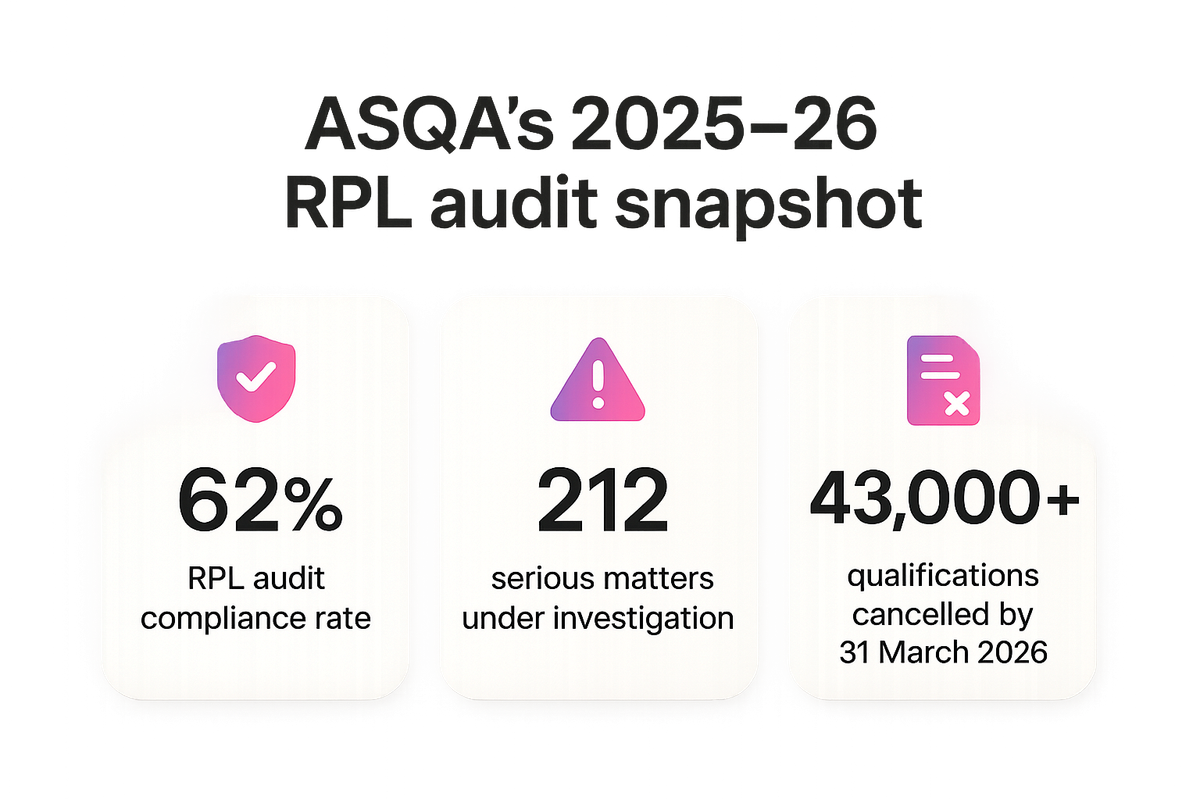
A 62% pass rate on its own is a hard number to ignore — it means roughly four in ten RPL-related audits ASQA ran in that window found something wrong. Combined with the scale of cancellations, it confirms RPL isn't a fringe issue affecting a handful of providers. It's systemic.
Tribunal decisions: what "no evidence" looks like in practice
The Gills College tribunal decisions give the audit data a concrete face. ASQA's cancellation of Gills College qualifications was affirmed on review, with the tribunal record documenting RPL pathways issued with:
- no assessor contact with the candidate,
- no tailored RPL guidance material, and
- no documentary evidence trail supporting the decision.
A related, earlier tribunal decision reached the same conclusion on a separate matter — evidence gaps that were obvious once someone actually opened the file. These aren't edge cases of a single rogue provider. They're the pattern ASQA's audit team is now finding often enough to justify treating RPL as a named risk priority sector-wide.
The four evidence gaps auditors keep finding
Sector guidance converging around ASQA's 2025–26 risk settings keeps pointing to the same failure points, and they map cleanly onto the core rules of evidence — valid, current, sufficient, authentic:
- Templated evidence packs. Phrasing that repeats near-identically across different candidates' files — an authenticity red flag auditors are now actively looking for.
- Stale evidence. Skills demonstrated years ago, with nothing more recent to establish currency. ASQA's guidance is explicit that old evidence can be rejected at audit unless supported by recent material.
- No assessor contact or third-party corroboration. Same-day RPL decisions with no verification beyond the candidate's own claim don't satisfy sufficiency or validity.
- Missing moderation trail. No record of what evidence was accepted, how sufficiency was judged, or how any gap training was delivered and assessed.
Any one of these can sink an RPL file at audit. Together, they're what's driving the 62% compliance figure.
The credit transfer domino effect
Here's the part providers often miss: a cancelled RPL-based qualification doesn't stay contained. ASQA's guidance on credit transfer, updated 24 March 2026, confirms that credit transfers relying on a since-cancelled qualification are no longer valid — unless the student can supply fresh evidence sufficient to support a new RPL decision.
That means a single weak RPL file, issued years ago, can unravel qualifications and credit chains built on top of it. For RTOs and TAFE institutes managing large portfolios, this is exactly the kind of exposure that turns a documentation shortcut into a multi-qualification remediation problem.
Where ASQA is looking next
ASQA's mid-2026 update signals two changes providers should plan for:
- Targeted quality reviews of workplace-based assessment in Individual Support, Carpentry and Early Childhood Education and Care — three qualification areas where RPL is commonly used and workplace evidence is central.
- Fewer but sharper audits, with immediate regulatory action favoured over rectification periods. That removes the grace window many providers have historically relied on to fix RPL files after the fact.
Bulk RPL offers made at enrolment, same-day decisions with no third-party corroboration, and reused evidence templates are the specific practices ASQA has flagged for closer scrutiny — all consistent with the tribunal findings above.
Closing the evidence gap before your next audit
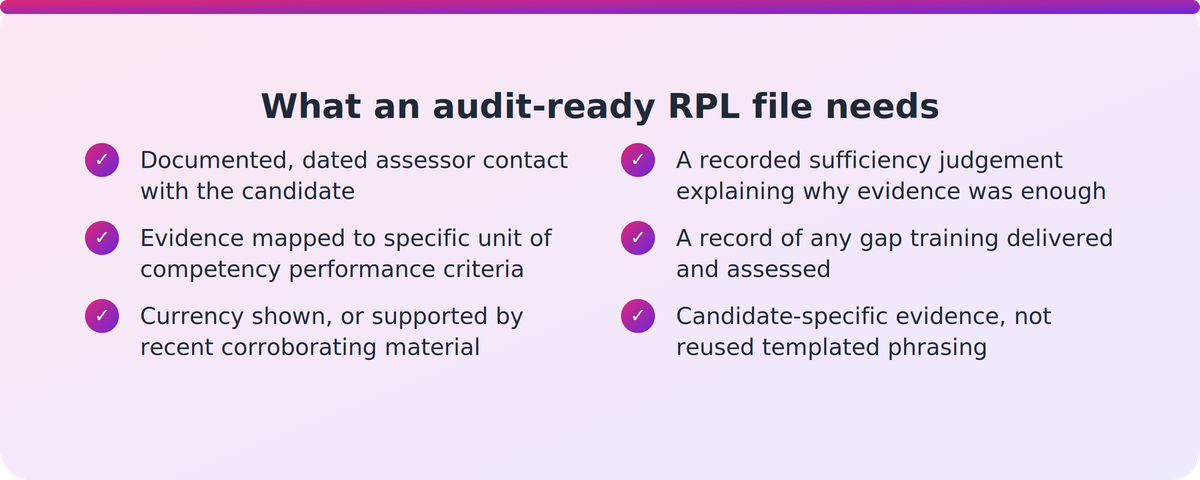
An audit-ready RPL file needs to show its working, not just its conclusion. At minimum, that means being able to demonstrate:
- Direct assessor contact with the candidate, recorded and dated.
- Evidence mapped explicitly against the specific unit of competency's performance criteria.
- Currency — evidence recent enough, or supported by more recent corroborating material.
- A documented sufficiency judgement: what was accepted, and why it was enough.
- A record of any gap training delivered and how it was assessed.
- Candidate-specific evidence and commentary — not phrasing that could be lifted from another file.
Key takeaways
- ASQA has named RPL a standing risk priority, with audit compliance sitting at 62% across 89 reviews between July 2025 and January 2026.
- Over 200 serious matters remain under investigation, and more than 43,000 qualifications had been cancelled by 31 March 2026, several tied to RPL evidence failures.
- Tribunal decisions on Gills College qualifications confirm the exact pattern auditors are finding: no assessor contact, no tailored guidance, no documentary trail.
- Cancelled RPL-based qualifications can invalidate downstream credit transfers, turning one weak file into a wider remediation problem.
- ASQA's 2025–26 posture favours fewer, sharper audits with immediate regulatory action — reducing the room providers have to fix RPL gaps after the fact.
Our take
The compliance risk in RPL was never really about the pathway — it's about whether an RTO can produce, on demand, the same standard of traceable evidence it would expect from a classroom-based assessment. The providers getting caught out aren't necessarily cutting corners deliberately; many simply never built RPL into their quality systems with the same rigour as their other assessment tools. With ASQA moving to fewer, sharper audits and less patience for rectification, treating RPL evidence as something assembled after the fact — rather than mapped and validated at the point of assessment — is no longer a workable strategy for any RTO carrying meaningful RPL volume.
FAQ
What compliance rate did ASQA find for RPL in its 2025–26 audits? ASQA's March 2026 sector update reported a 62% compliance rate across 89 performance reviews (audits) conducted between July 2025 and January 2026, with 212 serious matters still under investigation.
Why did ASQA cancel Gills College qualifications over RPL? Tribunal decisions affirming ASQA's cancellation found the RPL pathways involved no direct assessor contact with candidates, no tailored RPL guidance material, and no documentary evidence trail supporting the assessment decisions.
What happens to credit transfers if an RTO's RPL-based qualification is cancelled? Per ASQA's guidance updated 24 March 2026, any credit transfer relying on a cancelled qualification is no longer valid unless the student can supply fresh evidence sufficient for a new RPL decision.
Which qualification areas is ASQA scrutinising most closely for RPL evidence in 2025–26? ASQA's mid-2026 update flagged targeted quality reviews of workplace-based assessment in Individual Support, Carpentry, and Early Childhood Education and Care qualifications.
What are the most common RPL evidence failures auditors find? Sector guidance points to templated evidence packs with repeated phrasing, stale evidence lacking currency, same-day decisions without third-party corroboration, and missing records of how sufficiency and gap training were determined.