RTO Assessment Software: A 2026 Compliance Buyer's Guide
13 July 2026 · 8 min read

The right RTO assessment software is purpose-built for the Standards for RTOs 2025 and ASQA's training package requirements, not a generic LMS with AI bolted on. It maps assessments to units of competency, keeps a qualified assessor validating every decision, and produces audit-ready evidence — because ASQA's stated position is that AI cannot make assessment decisions unsupervised.
That's the short version. The longer version is that "RTO assessment software" has become a crowded category in 2026, and not every tool in it is built with the same standards in mind. Here's how to evaluate the options properly.
What counts as RTO assessment software
Industry buyer's guides typically split RTO software into distinct categories rather than treating it as one blob (rtopilot.com.au; cloudassess.com). It's worth knowing which one you're actually shopping for:
- Student/RTO management software (SMS) — centralises enrolments, AVETMISS reporting, and compliance records.
- Learning management systems (LMS) — delivers training content and tracks learner progress.
- Assessment & feedback tools — support marking, moderation and feedback workflows.
- AI & automation tools — generate or draft assessment and training content directly.
A tool built specifically to write and map assessments against units of competency sits in that last category. It's a different job to a system that just houses enrolments or hosts course content — and it should be evaluated on different criteria.
What to look for in AI assessment writing software
Raw drafting speed is the easiest thing to demo and the least useful thing to buy on. What actually protects an RTO at audit is whether the software supports — rather than replaces — a qualified assessor's judgement. Weigh these criteria:
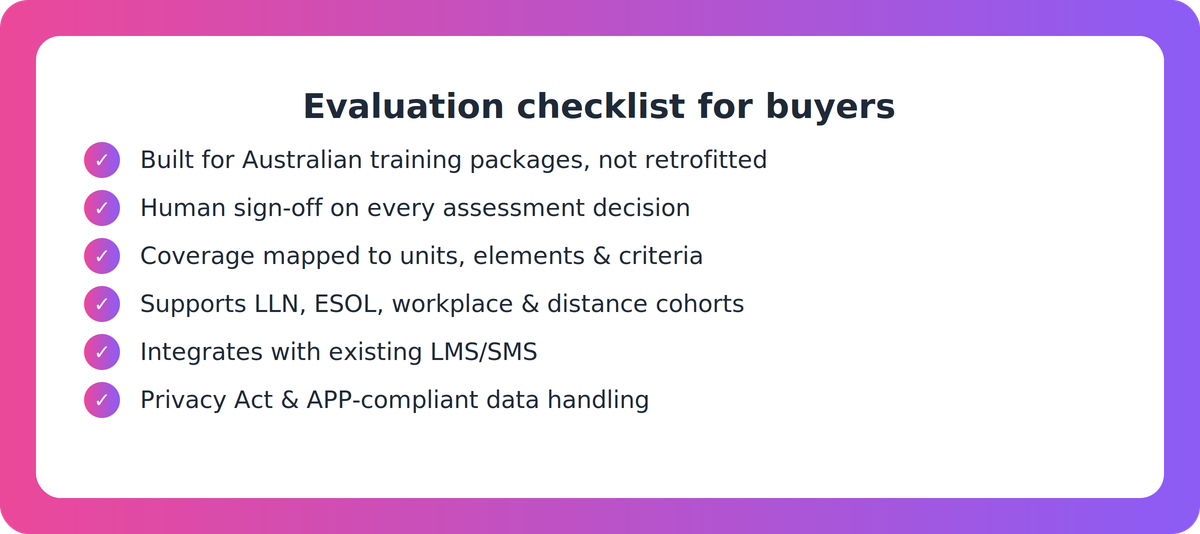
- Built specifically for Australian training packages and ASQA requirements, not a generic or overseas-adapted platform retrofitted for VET.
- A clear human-in-the-loop workflow where a trainer or assessor reviews, edits and signs off AI-drafted content — the AI drafts, the human decides.
- Assessments mapped back to units of competency, elements and performance criteria, with evidence you can retrieve at audit.
- Support for diverse cohorts — LLN, ESOL, workplace, distance — without maintaining separate manual versions of the same assessment.
- Integration with your existing LMS or SMS, so assessment content doesn't live in a disconnected silo.
- Vendor transparency about how their approach aligns with ASQA's draft AI Principles and the Standards for RTOs 2025.
- A process for tracking training package and regulatory changes so outputs don't quietly go stale between audits.
- Data handling consistent with the Privacy Act 1988 and the Australian Privacy Principles for any learner or assessment data the tool processes.
Does ASQA allow AI-generated assessments?
This is the question every RTO leadership team is asking going into 2026, and the answer is nuanced rather than a flat yes or no.
ASQA runs a risk-based audit approach and has cancelled the registration of providers whose assessment systems — including RPL — didn't meet training package requirements, the principles of assessment, or the rules of evidence (rtocoach.com.au). AI doesn't get a pass on any of that.
Through 2026, ASQA has been running sector workshops specifically examining whether RTOs' use of AI is compliant with the 2025 Standards, and has shared draft AI Principles that tie into the existing Standards rather than create new legislation (asqa.gov.au; skillseducation.com.au). The operative rule reported from ASQA's position is direct: AI cannot make assessment decisions, and co-assessment with AI is not considered a valid assessment method. Secondary reporting on ASQA's AI Transparency Statement also indicates that AI-generated content must be checked by qualified trainers and assessors, and that RTOs need to retain evidence that assessment decisions were made by humans, not automated tools.
A documented AI policy isn't yet a mandatory Standards requirement, but sector commentary on ASQA's 2026 workshops treats it as best practice heading into audits. If a vendor can't explain, in plain terms, where their software stops drafting and a human starts deciding, that's a gap worth pressing on before you sign anything.
How this is different from generic RTO management software
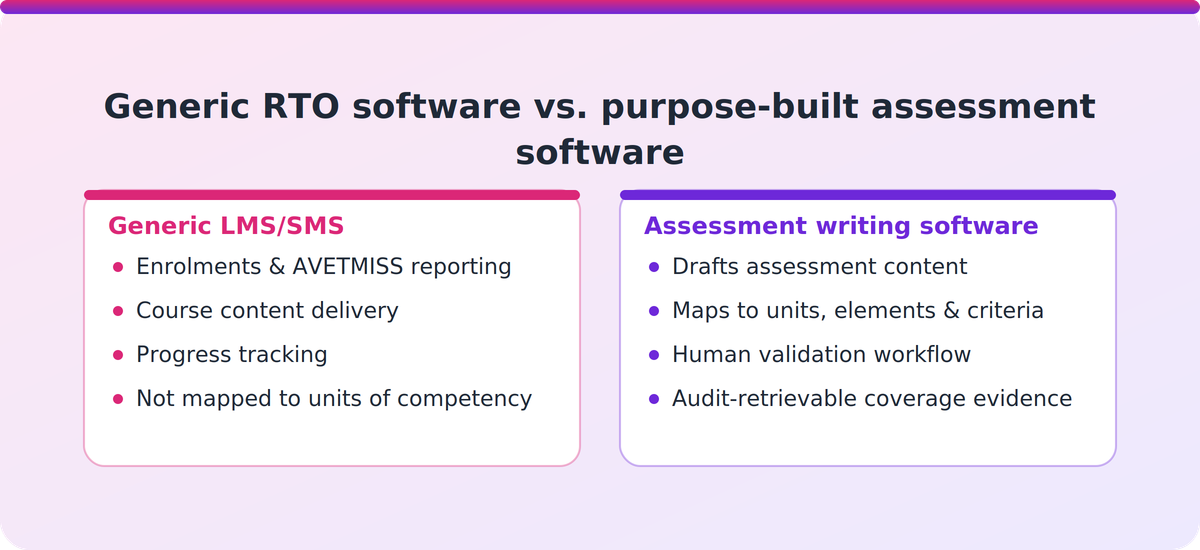
An SMS or LMS built for VET will handle enrolments, AVETMISS reporting and content delivery well. What it typically won't do is generate assessment content aligned to a specific unit of competency, map that content against elements and performance criteria, or flag gaps in coverage before an auditor does. That's a narrower, more specialised job — and it's the one this guide is about.
What compliance and privacy risks look like in practice
Two risks sit alongside each other here, and buyers should treat them as separate checks, not one.
The compliance risk is assessment validity: if AI-generated content isn't reviewed, mapped and signed off by a qualified assessor, it can fail the principles of assessment or the rules of evidence at audit — the same failure mode that has led ASQA to cancel registrations for non-AI assessment systems in the past.
The privacy risk is data handling: any AI tool processing learner personal information — names, LLN results, workplace evidence — is subject to the Privacy Act 1988 and the Australian Privacy Principles. Buyers should verify current obligations and penalty thresholds directly with the Office of the Australian Information Commissioner rather than relying on secondary summaries, including this one.
Where purpose-built tools fit
A handful of platforms are being built specifically around this compliance-first brief rather than adapted from generic ed-tech. VETos, for example, models a provider's scope — training package, qualifications, units, elements and performance criteria — as one connected structure, so assessments stay mapped and audit-retrievable rather than living as disconnected documents. It's described as producing draft assessments that educators then review and refine, which is consistent with a human-validated workflow rather than an AI-decided one — and it's positioned to integrate with common delivery platforms like Canvas, Moodle, aXcelerate and SharePoint rather than requiring an RTO to rip out its existing systems. That's a reasonable model for this category; it isn't the only one, and any vendor claim should be checked against your own compliance requirements before you buy.
Key takeaways
- "RTO assessment software" is a distinct category from SMS/LMS platforms — it drafts and maps assessment content against units of competency, rather than managing enrolments or delivering courses.
- ASQA's reported position is that AI cannot make assessment decisions; a qualified assessor must validate every outcome, and co-assessment with AI is not a valid method.
- Coverage mapping to units, elements and performance criteria, plus audit-retrievable evidence, matters more than raw drafting speed.
- Check data handling against the Privacy Act 1988 and Australian Privacy Principles for any learner data the tool touches.
- Purpose-built, Australian-training-package-aware tools are generally better positioned for this than generic or overseas-adapted platforms — but the human validation workflow is the thing to verify, not the marketing.
Our take
The category is going to keep splitting into "fast" and "defensible," and RTOs that chase the former without the latter are the ones ASQA's 2026 workshops seem aimed at. The honest framing is that AI assessment writing software should save a qualified assessor hours of drafting, not hours of judgement — if a vendor's pitch is speed alone, ask them to show you the validation trail instead.
FAQ
What should Australian RTOs look for in AI assessment writing software to stay compliant with the Standards for RTOs 2025?
Look for software purpose-built for Australian training packages, clear human-in-the-loop validation where a qualified assessor signs off every decision, coverage mapping to units of competency and performance criteria with audit-retrievable evidence, and vendor transparency about alignment with ASQA's draft AI Principles.
Does ASQA allow AI-generated assessments?
ASQA's reported position is that AI can assist with drafting but cannot make assessment decisions itself — co-assessment with AI is described as not a valid assessment method. RTOs must retain evidence that a qualified human made the final assessment decision.
How is AI assessment writing software different from a generic RTO LMS or SMS?
An SMS handles enrolments and AVETMISS reporting; an LMS delivers and tracks training content. AI assessment writing software is a narrower category focused specifically on drafting and mapping assessment content against units of competency, elements and performance criteria.
What compliance and privacy risks does AI-generated assessment content create for an RTO?
Compliance risk arises if AI content isn't validated by a qualified assessor and mapped correctly, which can fail the principles of assessment or rules of evidence at audit. Privacy risk arises from processing learner personal data, which is governed by the Privacy Act 1988 and the Australian Privacy Principles.
Is a documented AI policy mandatory under the Standards for RTOs 2025?
Not yet as a formal Standards requirement, but sector commentary on ASQA's 2026 workshops treats a documented AI policy as best practice heading into audits.