RTO Assessor Workload: The 2026 Compliance Crunch
27 July 2026 · 7 min read

RTO Assessor Workload: The 2026 Compliance Crunch
Assessor workload has quietly been re-priced in Australian VET. The Standards for RTOs 2025 demand more defensible evidence per learner, 2026 brings the first full Annual Declaration on Compliance cycle against those standards, and most RTOs haven't grown assessor headcount to match — a gap now showing up as compliance risk, not just admin strain.
What actually changed under the Standards for RTOs 2025
The Standards for RTOs 2025 have been in effect since 1 July 2025, but 2026 is the year they get tested properly. It's the first complete cycle of the Annual Declaration on Compliance (ADC), with the submission window running from 3 to 31 March 2026.
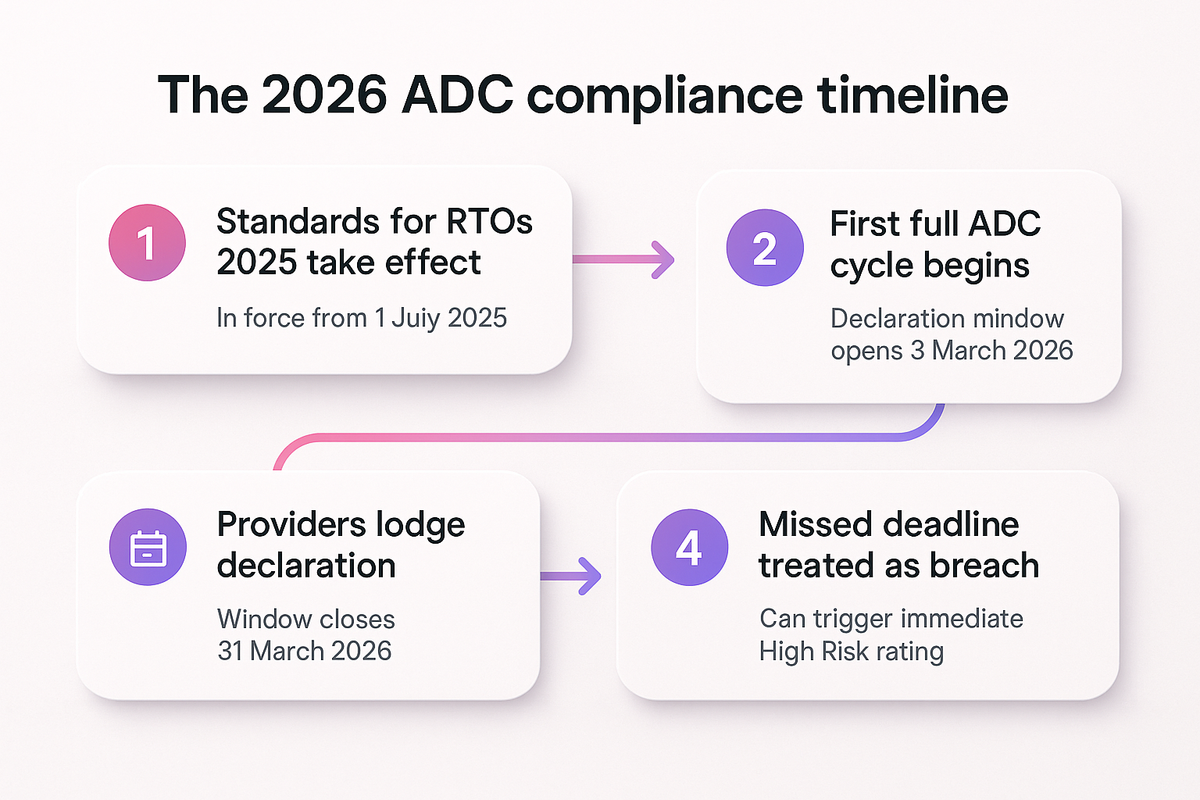
That window matters more than most compliance dates on the calendar. A missed ADC deadline is treated as a breach of registration conditions, and ASQA can move a provider straight to a 'High Risk' rating as a result. There's no grace period built into that mechanism — the declaration is either lodged, accurate and on time, or it isn't.
For training and assessment teams, the ADC isn't a paperwork exercise separate from day-to-day delivery. It's a declaration that the evidence behind every unit of competency, every training package requirement and every assessor sign-off will hold up if ASQA looks closely. That's the part catching providers out.
Why assessment evidence costs more assessor time now
Under ASQA's 2025-26 Risk Priorities, assessment evidence has to meet the VSAC test: Valid, Sufficient, Authentic and Current. It's a higher bar than the older 2015 approach, and it sits inside a broader shift to outcome-based audits, where ASQA is less interested in whether a process exists on paper and more interested in whether the evidence trail actually proves competency.
In practice, VSAC means an assessor can't rely on a single observation checklist and a signature. They need:
- Evidence that's clearly tied to the specific performance criteria in the unit, not just the qualification broadly
- Enough evidence to be confident the learner is competent, not just plausible
- Evidence that's genuinely the learner's own work, gathered under conditions the assessor can vouch for
- Evidence collected close enough to now that it still reflects current competency
None of that is unreasonable. But producing it, mapping it back to the unit, and documenting it for a future audit takes real time — time that hasn't been added to most assessors' week.
The workforce data behind the crunch
This is where the numbers get uncomfortable. At an ASQA update session in March 2026, VET Workforce — Quality Area 3 of the Standards — attracted only 1% of provider confidence, and Credential Policy was flagged as the area providers feel least confident managing.
That's not a fringe result. It's providers themselves saying trainer and assessor capability, and the systems that support it, are the weakest link in their compliance readiness right now.
It also lines up with what NCVER has documented for years: a structural shortage of qualified trainers and assessors across almost every industry area the VET sector serves. This isn't a temporary staffing dip that resolves with a recruitment drive. RTOs facing a heavier evidentiary load in 2026 largely can't hire their way out of it, because the qualified assessors they'd need to hire are already stretched thin somewhere else in the system.
Workplace assessment: the sharpest edge of the squeeze
ASQA has separately called out workplace assessment as a specific risk area for 2026. Two failure patterns keep showing up:
- Supervisor sign-off happening without a qualified assessor actually overseeing the assessment
- Insufficient evidence being gathered during the placement itself
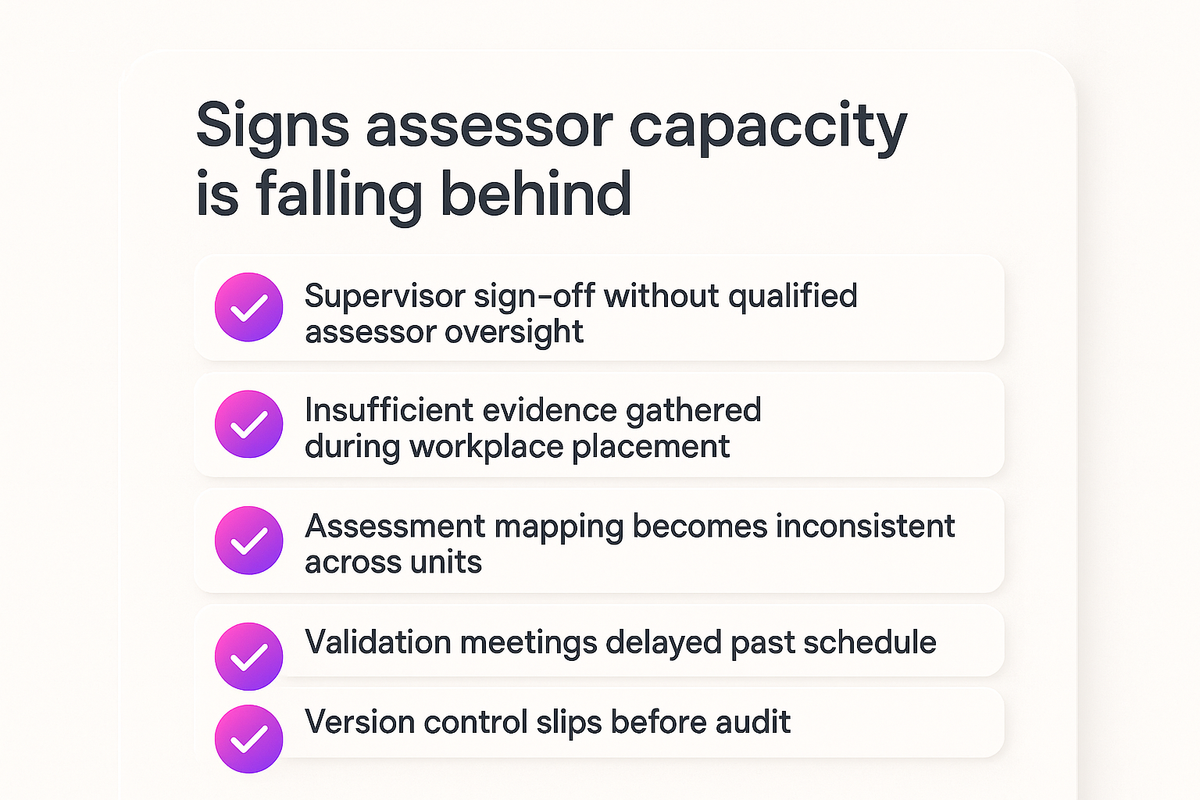
Both are symptoms of the same root cause: assessors with too many learners and too little time to properly supervise assessment that happens off-site, on someone else's schedule.
Industry commentary from PeoplePartners BPO in March 2026 draws a direct line from staff turnover and burnout to exactly this kind of compliance slippage. Long before a breach shows up in an audit finding, it shows up as:
- Assessment mapping that stops being consistent across units
- Validation meetings pushed back and rescheduled
- Version control on assessment tools quietly slipping
By the time an auditor sees the gap, it's been building for months.
The vendor response confirms this is now a competitive category
RTO software vendors have noticed. Providers like Cloud Assess are now marketing AI features explicitly around giving assessors their time back — a sign that assessor capacity has moved from being a background HR problem to a recognised buying criterion in VET technology.
That shift matters because it suggests the sector understands this isn't solvable by working harder within the same processes. Assessment generation, unit-of-competency coverage mapping and pre-validation checks are increasingly being treated as places where technology can absorb hours that used to sit entirely with a human assessor — tools like Supahuman VETos are part of that same trend, generating assessments mapped back to the unit with audit-ready documentation attached from the start.
Key takeaways
- 2026 is the first full ADC cycle under the Standards for RTOs 2025, with the submission window open 3–31 March 2026 and missed deadlines treated as a registration breach.
- ASQA's VSAC requirement (Valid, Sufficient, Authentic, Current) means assessors must produce more defensible evidence per learner under outcome-based audits than the old 2015 approach required.
- Provider confidence in VET Workforce (Quality Area 3) sat at just 1% in ASQA's March 2026 update, with Credential Policy flagged as the weakest area overall.
- NCVER research shows a long-standing structural shortage of trainers and assessors, meaning most RTOs can't close this gap through recruitment alone.
- Workplace assessment is a named 2026 risk area, and turnover-driven burnout is already showing up as inconsistent mapping and delayed validation before it ever reaches an audit.
Our take
The uncomfortable truth is that the Standards for RTOs 2025 didn't just tighten wording — they changed what counts as proof, and proof takes time to build. Providers that treat this as a documentation problem will keep losing ground to providers that treat it as a capacity problem and redesign how assessment evidence gets generated, mapped and checked in the first place. The workforce shortage NCVER has flagged for years isn't going away in 2026, so the realistic path forward is giving existing assessors better tools to produce compliant evidence faster, not waiting for a hiring market that isn't coming.
FAQ
What is the Annual Declaration on Compliance (ADC) and when is it due in 2026? The ADC is the mechanism RTOs use to declare ongoing compliance with the Standards for RTOs 2025. The 2026 submission window runs from 3 to 31 March, and 2026 is the first full compliance cycle conducted entirely under the revised Standards.
What does VSAC mean for assessment evidence? VSAC stands for Valid, Sufficient, Authentic and Current — the four qualities ASQA expects assessment evidence to demonstrate under its 2025-26 Risk Priorities. It requires assessors to gather more thorough, better-documented evidence per learner than earlier compliance approaches required.
Why has ASQA flagged workplace assessment as a specific risk in 2026? ASQA has identified two recurring issues: supervisor sign-off occurring without qualified assessor oversight, and insufficient evidence being collected during placement. Both point to assessors managing more learners and sites than they can properly supervise.
Can RTOs solve the assessor shortage by hiring more staff? Not easily. NCVER research documents a structural shortage of qualified trainers and assessors across most industry areas, so the pool of people RTOs could hire is already limited — making workload redesign and better tooling a more realistic near-term lever than recruitment alone.
What happens if an RTO misses the 2026 ADC deadline? A missed ADC submission is treated as a breach of registration conditions and can trigger an immediate move to a 'High Risk' rating from ASQA, regardless of the provider's underlying delivery quality.