RTO Board Reporting: Beyond the Compliance Checklist
21 September 2026 · 7 min read
Ask an RTO board how confident it is in the organisation's risk management, and most will point to the compliance register. That register isn't what ASQA is judging anymore. Under the Standards for RTOs 2025, the audit trail runs through the reporting pack itself — which means the document you assemble every month has quietly become a compliance artefact, not just an update for the board.
Why this lands on your desk
You own the systems that produce every number in that pack — enrolment data, AVETMISS submissions, delivery capacity, the continuous improvement log. When ASQA audits an RTO on evidence from 1 July 2025 onward, it's assessing against the new Standards, not the checklist-based practice most reporting cycles were built around (ASQA, "2025 Standards for RTOs commence"). That puts your board report squarely in scope, because it's often the clearest single document showing how the organisation actually identifies and responds to risk.
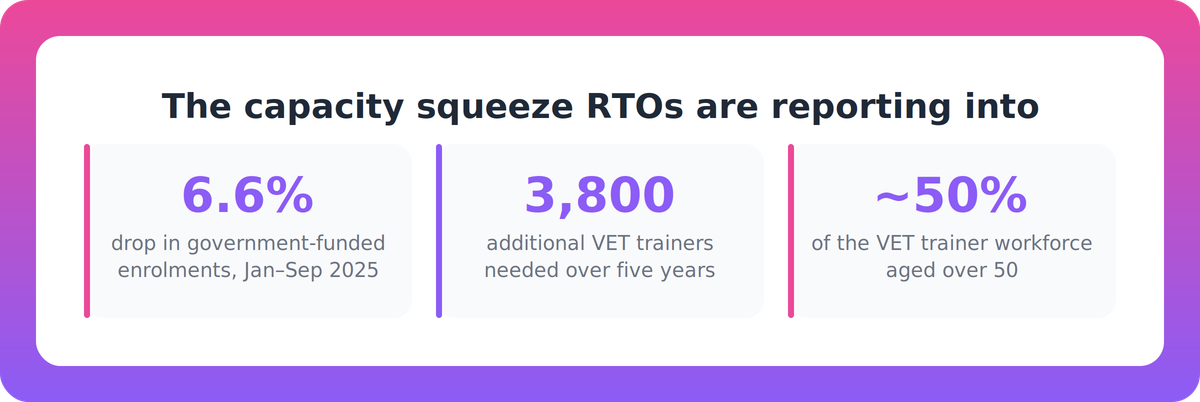
At the same time, you're managing this shift against real cost pressure. Government-funded VET enrolments fell 6.6% — 72,225 students — in the first nine months of 2025 compared to the same period in 2024 (NCVER). Reporting and governance obligations haven't shrunk to match. If anything, they've grown, which means per-student overhead is rising even as you're expected to demonstrate tighter process control, not looser.
The shift: from checklist to self-assurance
The 2015 Standards for RTOs asked, in effect, "did you do the thing." Stakeholder feedback into the reform process found that model too focused on administrative, input-based compliance rather than outcomes (ASQA; DEWR, "2025 Standards for Registered Training Organisations"). The 2025 Standards, which commenced 1 July 2025 after nearly a decade under the old framework, respond by separating Outcome Standards from Compliance requirements and pushing RTOs toward risk-based self-assurance instead of a one-size-fits-all list of ticks.
That's not a wording change. It changes what a defensible board report looks like. A pack built around "we completed the annual compliance calendar" no longer matches what an auditor is testing for. The more defensible model shows how a risk was identified, what the organisation did about it, and what evidence backs that response — activity plus reasoning, not activity alone.
What sits underneath every board report
None of this happens in isolation from your data infrastructure. Every board report you produce is downstream of mandatory feeds: Total VET Activity (TVA) reporting to NCVER, AVETMISS-compliant data under the VET Data Policy, and, depending on jurisdiction, additional obligations like Western Australia's Training Accreditation Council requirements for timely, accurate submissions.
AVETMISS data quality is a known, recurring weak point across the sector — incorrect activity dates, wrong attendance hours, missing employer ABNs, all surfacing at deadline time rather than when they're cheap to fix. If your student management system and learning management system don't talk to each other, you inherit that reconciliation burden by hand, and it compounds every reporting cycle rather than getting easier. A board report that can't speak to the integrity of its own source data isn't much of a risk-management artefact, whatever the Standards say.
Capacity is now a board-level risk, not an HR footnote
The workforce data should be uncomfortable reading for anyone reporting on delivery risk. Jobs and Skills Australia data shows VET teachers have been in national shortage for two consecutive years, with nearly half the workforce aged over 50 and roughly 3,800 additional trainers needed over the next five years. Combine that with falling government-funded enrolments and you have a structural tension: fewer students to spread fixed compliance and governance costs across, and a shrinking pool of qualified people to deliver against a rising documentation burden.
A board report that only counts enrolments and pass rates misses the risk that actually matters here — whether your delivery capacity scales without headcount growing in lockstep. That's a COO's question to answer, and it belongs in the pack, not in a separate HR update nobody reads before the board meeting.
Redesigning the report itself
If the goal is evidence of risk-based self-assurance rather than a completed checklist, the report needs different content, not just a different cover page.
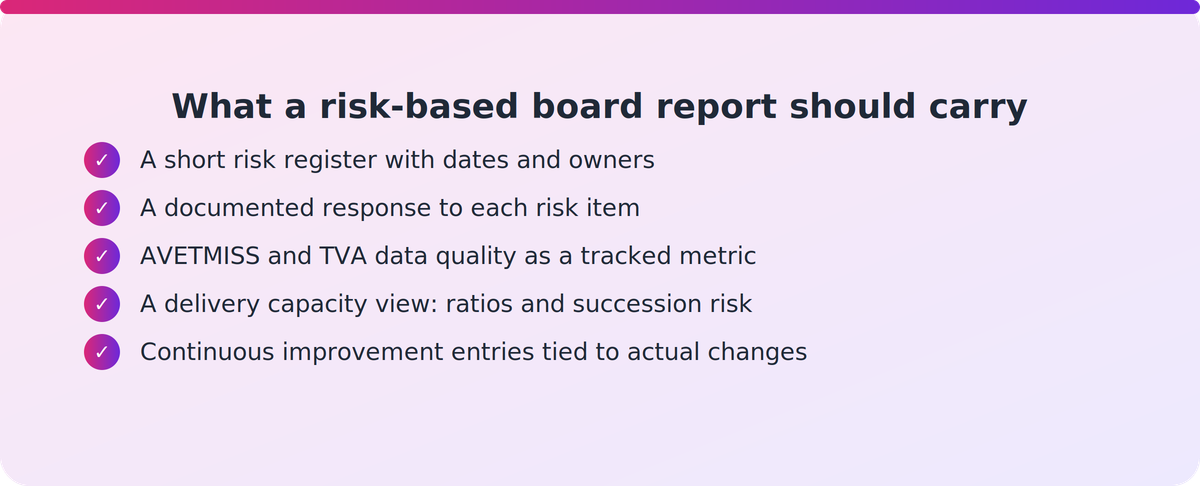
- Replace activity counts with a short risk register: what was identified, when, and by whom.
- Show the response to each item, with a date and an owner — not just a policy reference.
- Report AVETMISS and TVA data quality as a metric in its own right, not an assumed given.
- Include a delivery capacity view: trainer-to-student ratios, shortage exposure, succession risk.
- Link continuous improvement entries to an actual change made, not a description of intent.
None of this requires new systems to be useful this quarter. It requires deciding, deliberately, what evidence a report needs to carry — and then building the monthly cycle to produce it as a by-product of normal operations, not a special exercise before every board meeting.
Key takeaways
- The Standards for RTOs 2025 commenced 1 July 2025 and shift ASQA's audit focus from completed checklists to evidence of risk-based self-assurance and continuous improvement.
- Your board report is increasingly the primary artefact an auditor reads to judge that evidence — treat it as compliance documentation, not a governance courtesy.
- AVETMISS and Total VET Activity data quality sit underneath every board figure; unresolved reconciliation issues between SMS and LMS platforms are a named, recurring sector risk.
- Government-funded enrolments fell 6.6% in the first nine months of 2025, while a national VET teacher shortage (roughly 3,800 additional trainers needed over five years) puts real pressure on delivery capacity — both belong in the board pack as risk items, not footnotes.
- The practical shift for this quarter: redesign the report to show risk identified, response taken, and evidence attached — not just what activity happened.
Our take
The honest read here is that most RTO board packs were built for a regulator that no longer exists in the same form. They were designed to prove activity happened, because that's what used to get checked. The 2025 Standards ask a different question, and a lot of reporting infrastructure — including the manual reconciliation between disconnected systems that eats a week every quarter — simply wasn't built to answer it.
We think the RTOs that come through this transition well won't be the ones who add more pages to the pack. They'll be the ones who make risk evidence a natural output of how they already run enrolments, delivery and data — so the board report is assembled, not manufactured. Some of that is process discipline. Increasingly, some of it is tooling that keeps assessment, training material and compliance evidence connected rather than living in separate systems reconciled by hand — which is part of what we build at Supahuman VETos, for RTOs who'd rather not rediscover this problem every audit cycle.
FAQ
Do the 2025 Standards for RTOs apply retrospectively to audits conducted before 1 July 2025? No. ASQA audits conducted from 1 July 2025 assess evidence against the 2025 Standards, which replaced the 2015 Standards after nearly a decade in effect. Earlier audit activity was assessed against the previous framework (ASQA, "2025 Standards for RTOs commence").
What's the practical difference between the old Standards and the new ones for board reporting? The 2015 Standards leaned toward input-based, administrative compliance — did the RTO complete a defined set of tasks. The 2025 Standards separate Outcome Standards from Compliance requirements and expect RTOs to demonstrate risk-based self-assurance: how risks were identified and addressed, with evidence, rather than a static checklist (ASQA; DEWR).
Where does AVETMISS reporting fit into board-level risk reporting? AVETMISS-compliant data under the VET Data Policy, along with Total VET Activity reporting to NCVER, underpins most of the figures a board relies on. Data quality issues — wrong activity dates, missing ABNs, incorrect attendance hours — are a recurring, well-documented risk in the sector and are worth reporting as a metric in their own right, not assumed to be clean.
How should a COO report on the VET trainer shortage as a board-level risk? Treat it as a delivery capacity risk alongside enrolment and compliance metrics, not a separate HR item. With roughly 3,800 additional trainers needed nationally over five years and nearly half the current workforce aged over 50, boards need visibility into trainer-to-student ratios and succession exposure to judge whether delivery can scale without proportional headcount growth.