RTO Board Reporting Metrics for the 2025 Standards Era
31 August 2026 · 7 min read

The board pack that satisfied your RTO board eighteen months ago probably wouldn't pass now. The Standards for RTOs 2025 replaced a decade of process-based compliance measures with outcome evidence, which means the question your board should be asking each quarter has changed — from 'are we compliant' to 'can we prove it, and would it hold up.'
Why this lands on your desk, not your compliance manager's
You own the relationship with the board and with ASQA — nobody else in the building answers for both at once. When ASQA audits conducted from 2026 test evidence against the 2025 Standards rather than legacy policy, a board pack built on last year's template doesn't just look dated. It can misrepresent your actual regulatory position to the people meant to be governing it.
ASQA has been explicit that providers who can show strong, evidence-based self-assurance may see reduced regulatory burden, while providers with weaker practice attract more scrutiny. That's not abstract policy language. It's a direct line between what you put in front of your board each quarter and how hard your next audit is.
The Standards rewired the question your board should ask
The Standards for RTOs 2025 commenced 1 July 2025, replacing the 2015 Standards. They're structured around three parts — Outcome Standards, Compliance requirements, and Fit and Proper Person Requirements — and the sector has described this as the most significant regulatory shift in close to a decade. The practical effect on your board pack is that outcomes now sit alongside compliance as a distinct reporting obligation, not folded into it.
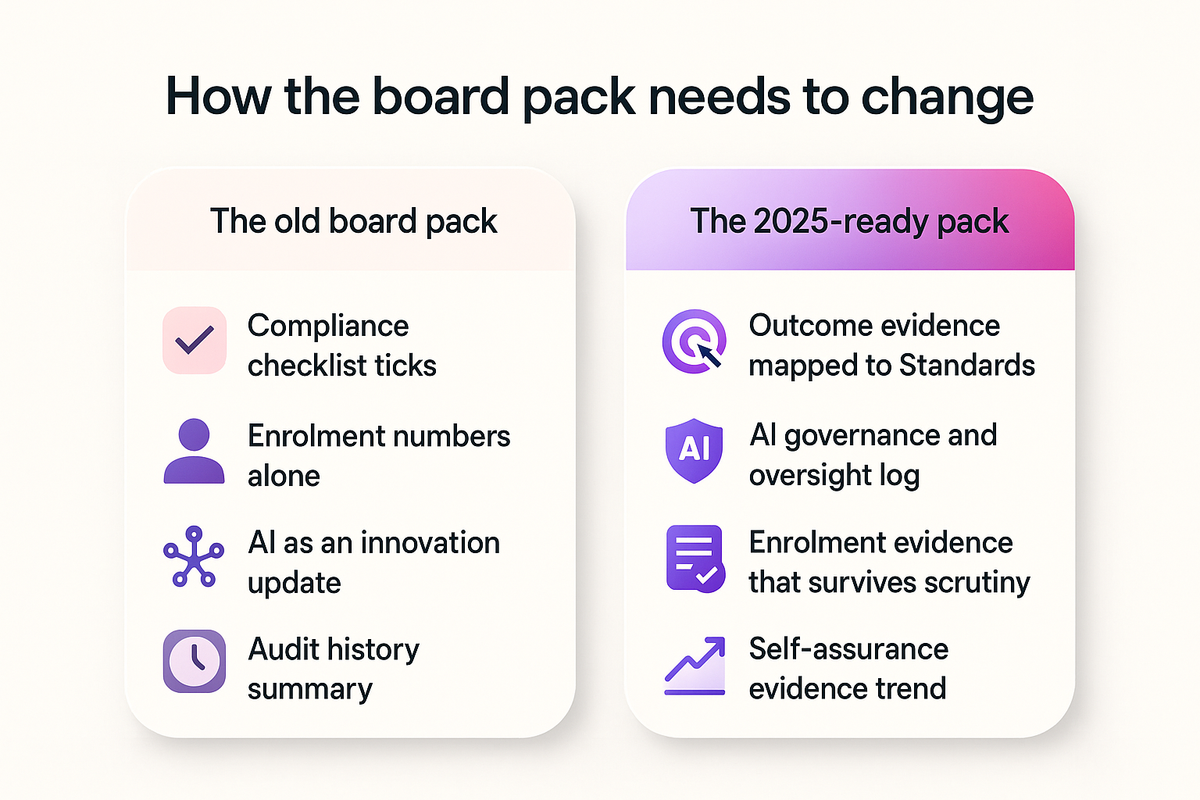
That matters because ASQA audits from 2026 assess evidence against the 2025 Standards, not the framework RTOs have reported against for years. If your board template still frames every metric as a compliance tick — enrolments up, complaints down, last audit clean — it's answering last year's question well and this year's question not at all. The new question is whether you can evidence outcomes: completion quality, assessment validation trends, learner progression, not just activity counts.
AI oversight has moved from the innovation slide to the risk register
If AI has come up in your board meetings, it's probably been framed as an efficiency story — content generation, chatbots, progression analytics. ASQA has moved past treating that as innovation and placed it squarely inside governance. Its five Principles for the Responsible Use of AI in VET cover governance, human oversight and accountability, secure information handling, and support for student equity and accessibility. They don't create new rules; they interpret how existing obligations under Standard 1.4 and Standards 3.2 and 3.3 apply once AI is in the room.
ASQA made this the explicit theme of its 2026 sector workshops, asking providers directly whether their AI use complies with the 2025 Standards — covering generative content tools, learner-facing chatbots, and progression analytics alike. If your organisation is using any of these and your board has never seen a governance log for it, that's a gap worth closing before an auditor closes it for you.
Growth evidence now needs to survive scrutiny, not just impress
Enrolment growth used to be a straightforwardly good quarterly number. It still matters, but it now needs to hold up under more forensic review than it used to. CRICOS settings and genuine student requirements continue to evolve, and providers who can demonstrate real outcomes and genuine educational purpose are better positioned for favourable enrolment allocations. Growth without evidence behind it is a fragile number to bring to a board.
The same pressure shows up in the market for RTOs themselves. The sector has entered a more disciplined consolidation phase, and buyer behaviour is increasingly evidence-led rather than headline-led. ASQA treats a change of ownership as a high-risk event that triggers intense regulatory scrutiny — so if growth, acquisition or exit is anywhere on your board's horizon, the quality of your quarterly evidence trail is already part of your valuation story, not a separate governance exercise. Diversification into resilient, demand-driven sectors — healthcare and aged care are the clearest example as Australia's population ages — is worth its own line in that story too.
What a board-ready quarterly pack actually contains
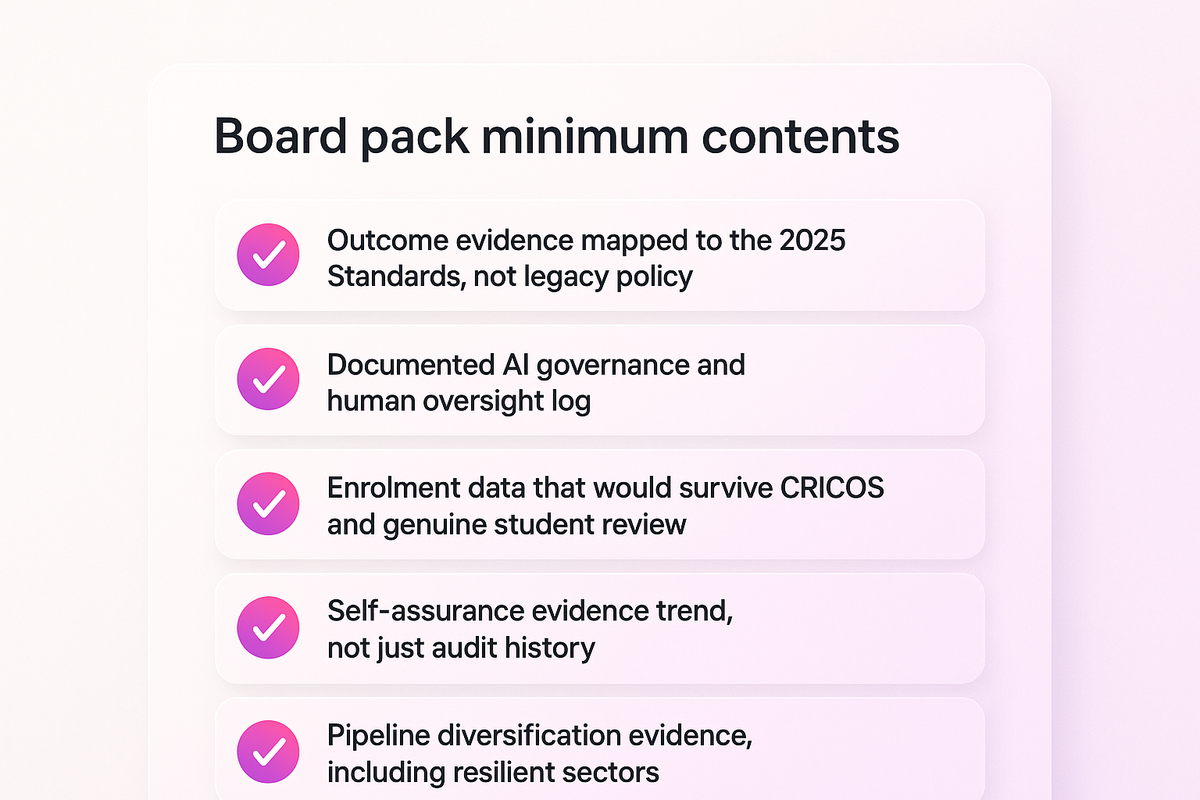
None of this means discarding your existing reporting. It means restructuring what earns a place in the pack.
Key takeaways
- The Standards for RTOs 2025 commenced 1 July 2025 and restructured obligations around Outcome Standards, Compliance requirements, and Fit and Proper Person Requirements — audits from 2026 assess against this framework, not legacy policy.
- Strong, evidence-based self-assurance can reduce regulatory burden; weak practice invites closer scrutiny — making quarterly board evidence a direct input into your audit exposure.
- ASQA's five Principles for the Responsible Use of AI in VET and its 2026 sector workshops mean any AI use — content generation, chatbots, progression analytics — needs a documented governance and human-oversight trail your board has actually seen.
- Enrolment growth needs to be reported with the evidence behind it, particularly where CRICOS and genuine student requirements are in play, and especially if ownership change or investment is on the horizon.
- Pipeline diversification into resilient sectors like healthcare and aged care is a governance-relevant data point, not just a marketing one.
Our take
The easy move here is to bolt an AI slide onto your existing board pack and call it done. That misses the point of what's changed. The 2025 Standards didn't just add a topic to report on — they changed the standard of proof for everything you already report. A board pack that lists metrics without the evidence trail behind them will look increasingly thin against what ASQA now expects providers to be able to show.
The providers who come out ahead in this cycle won't be the ones with the fanciest dashboard. They'll be the ones who treated this as a genuine structural rewrite — where outcome evidence, AI governance, and growth data are held to the same standard of proof, all year round, not assembled defensively the week before an audit. That's a harder habit to build than a new report template, but it's the one that actually holds up when someone outside the building starts asking questions — a board member, a buyer, or an ASQA auditor.
FAQ
What actually changed in the Standards for RTOs 2025 that affects board reporting? The 2025 Standards, which commenced 1 July 2025, restructured RTO obligations around Outcome Standards, Compliance requirements, and Fit and Proper Person Requirements. Audits conducted from 2026 assess evidence against this new framework rather than the 2015 Standards, so board reporting needs to demonstrate outcomes, not just process compliance.
Does my board need to see an AI governance report every quarter? If your organisation uses AI in any form — content generation, chatbots, progression analytics, or learner-facing tools — yes. ASQA's five Principles for the Responsible Use of AI in VET interpret existing obligations under Standard 1.4 and Standards 3.2 and 3.3, and made AI compliance the explicit theme of its 2026 sector workshops. A board that hasn't seen a governance and oversight log for AI use is missing a live regulatory risk item.
What's the risk of not updating our board reporting template? Beyond the governance gap itself, ASQA has indicated that providers demonstrating strong, evidence-based self-assurance may face reduced regulatory burden, while those with weaker practices attract more scrutiny. A board pack built on the old checklist model may leave both your board and your organisation unaware of gaps an auditor would flag under the 2025 Standards.
How does this affect RTOs considering a sale, merger, or investment round? ASQA treats a change of ownership as a high-risk regulatory event, and buyer behaviour in the current consolidation phase is increasingly forensic and evidence-led. Enrolment growth and outcome data that can't be substantiated in detail will weaken a provider's position at exactly the point where scrutiny is highest.