Beyond the Discount: Competing on RTO Outcomes, Not Price
20 September 2026 · 8 min read
Discounting fees has been the default competitive lever for Australian RTOs for a decade. That lever is now working against you. The Standards for RTOs 2025 have shifted ASQA's bar from paperwork to proof of outcomes, and the market you compete in is consolidating around providers who can demonstrate it.
That's not a marketing observation. It's a structural one, and it lands squarely on the CEO's desk.
Why this is now your problem, not just compliance's
You answer to the board for growth, margin and regulatory standing. Until recently, those three things could be managed somewhat separately — compliance kept the licence, sales kept the pipeline, finance kept the margin. The Standards for RTOs 2025, in effect since 1 July 2025, collapse that separation. ASQA now expects evidence that training actually produces competent, work-ready graduates, not just a policy folder that says it should.
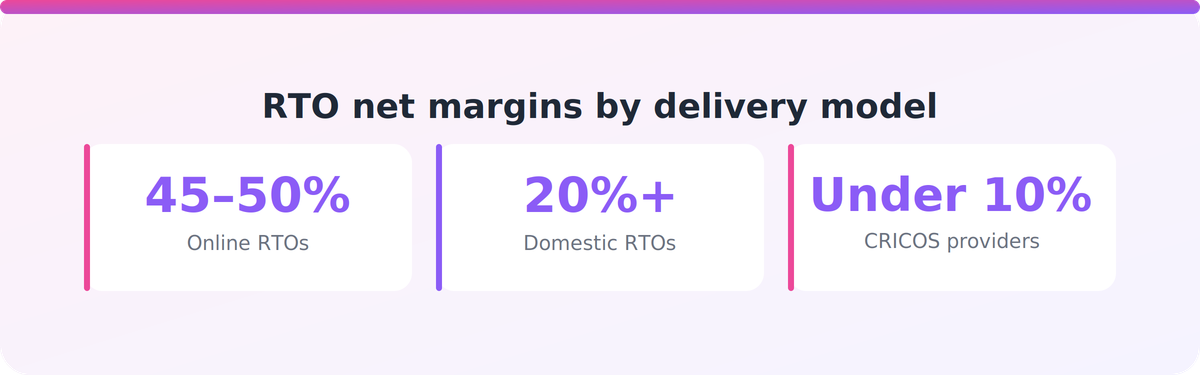
At the same time, the numbers you report at board level are under genuine pressure. Industry market reporting from Infinity Business Brokers puts online RTO net margins at 45–50%, domestic RTO margins around 20%+, and CRICOS providers often below 10% once agent fees and slower enrolment growth are factored in. Compliance cost is rising into that same margin, not sitting outside it.
And the market itself is sorting winners from losers. As weaker operators exit under tighter regulatory settings, buyers of RTOs are behaving more forensically — valuations increasingly reflect governance discipline, not reputation or a lower price point. If you're thinking about growth, exit, or investment, this changes what "a good business" looks like to the people writing cheques.
What "quality" now means at audit
Sector commentary describes the Standards for RTOs 2025 as the most significant compliance shift in a decade — a move away from a tick-box approach toward direct evidence of practice. That's a meaningful change in what an auditor asks for, and what your trainers and assessors need to be able to produce on demand.
ASQA's own enforcement pattern backs this up. In 2025–26, audit volume was lower but scrutiny was deeper and more targeted, with cancellations and non-renewals up compared to prior periods, and conditions or suspensions used where rectification looked achievable. Being previously compliant doesn't buy you as much cover as it used to.
Qualification integrity has become a named national priority in its own right. ASQA reported more than 43,000 qualifications or statements of attainment cancelled as at 31 March 2026, backed by an additional $4.8 million in 2026–27 funding on top of $4.7 million the year before, specifically to address fraudulent VET qualification issuance. If your quality assurance can't clearly show how a learner earned a unit of competency, that's now a live enforcement risk, not a theoretical one.
The margin math behind the price war
Discounting has always looked like the fastest way to win an enrolment. It's a slower way to lose the business.
When your margin is already compressed by compliance overhead — trainer time, assessment validation, audit preparation — cutting fee price further has nowhere to come from except delivery quality or staff capacity. Both of those are exactly what ASQA is now asking you to evidence, and exactly what a prospective buyer or investor will stress-test if you're ever selling the business.
Competing on outcomes instead doesn't mean charging more for the same delivery. It means being able to show, with evidence, that your graduates are more work-ready than the RTO down the road charging less. That's a defensible position with employers, with learners choosing between providers, and with the regulator.
The four risks ASQA has already told you about
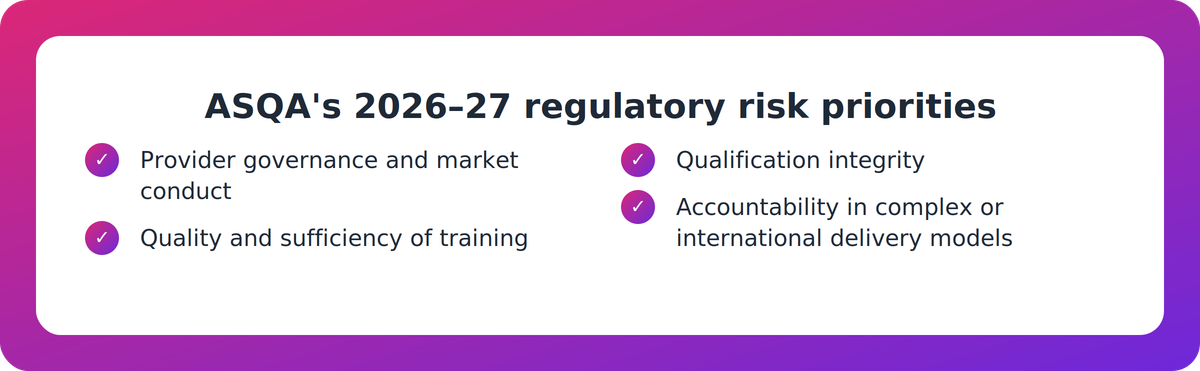
ASQA's 2026 Environmental Scan names four regulatory risk areas for 2026–27, and each one is effectively a prioritisation list for where you should be investing governance attention this year:
- Provider governance and market conduct
- Quality and sufficiency of training
- Qualification integrity
- Accountability in complex or international delivery models
None of these are new concerns dressed up. They're the areas where ASQA has told the sector, explicitly, that it expects to look hardest.
AI governance is now part of your regulatory strategy, not a side project
ASQA has published five Principles for the Responsible Use of AI in VET, framed as sitting within existing obligations under the Standards for RTOs 2025 rather than as brand-new rules. More significantly for a CEO's planning, ASQA has flagged that 2026 sector workshops will examine whether providers' AI use is compliant — meaning AI governance is an active audit consideration now, not something to figure out later.
Skills ministers have also signalled a national push toward baseline AI capability across tertiary education. Read together, the direction is clear: CEOs who treat AI as a genuine capability question — how it's governed, where it touches assessment and learner outcomes, how it's documented — will be aligned with where sector policy and regulatory scrutiny are both heading. Those treating it purely as a back-office efficiency tool are missing half the brief.
What competing on outcomes actually looks like this quarter
You don't need a rebrand to start shifting your competitive position. Three things are within reach without a major project:
- Audit your evidence trail, not just your policies. Pick one qualification and trace, end to end, how you'd prove a graduate is competent — not just that a policy exists saying they should be.
- Map your margin against your delivery model. If you're a CRICOS provider sitting near or below the 10% margin reported across the sector, know exactly which cost lines are compliance-driven versus discount-driven, and treat them differently in board reporting.
- Put AI governance on the same agenda as compliance, not a separate one. If AI already touches your assessment, marking, or learner support workflows, document how — before a 2026 workshop or audit asks you to.
Key takeaways
- The Standards for RTOs 2025 require evidence that training produces outcomes, not just documented policy — this is now what ASQA checks at audit.
- ASQA's 2025–26 enforcement pattern shows fewer but sharper audits, with cancellations and non-renewals up — regulatory standing is a sharper risk than it was two years ago.
- Margins vary widely by delivery model: 45–50% for online RTOs, 20%+ domestic, often under 10% for CRICOS providers, per Infinity Business Brokers market reporting.
- Buyers of RTOs are increasingly forensic, and valuations now reward governance discipline over reputation or price positioning.
- ASQA's five AI principles and its planned 2026 sector workshops mean AI governance sits inside your compliance strategy, not beside it.
Our take
The CEOs who do well out of this shift won't be the ones who write the best mission statement about "quality over price." They'll be the ones who can hand an auditor, a buyer, or a board member hard evidence that their graduates are competent — on demand, not after a scramble.
That evidence has always been expensive to produce well. Realistic practice, coached feedback, and assessment that actually mirrors the job — the things that build genuinely work-ready graduates — have traditionally required instructional designers, facilitators, and time that smaller and mid-sized RTOs can't easily fund at scale. That cost gap is precisely why so much of the sector has defaulted to price competition instead: it's the lever available to everyone, regardless of margin.
We think that gap is closing, and CEOs should watch it closely over the next two years — not because the regulator is forcing better training, but because it's about to become cheaper to build genuinely defensible outcomes than it has ever been. That changes the calculus on where discounting still makes sense, and where it just erodes the case you'll eventually need to make at audit, at the boardroom table, or at sale.
FAQ
What exactly did the Standards for RTOs 2025 change for a CEO? They shift ASQA's expectation from holding documented policies to demonstrating, with evidence, that training delivers competent graduates. Sector commentary describes it as the most significant compliance shift in a decade, moving the sector away from a tick-box approach.
Why is ASQA's enforcement described as "fewer but sharper"? In 2025–26, ASQA ran fewer audits overall but applied deeper, more targeted scrutiny, with cancellations and non-renewals up and conditions or suspensions used where rectification looked achievable — a sign that prior compliance doesn't guarantee future standing.
Does competing on outcomes actually protect margin, or does it just add cost? Industry market reporting shows margins already vary sharply by delivery model — 45–50% online, 20%+ domestic, often under 10% for CRICOS — driven by compliance cost and competition. Discounting further compresses margin without changing your audit or valuation position; evidenced outcomes are what buyers and regulators are actually pricing in.
What does ASQA expect regarding AI use in training delivery? ASQA has published five Principles for the Responsible Use of AI in VET, framed within existing Standards for RTOs 2025 obligations, and has flagged 2026 sector workshops that will examine whether providers' AI use is compliant — making AI governance an active audit consideration now.
The fastest place to start is small: pick one qualification, trace its evidence trail from enrolment to outcome, and ask whether it would satisfy an auditor today. Whatever gaps that exposes will tell you more about your real competitive position than any pricing decision will.