RTO Completion Rates: A Symptom, Not a Strategy
10 August 2026 · 7 min read

A completion rate doesn't tell you why students finish or leave. It tells you whether your unit design, assessment rigour, training-to-assessment coherence and trainer capacity are working together — or quietly failing in ways that only show up months later as a number on a board pack.
Why this lands on your desk
Completion has stopped being an internal KPI you manage quietly. It's now a national policy metric with money attached: the $2.3 billion National Skills Agreement names lifting completion rates as a priority, backing it with $37 million over four years specifically to address the problem. That means your numbers are being tracked, reported and benchmarked at funder and board level, not just inside your own dashboards.
At the same time, the Standards for RTOs 2025, which took effect on 1 July 2025, shifted what auditors actually want to see. It's no longer enough to have policies about pacing and progression — you need evidence that training is structured to give students sufficient time for instruction, practice, feedback and assessment, and that your quality systems function in practice, not just on paper. Add a sector-wide trainer shortage into the mix, and the pressure to lift completions collides directly with a shrinking capacity to do the upstream work that actually produces them.
What the completion number is actually telling you
NCVER's 2024 release put the four-year completion rate for qualifications commencing in 2020 at 49.0%, up from 47.5% for 2019 commencers. That headline movement is worth noting — but the variation underneath it is more useful to you as a manager. Diploma-level or higher qualifications sit at 55.5%, while Certificate I sits at 40.4%.
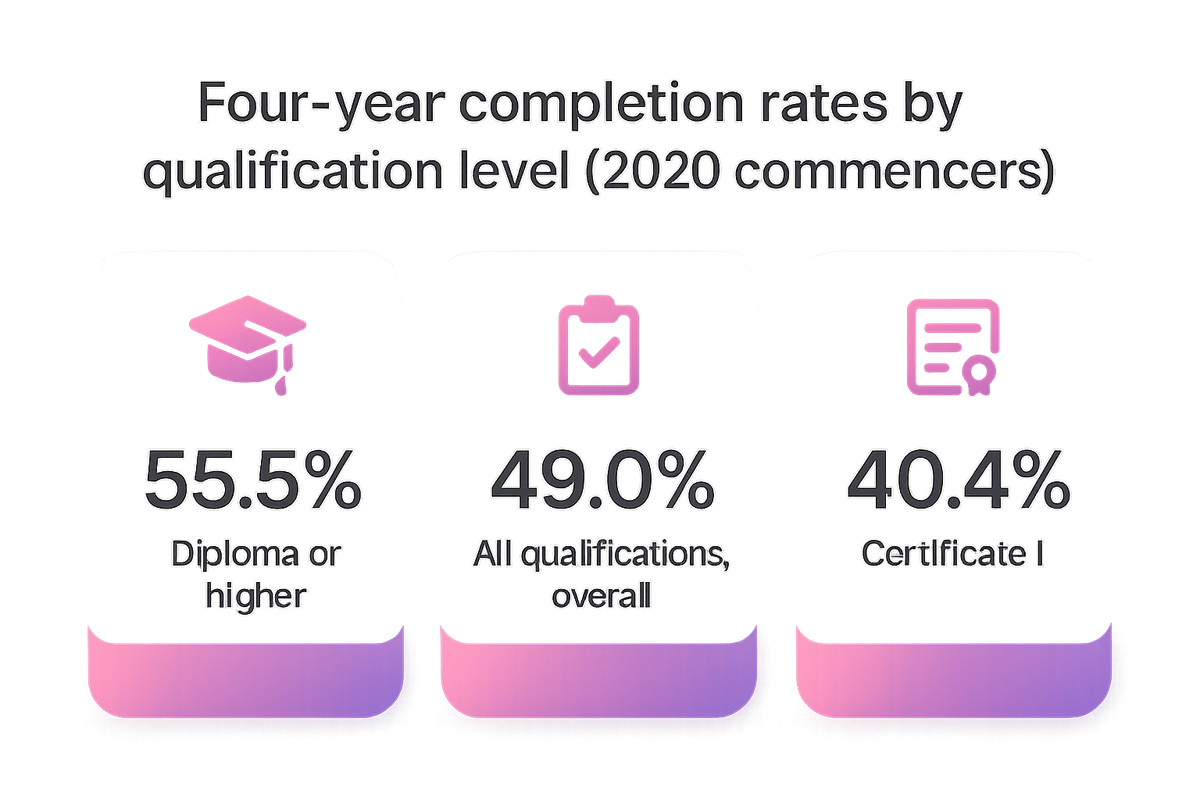
That 15-point spread isn't a motivation gap. It tracks qualification design and delivery model — how assessment is paced, how coherent the path from training to assessment is, and how much support structure sits around lower-AQF-level cohorts who often need it most. If your Certificate I completion rate looks weak against your Diploma cohort, the first question isn't "how do we retain these students harder" — it's whether the unit sequencing, assessment load and trainer contact time were ever designed to let them succeed in the first place.
The 2025 Standards changed what auditors want to see
From 2026, ASQA audits assess evidence against the 2025 Standards, not legacy policy. That's a meaningful shift in what you need on file. Under the previous approach, plenty of RTOs could point to a retention policy, an enrolment procedure and a support register and call it compliant. Under the 2025 Standards, the audit question becomes: can you show, with evidence, that your training is paced to support progression and that your validation processes actually catch assessment problems before they become systemic?
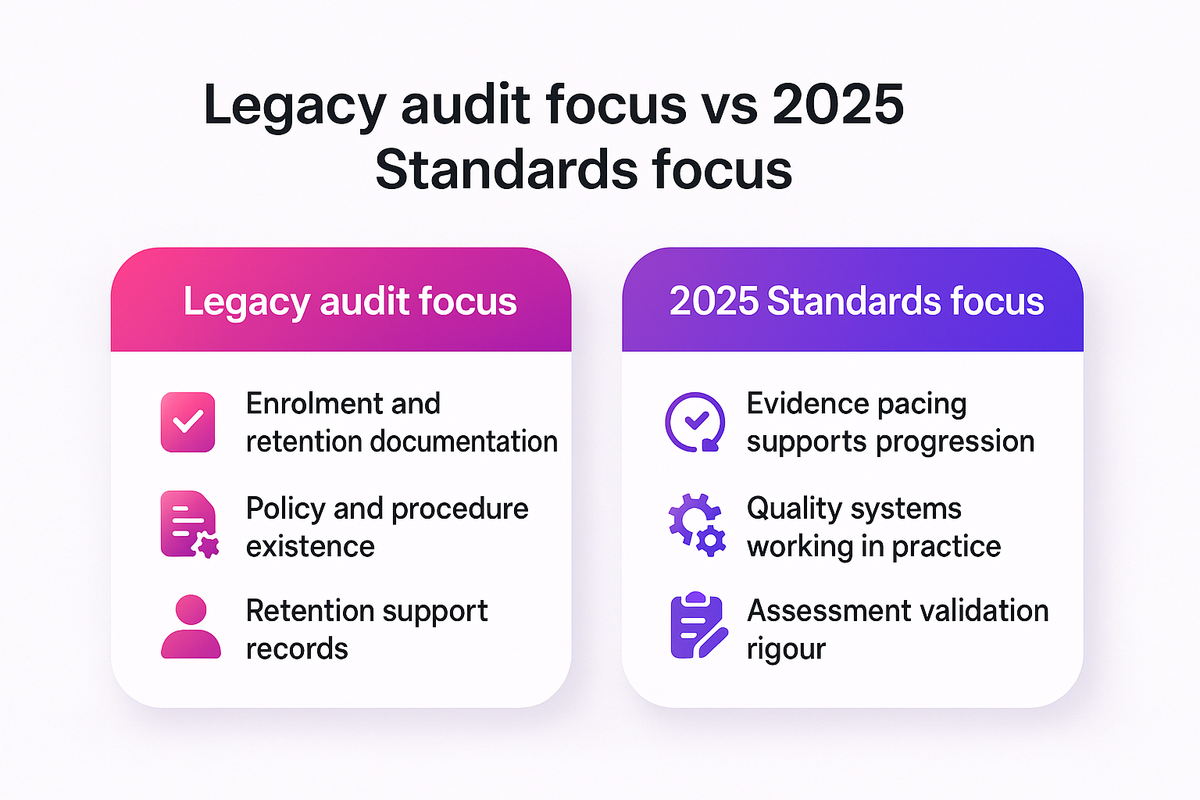
That's a different kind of proof. It means your quality systems have to be observable in action — validation outcomes that feed back into assessment redesign, pacing decisions that reflect the AQF level and cohort you're teaching, and assessor guides that hold up when someone other than the original writer applies them. If your documentation hasn't been rebuilt around outcomes evidence rather than procedural existence, your completion numbers won't shield you from a non-compliance finding.
The trainer shortage is quietly rewriting your risk profile
Infinity Business Brokers' 2025 sector report found 67% of RTOs are experiencing trainer shortages, concentrated in areas like aged care, WHS and education support, with 43% expecting the shortage to deepen. That's a resourcing constraint hitting exactly the capacity you need most: people to deliver consistent training and to run rigorous, well-supervised assessment validation.
The removal of the mandatory current-industry-experience requirement for trainers was meant to ease that shortage. It does — but it also shifts more of the burden for assessment rigour onto supervision and validation processes that you own. Fewer trainers with guaranteed current industry currency means your validation cycle has to work harder to catch drift in assessment judgement, particularly where casual or newer trainers are covering gaps. That's not a reason to panic about every hire — but it is a reason to treat validation scheduling as a risk-management function, not an annual compliance chore.
Completion is necessary, not sufficient
The Productivity Commission's Report on Government Services 2026 notes completions up around 16% since 2020, with student satisfaction near 90% — genuinely good news. But it also flags employer satisfaction declining, particularly for apprenticeships and traineeships. That's the gap that should worry you more than the completion number itself: students can finish and feel good about it while employers start doubting whether the qualification means what it used to.
NCVER's VET Student Outcomes data shows 77.1% of completers were employed after training and 80.4% reported a job-related benefit — which is the outcome you're ultimately judged on. But that link between completion and workforce value only holds if the training and assessment behind the certificate is genuinely rigorous. A completion rate you've lifted through pacing tweaks or support programs, without touching assessment quality, risks becoming a number that looks good internally and means less externally.
Key takeaways
- NCVER's four-year completion rate for 2020 commencers was 49.0%, but ranges from 40.4% (Certificate I) to 55.5% (Diploma+) — the spread reflects design and delivery, not just student effort.
- The National Skills Agreement makes completion a funding-linked national metric, tracked above the RTO level, not just an internal target.
- The Standards for RTOs 2025 require evidence that pacing, progression support and quality systems work in practice — documentation of policy alone won't satisfy a 2026 audit.
- Two-thirds of RTOs report trainer shortages, and the removal of mandatory current-industry-experience shifts more assessment-rigour responsibility onto your supervision and validation processes.
- Rising completions with falling employer satisfaction (Productivity Commission, 2026) signals that completion gains alone don't protect the credibility of the outcome you're actually accountable for.
Our take
Treat completion rates the way you'd treat a fever, not a diagnosis. Chasing the number directly — more nudges, more check-ins, softer assessment — might move it in the short term, but it does nothing to fix whichever upstream system is actually broken, and it leaves you exposed the moment an auditor or an employer looks past the headline figure. The RTO Managers who come through the 2025 Standards cleanly will be the ones who used this transition to trace their completion gaps back to specific units, specific trainers, specific assessment tools — and fixed those, knowing the completion number would follow as a side effect, not a target.
FAQ
Does ASQA audit completion rates directly? ASQA doesn't audit a completion percentage in isolation. Under the Standards for RTOs 2025, it audits whether your training is structured and paced to support student progression and whether your quality systems function in practice — completion data can be one signal an auditor uses to test that evidence, but it isn't the compliance standard itself.
What's the practical difference between the old and new audit expectations? Previously, having a retention policy and support register was often enough to demonstrate compliance. From 2026, audits assess the 2025 Standards, which require evidence that pacing and validation processes actually work — meaning documented outcomes, not just documented procedures.
How does the trainer shortage change our assessment validation risk? With the mandatory current-industry-experience requirement removed and 67% of RTOs reporting trainer shortages (per Infinity Business Brokers' 2025 report), more of the responsibility for catching inconsistent assessment judgement now sits with your supervision and validation cycle rather than trainer credentials alone.
Is a low completion rate always a red flag? Not on its own. NCVER data shows completion rates vary significantly by AQF level — Certificate I sits well below Diploma-level completions nationally — so the more useful diagnostic is whether your rate is in line with comparable qualifications and cohorts, and whether the gap traces to a specific design or delivery issue you can name.