RTO Compliance Evidence Management: The Trail Problem
23 August 2026 · 7 min read

ASQA no longer checks whether your policies exist — it tests whether your systems demonstrably work, in practice, right now. If the evidence proving that lives across a shared drive, three inboxes and a spreadsheet nobody's touched since March, you already have a compliance problem, whether or not an auditor ever asks.
Why this lands on your desk this year
Your CEO signs the Annual Declaration on Compliance. You're the one who assembles the evidence base it rests on. The 2026 ADC window — open 3 March to 31 March 2026 — is the first time providers must declare a full year of compliance against the 2025 Standards, and ASQA has been explicit that self-monitoring evidence should underpin the declaration, with regulatory activity possible where compliance isn't demonstrated.
Layered on top of that: tightened Fit and Proper Person Requirements now demand you can show who's accountable for governance, when declarations were made, and how conflicts of interest were assessed. Both of these are, fundamentally, document-ownership problems. Both land on your desk.
The Standards didn't just change — they split apart
For years, RTOs worked from one consolidated Standards document. Since 1 July 2025, that's gone. Obligations now sit across the Outcome Standards, the Compliance Standards (which include the Fit and Proper Person Requirements), and a separate Credential Policy on the national training register — three distinct instruments instead of one file to keep current.
That split matters more than it sounds. It means your evidence trail now has to cross-reference between instruments rather than sit under a single heading. A governance decision might need to satisfy the Compliance Standards and the Credential Policy simultaneously — and if your evidence for each lives in a different system, you're the one reconciling them under time pressure.
From "show me the policy" to "show me it happened"
ASQA's practice guides under the new Standards put real weight on evidence of practice — actual assessment tools, completed student work, trainer records, validation outcomes, governance documentation. A written policy that describes what should happen is no longer sufficient on its own.
Sector commentary on the Standards describes the Training and Assessment Strategy as needing to be a living document in 2026: auditors expect a visible, dated link between the TAS, your industry consultation logs, and what students actually experienced in the room. A TAS reviewed once a year and filed away doesn't hold up to that test. Scattered evidence isn't just inconvenient here — it's the exact thing that fails an audit built around demonstrated practice.
The Annual Declaration is only as good as your trail
The Outcome Standards require RTOs to systematically monitor and evaluate their own performance to support continuous improvement — and that self-assessment activity is precisely what's meant to feed the Annual Declaration on Compliance. It's the early-warning function compliance managers are so often told they're missing, built into the regulatory model itself.
If self-monitoring only happens as a pre-March scramble, you're not declaring a year of compliance — you're reconstructing one. That's a materially different (and riskier) exercise, and it's happening for the first time ever under the 2025 Standards this year.
Fit and Proper Person Requirements: ownership meets traceability
In May 2026, ASQA issued a Statement of Regulatory Expectations reinforcing FPPR obligations — notifying material changes promptly and engaging transparently with the regulator. ASQA's own Fit and Proper Person Requirements Practice Guide names recurring failure points that are, in essence, evidence-trail failures.
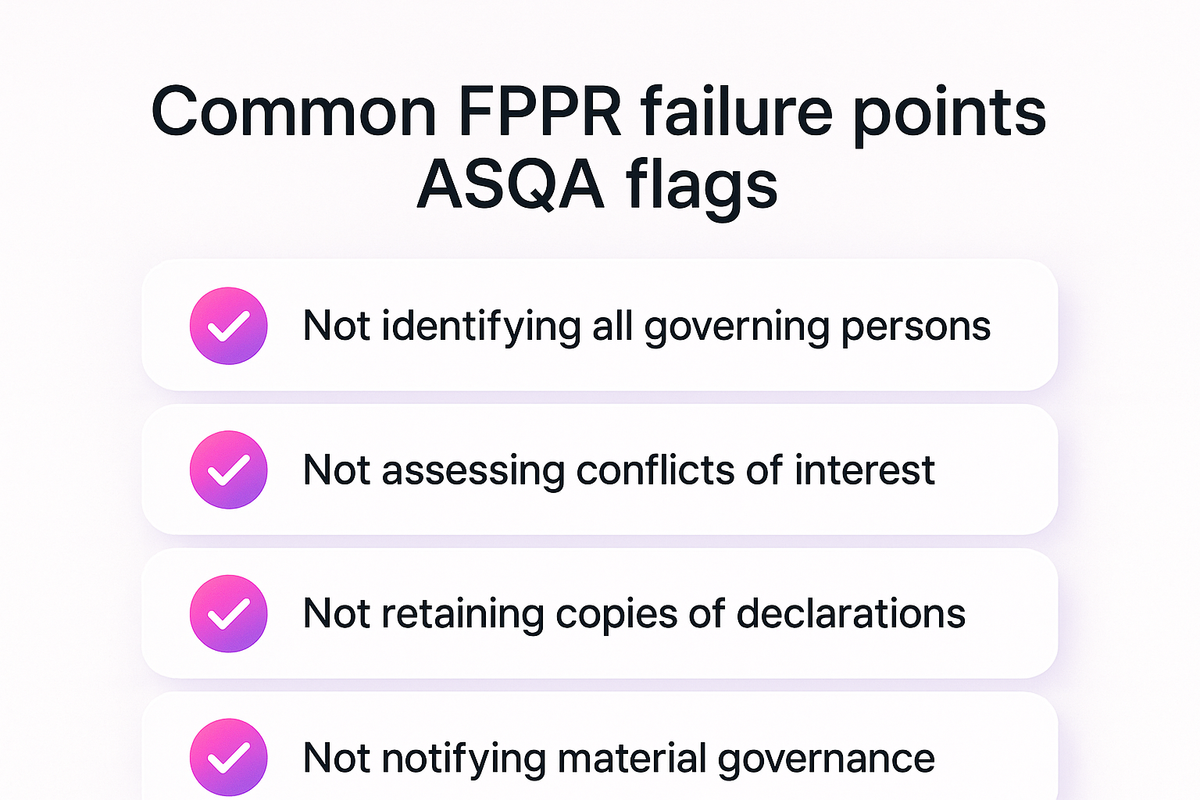
Common FPPR failure points ASQA flags
- Not identifying all governing persons across the organisation
- Not assessing or documenting conflicts of interest
- Not retaining copies of signed declarations
- Not notifying material changes to governance as they occur
Every one of these is solvable with a clear register and a named owner. None of them is solvable with a policy statement that says the process exists.
The workforce squeeze is stacking evidence risk higher
This isn't happening in isolation. Jobs and Skills Australia has reported a national VET teacher shortage for two years running, with nearly half the workforce aged over 50 and roughly 3,800 additional VET teachers needed over the next five years. ASQA's practice guides separately flag failing to authenticate trainer credentials, or failing to identify gaps in industry currency, as recurring audit risks.
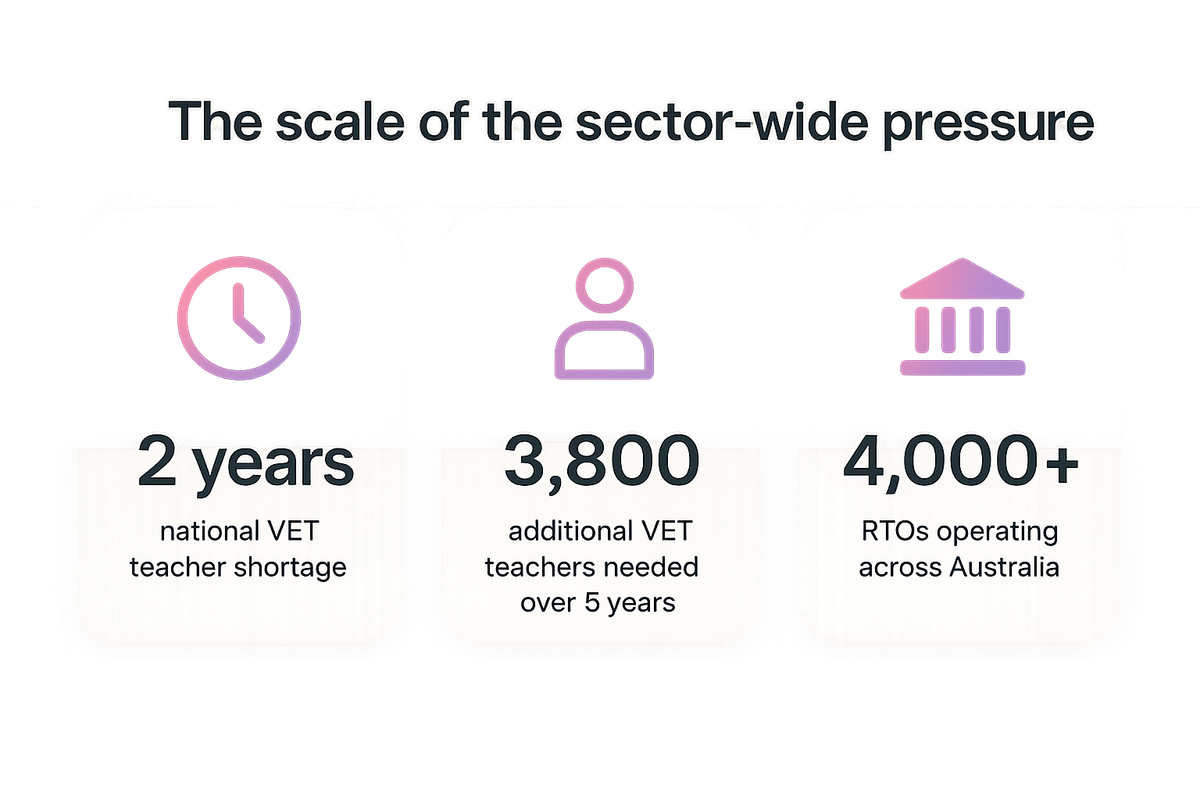
Put those together and the evidence burden compounds: fewer experienced trainers, more churn in credentials and currency records, and more evidence to keep traceable per trainer, not less. With more than 4,000 RTOs operating across Australia, this is a shared, sector-wide pressure — not a sign that any one provider is falling behind.
What everyday operating discipline actually looks like
None of this is solved by working harder in March. It's solved by treating evidence traceability as a weekly habit rather than an annual event.
- Name an owner per evidence category — TAS, FPPR declarations, validation outcomes, trainer currency — so "who has that?" never becomes a bottleneck.
- Log where each evidence type actually lives, and review that map quarterly, not once a year.
- Update the TAS after every consultation, not before every audit — dated entries beat a single annual revision.
- Track trainer currency and credential expiry as a running list, not a discovery made during a document review.
- Practice retrieval, not just retention. Being able to produce the right evidence quickly matters as much as having it somewhere.
Key takeaways
- The 2025 Standards for RTOs, in force since 1 July 2025, split obligations across the Outcome Standards, Compliance Standards (including the Fit and Proper Person Requirements) and a separate Credential Policy — evidence now has to be cross-referenced, not filed under one heading.
- ASQA's audit model under the new Standards tests evidence of practice — completed student work, trainer records, validation outcomes, and a visible TAS-to-consultation-log link — not just the existence of written policy.
- The 2026 Annual Declaration on Compliance (3–31 March 2026) is the first full-year declaration against the 2025 Standards, and ASQA states self-monitoring evidence should underpin it.
- Recurring FPPR failure points named by ASQA — unidentified governing persons, unassessed conflicts of interest, undocumented declarations — are traceability failures, not policy gaps.
- A national VET teacher shortage is adding volume to the credential and currency evidence RTOs already have to keep traceable.
Our take
The regulator has effectively told compliance managers what good looks like: continuous self-monitoring that produces its own evidence trail, rather than a document review performed once a year under deadline pressure. That's a genuine shift in what the job requires, not just more paperwork layered onto the same job.
The providers who find 2026 straightforward won't be the ones with the tidiest policy folder. They'll be the ones who can already answer "show me" on any given Tuesday — because the evidence was captured as the work happened, not reconstructed afterward. That's a harder habit to build than a compliant document, and a much more defensible one to have.
FAQ
What changed with the 2025 Standards for RTOs? From 1 July 2025, the single Standards document RTOs previously worked from was replaced by separate legislative instruments: the Outcome Standards, the Compliance Standards (which include the Fit and Proper Person Requirements), and a distinct Credential Policy governing the national training register.
What is the 2026 Annual Declaration on Compliance and when is it due? The 2026 ADC window runs from 3 March to 31 March 2026. It's the first time RTOs must declare a full year of compliance against the 2025 Standards, and ASQA states self-monitoring evidence should support the declaration, with follow-up regulatory activity possible where compliance can't be demonstrated.
What are the Fit and Proper Person Requirements now asking for? Beyond declaring individuals fit and proper, the requirements now carry explicit traceability expectations: identifying all governing persons, assessing and documenting conflicts of interest, retaining copies of declarations, and notifying ASQA of material governance changes as they occur.
What does "evidence of practice" mean for an audit under the new Standards? It means auditors review actual outputs — completed assessment tools, student work, trainer records, validation outcomes and governance documentation — and look for a demonstrable link between planning documents like the TAS and what students actually experienced, rather than relying on the existence of a written policy alone.