RTO Compliance Risk Management: The Growth Trap
14 October 2026 · 7 min read
Enrolment growth is the one number on your dashboard that can look like success and read like a warning at the same time. When intake climbs faster than trainer, assessor and support capacity, the growth itself becomes the risk. Under the Standards for RTOs 2025, your job is to prove capacity before you chase volume.
Why this lands on your desk
You own the call on how many students to take. You make it against fixed trainer, assessor and support capacity, usually with a small team and a growing compliance workload.
Completion is the metric you answer for. NCVER's four-year completion rate for 2020 commencements was 49.0%, up from 47.5% for 2019. NCVER cautions that this figure spans diverse settings, objectives and cohorts, so compare like with like and don't treat it as a simple target. The point still stands: a benchmark that modest leaves little room for growth that dilutes support.
Then there is the standards framework. The 2025 Outcome Standards cover training and assessment, VET student support, VET workforce and governance. You have to show working systems across all four at once. When intake jumps, all four are tested at the same moment.
Your growth is probably a shift, not a tide
It's easy to assume a rising tide. The data doesn't show one.
NCVER reports 5.1 million students in nationally recognised VET in 2025, up only 1,585 on 2024. The domestic participation rate for 15–64 year-olds slipped to 26.4%. If your numbers are climbing, you are most likely taking share or changing your mix.
The mix is moving too. NCVER reports growth among younger students, including those in school, and among regional and remote, disability and First Nations students. Full-time and female student numbers fell. NCVER's headline also says qualification enrolments fell, with short course and stand-alone subject enrolments strongest in fee-for-service training.
Different cohorts need different support and different assessment approaches. Adding learners isn't the same as adding more of the same learner, and your capacity maths has to reflect that.
What fast intake does to completions
People leave for reasons you partly control. In NCVER's VET student outcomes 2025 survey, 38.4% of qualification part-completers gave training-related reasons. They named better support, flexibility and workload.
Those are the pressures that tend to rise when intake outpaces capacity. Trainers stretch, feedback slows, and support contact thins out. Nobody decides to lower quality. It erodes through overloaded weeks.
So a completion dip after a growth push is not bad luck. It's a predictable output of the capacity decision you made two terms earlier.
Scaling trainers is harder than scaling enrolments
You can open enrolments overnight. You can't hire a qualified trainer and assessor that quickly.
The JSA VET Workforce Study (October 2024) found almost half the VET workforce is over 50, with an average age of 47 against 41 for the Australian workforce. It describes the workforce as older, highly casualised and lower paid than teaching counterparts in other sectors. Industry Skills Australia reports a significant shortage of qualified trainers and assessors in regional, rural and remote areas. It also says the cost and complexity of the Certificate IV in Training and Assessment discourages entrants.
If your growth plan quietly assumes you'll recruit your way out, test that assumption first.
How practitioners say the risk gets read
Treat this section as interpretation, not regulator statements. Verify anything here against asqa.gov.au before acting on it.
ASQA has published a revised Regulatory Assessment and Monitoring Approach, describing risk-based regulation to support quality outcomes for students and ensure VET integrity. Read it directly. I won't characterise what changed.
Practitioner commentary offers a reading of the risk settings:
- CAQA says the 2025–26 risk settings treat enrolment spikes alongside flat trainer capacity, and clusters of unusually early completions, as signs learning is being squeezed.
- Coastwide Training says ASQA's 2026–27 Regulatory Risk Priority 1 covers business decisions driven by enrolment growth over outcomes, and governing persons not actively overseeing compliance.
If that reading is even broadly right, your growth numbers are not just a commercial matter. They are also evidence about how your governing persons oversee the organisation. You're the one who has to produce that evidence.
A capacity-first growth test
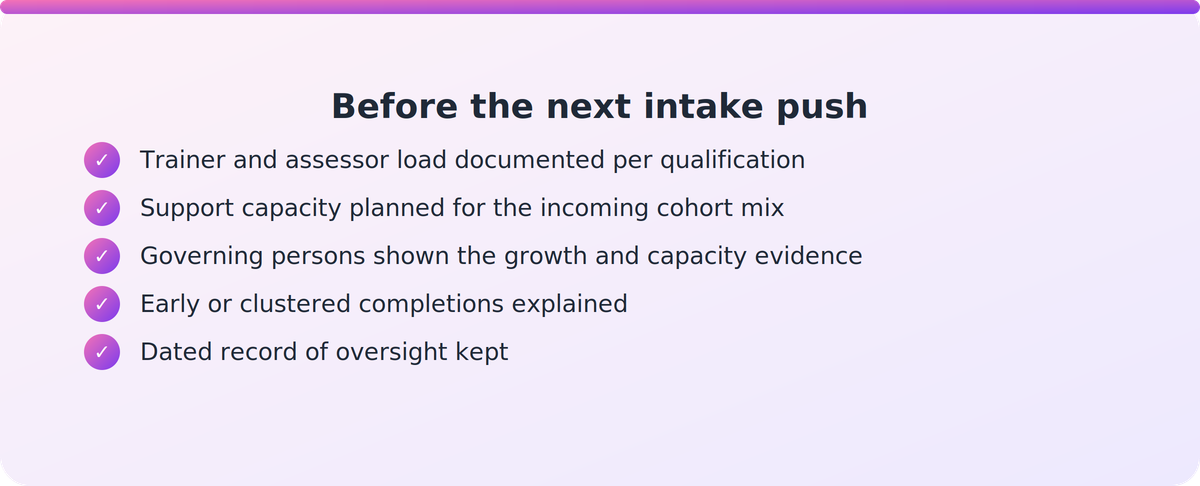
Before the next intake push, put these questions to your own data:
Can you show capacity ahead of demand?
For each qualification, document trainer and assessor load, support staff contact capacity, and the cohort mix you're taking on. Do it before the enrolments arrive, not after.
Can you show oversight?
Record that your governing persons or CEO saw the growth plan and the capacity evidence, and when. A dated paper trail is worth more than a verbal assurance in a hard week.
Do your completion patterns look like learning?
Watch for completions that arrive suspiciously early or in clusters. If you can't explain them, assume someone else will ask.
Key takeaways
- Enrolment growth is a risk event as much as a win. Capacity has to be shown to scale first.
- The sector is almost flat (5.1 million students, up 1,585), so your growth is likely share-taking or a mix shift that others can see.
- 38.4% of part-completers cited training-related reasons for leaving, which are the pressures that rise when intake outruns capacity.
- Trainer supply is structurally tight, so you can't assume hiring will catch up with enrolments.
- Practitioner commentary links enrolment spikes against flat trainer capacity, and weak governance oversight, to regulatory attention. Verify with ASQA directly.
Our take
Most RTO growth decisions get made on the commercial side and inherited by compliance afterwards. We think that's backwards. The RTO Manager should be the person who sets the capacity ceiling, in writing, before the intake target is agreed.
That isn't an argument against growth. It's an argument for earning it in a form you can defend: trainers rostered, support planned, oversight recorded, and completions that make sense. The RTOs that scale safely are usually not the fastest ones. They're the ones who can explain their numbers.
Here's a first step for this week. Pick your fastest-growing qualification and write one page showing how trainer, assessor and support capacity compares with this year's intake. If that page is hard to write, you've found your risk before anyone else did.
FAQ
Does ASQA treat enrolment growth as a compliance breach?
No source in our research says growth itself is a breach. Practitioner commentary from CAQA and Coastwide Training suggests rapid intake against flat trainer capacity, or decisions driven by growth over outcomes, can read as a risk signal. These are interpretations, so confirm on asqa.gov.au.
Which parts of the Standards for RTOs 2025 matter most when scaling?
All four Outcome Standards are tested together: training and assessment, VET student support, VET workforce and governance. The Outcome Standards and Compliance Standards are the two legislative instruments ASQA-regulated RTOs are regulated against. DEWR notes the Credential Policy and other policy documents do not impose legal obligations.
Is 49.0% the completion rate I should aim for?
Not as a simple target. 49.0% is NCVER's four-year completion rate for 2020 commencements, up from 47.5% for 2019. NCVER cautions that it spans diverse settings, objectives and cohorts, so compare against similar cohorts and programs.
Why can't I just hire more trainers when intake rises?
The workforce is a constraint. The JSA VET Workforce Study describes an older, highly casualised, lower paid workforce, with almost half over 50. Industry Skills Australia reports a significant shortage of qualified trainers and assessors in regional, rural and remote areas, and says the cost and complexity of the Certificate IV in Training and Assessment discourages entrants.