RTO Cost per Student: A CEO's Take on the Quality Trade-off
14 October 2026 · 7 min read
Most RTO boards run on an unspoken equation: better quality means more trainers, assessors and compliance hours, so quality and margin pull against each other. That equation is breaking. The regulator, the enrolment data and the workforce numbers all squeeze it, and RTO cost per student now depends on where quality effort goes, not how much headcount you can buy.
Why this lands on your desk
You own the P&L and answer to the board for cost per student. Any plan that lifts quality by adding delivery or assessment headcount runs into a VET workforce that Jobs and Skills Australia (JSA) says has shrunk 11–18% over a decade.
You also carry regulatory standing. ASQA has deregistered 10 critically non-compliant RTOs and cancelled over 25,500 fraudulently issued qualifications and statements of attainment as at September 2025. "Cheap and thin" is the position the regulator is targeting.
And you answer for the pipeline. When enrolments soften, delivery quality is one of the few differentiators left. So the old question, "how much quality can we afford?", is the wrong one. The better question is which parts of quality can be delivered differently.
Three squeezes on the old equation
The regulator is looking at outcomes, not paperwork
The 2025 Standards for RTOs have three elements: the Outcome Standards, the Compliance Standards (including the Fit and Proper Person Requirements) and the Credential Policy. They have applied to ASQA regulatory activity since 1 July 2025. The Outcome Standards cover four quality areas: training and assessment, VET student support, VET workforce, and governance (DEWR).
ASQA's 2026-27 priorities include provider governance and market conduct, quality sufficiency and fitness-for-purpose of training, and the integrity of qualifications and competency outcomes. Consultancy commentary says the audit lens is moving from documents to evidence that systems work in practice, and flags Self-Assurance (Outcome Standard 4.4) as a common blind spot. That is trade commentary, so check it against asqa.gov.au. For a GM, though, it is a single-view-of-performance question as much as a compliance one.
Demand is flat where it counts
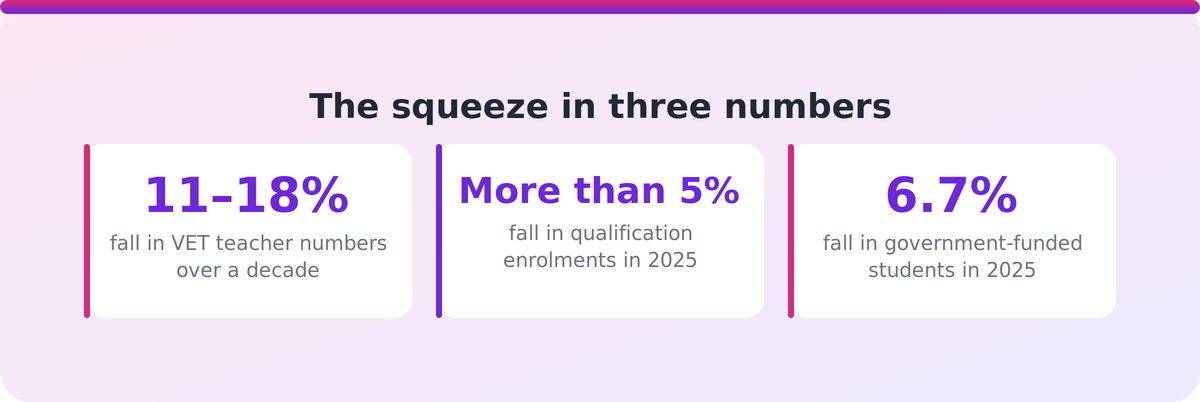
NCVER reports 5.1 million students in nationally recognised VET in 2025, up only 1,585 on 2024. Underneath, qualification enrolments fell by more than 5%. Government-funded students fell 6.7% (82,170) and program enrolments fell 9.2%.
Growth came from younger students, including VET in Schools, which reached 276,860 students, its highest since the collection began in 2006. Revenue is not rising to cover a bigger quality bill.
You cannot hire your way out
The JSA VET Workforce Study (October 2024) found that VET teacher numbers shrank 11–18% over the last decade and that Australia needs about 3,800 more VET teachers within five years. The average age is 47, against 41 for the wider workforce. The workforce is also highly casualised and paid less than teaching counterparts in other sectors.
Industry Skills Australia adds two cost drivers. The cost and complexity of the Certificate IV in Training and Assessment discourages new entrants. Digital transformation is also increasing the time and cost of maintaining vocational currency.
If your quality depends on a handful of experienced trainers, it is fragile. That is key-person risk, and it sits on your register whether or not the board has named it.
Where quality effort can move
If you cannot add heads, the lever is where trainer and assessor time goes. Three areas are worth examining.
- Practice. Learners in service, sales-adjacent, care and leadership-style units need repeated, realistic rehearsal before they are judged. That is expensive to run when it needs a facilitator or an actor in the room every time.
- Coaching. One-to-one feedback is the thing most trainers wish they had more time for, and it is the first thing to go when loads rise.
- Evidence of outcomes. A clear, current view of how learners are actually performing, across cohorts and trainers, is what you need before an audit and what you need to run the business.
AI can support the first two and help organise the third. ASQA's stated position, reported by trade press, is that its AI principles introduce no new regulatory requirements. They help providers manage AI within existing obligations, including the 2025 Standards. Consultancies report that ASQA's 2026 sector workshops would examine whether AI use complies with those Standards, and that AI cannot make assessment decisions or complete validation where qualified people are required.
That gives you a workable line. Technology can prepare, rehearse and surface evidence. Competency decisions stay with qualified assessors. Treat the consultancy sources as pointers and confirm the position with ASQA directly.
There is a flip side. Commentary also flags AI-assisted cheating, contract cheating and plagiarism as an integrity risk in ASQA's priorities. The tools that widen your options widen your exposure too, so your board needs a position on both.
Cutting scope is not the escape route
If the margin squeeze is the problem, the tempting answer is to shrink the offering. Be careful. Notes from ASQA's March 2026 Brisbane workshop, taken by a training provider and not published by ASQA, say the regulator monitors RTOs that sharply reduce scope and looks to confirm financial viability. Treat that as secondary and verify it.
The broader point holds without it. You cannot cut your way to a better cost per student without regulatory consequences. The work is in redesigning how quality is produced.
Key takeaways
- The "more quality means more headcount" equation is under pressure from ASQA's 2026-27 priorities, falling qualification enrolments (more than 5% in 2025) and a VET workforce that shrank 11–18% over a decade.
- ASQA's lens, per consultancy commentary, is evidence that systems work in practice, not documents alone. A single view of performance is a governance need.
- Practice, coaching and evidence of outcomes are the places effort can be redistributed.
- AI can support preparation and practice, but competency decisions stay with qualified assessors.
- Quality that rests on a few experienced trainers is key-person risk. Scope cuts carry their own regulatory scrutiny.
Our take
Boards will keep treating quality as a cost line until someone shows them it is a design problem. We think the RTOs that hold margin over the next few years will not be the ones that hired fastest or cut deepest. They will be the ones that decided deliberately where scarce human expertise goes, which is judgment, assessment decisions and mentoring, and where repeatable effort like rehearsal and evidence gathering can be supported differently.
We are inferring here. No single source says this outright. But the evidence on regulation, demand and workforce points the same way, and waiting for the equation to fix itself is a decision too.
A first step you can take this week: ask your Head of Training to list where trainer and assessor hours went last term, split into judgment work and repeatable work. Then ask which of those hours your most experienced person could not be replaced for.
FAQ
Does better training quality always mean a higher RTO cost per student?
Not necessarily, but it does if quality is bought only through more trainers, assessors and compliance hours. With the VET workforce shrinking 11–18% over a decade, that route is increasingly constrained. The alternative is changing where practice, coaching and evidence effort goes, while keeping competency decisions with qualified people.
What is ASQA focused on in 2026-27?
ASQA's priority areas are provider governance, market conduct and non-genuine operations; quality sufficiency and fitness-for-purpose of training; integrity of qualifications and competency outcomes; and transparency and assurance in complex and international delivery models.
Can AI make assessment decisions in an RTO?
Per consultancy reports of ASQA's messaging, no. AI cannot make assessment decisions or complete validation where qualified people are required. ASQA's AI principles, reported by The Sector, do not add new requirements. They help providers manage AI within existing obligations, including the 2025 Standards. Confirm current guidance on asqa.gov.au.
Can we protect margin by reducing our scope?
It carries risk. Unpublished notes from ASQA's March 2026 Brisbane workshop say ASQA monitors RTOs that sharply reduce scope and looks to confirm financial viability. This is secondary evidence, so verify it before relying on it.