RTO Enrolment Growth Strategy: A CEO's Guide to Risk
7 October 2026 · 7 min read
Enrolment growth and regulatory risk are now one decision. Under the 2025 Standards for RTOs, every new cohort, short course or fee-for-service contract is also a new body of quality evidence you must be able to produce. The RTO enrolment growth strategy worth backing is the one where assurance scales with intake.
Why this lands on your desk
You own the growth plan, and you answer to the board for regulatory standing. Those used to be two conversations. The 2025 Standards for RTOs came into effect on 1 July 2025, and ASQA says to expect more regulatory engagement. Scaling intake without scaling assurance is now a board-level exposure.
The market is also not growing the way many plans assume. NCVER reports 5.1 million students in nationally recognised VET in 2025, up only 1,585 on 2024. The domestic participation rate for 15–64 year olds fell marginally to 26.4%. If your forecast assumes a rising tide, test that assumption first.
What the 2025 Standards actually changed
The 2025 Standards have two parts: Outcome Standards and Compliance Requirements, which include the Fit and Proper Person Requirements. ASQA describes them as focused on the quality of outcomes for students and employers. It also says they allow more flexibility and support innovation in training delivery.
The practical shift is from "does the paperwork exist?" to "can you show what happened for the learner and the employer?" That is a harder question for a fast-growing provider. Evidence of outcomes is slower to build than a policy folder, and it can't be bought in a week.
Reading the audit numbers without over-reading them
The headline figures are sobering. In 2024–25, ASQA undertook 284 performance assessments, and 221 (78%) found non-compliance. From July 2025 to March 2026, 45 of 116 (39%) did.
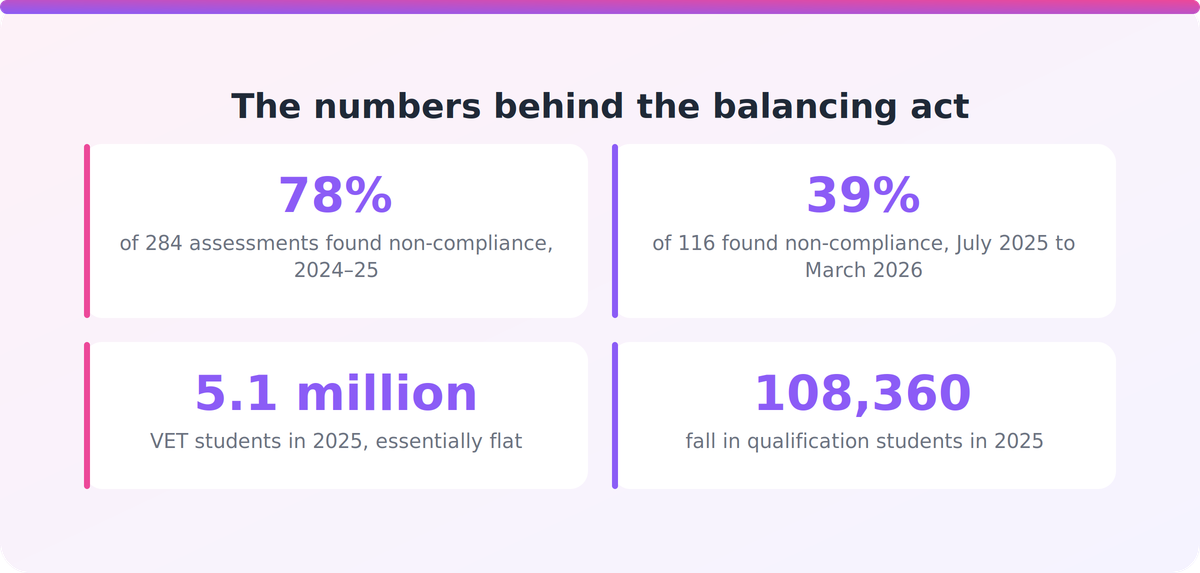
Don't build a story on the drop. ASQA selects providers using risk indicators, so these are not a random sample of the sector. The two periods differ, and ASQA's pages don't explain the gap. Read both numbers as a sign that non-compliance is common among providers ASQA chooses to look at, not as a trend.
Enforcement is also real. The Integrity Unit was supported by $33.3 million in government funding. Since November 2024, ASQA has cancelled the registration of 7 critically non-compliant providers found to have systematically issued fraudulent qualifications. The 2024–25 annual report records the cancellation of more than 25,500 qualifications and statements of attainment.
Where the growth actually is
Qualification students fell by 108,360 in 2025. Short courses and stand-alone subjects grew, strongest in fee-for-service. Growth now tends to mean new products and new cohorts, and each one needs its own quality evidence.
There are pockets worth knowing about. NCVER reports growth among younger students, regional and remote students, students with a disability and First Nations students. VET in Schools reached 412,840 program enrolments, up 4.8% and the highest since the collection began in 2006. Each group may need different support and different proof that the support worked.
The funding landscape adds pressure. The government is committing over $1.6 billion to 2034–35 for at least 100,000 Free TAFE and VET places per year from 2027, underpinned by the Free TAFE Act 2025. ATEC reports that 24 TAFEs account for 28% of qualification enrolments, and more than 3,100 private RTOs account for 58.3%. A Victorian parliamentary debate cited TAFEs receiving 73 per cent of VET funding in 2024–25. Subsidies are highly targeted, so the cost of the same course can vary significantly between providers. Private RTOs can't win on price alone. Differentiation has to come from outcomes and delivery quality you can demonstrate.
Growing where you can prove it
Before you approve a new product line, intake channel or employer contract, put four questions to the people who would carry it:
- Who owns the outcome evidence? Name one person, not a department.
- Does it survive a resignation? If your compliance lead or head of training left next month, could someone else produce the evidence?
- What does assurance cost per student? Include it in the margin before you commit to the revenue.
- Does this cohort need something different? VET in Schools, regional, disability and First Nations learners may each need distinct support, and distinct evidence that it worked.
On margin, be honest about what you don't know. The research found no authoritative public benchmark for private RTO operating margins or cost per student. It also didn't retrieve data on trainer and assessor workforce pressures, or on the specific financial viability and key personnel requirements. Treat all three as questions to test against your own numbers, not as facts to quote to your board.
AI: a governance decision before a capability one
Uncertainty about AI lands on your desk as both opportunity and risk. Secondary sources (CAQA and The Sector) report that ASQA flagged AI as a topic in its 2025 Standards workshops. They also report that its AI principles don't introduce new regulatory requirements but help providers interpret existing obligations, and that ASQA doesn't currently use AI in regulatory decision-making. I haven't verified those points against ASQA's own material, so check asqa.gov.au before you repeat them.
The useful framing is that existing obligations still apply, whatever tool is involved. Where AI touches assessment, learner support or learning design, ask who signs off, what a trainer can explain to an auditor, and where a human decision sits. Settle that first. Efficiency gains come second.
Key takeaways
- The 2025 Standards (in force from 1 July 2025) ask for demonstrable outcomes for students and employers, so growth plans need an assurance plan attached.
- ASQA found non-compliance in 78% of 284 performance assessments in 2024–25 and 39% of 116 from July 2025 to March 2026. The assessments are risk-selected and the gap is unexplained, so don't read a trend into it.
- Total enrolments are flat at 5.1 million. Qualification enrolments are falling while short courses and fee-for-service grow, so growth means new products that each need their own evidence.
- Compliance that rests on a few people is a key-person risk, and it is your risk.
- Treat AI as a governance decision within existing obligations, and verify ASQA's position directly.
Our take
Most growth plans are written as if compliance were a cost to be kept low. We think that is backwards. In a market that is flat overall, with funding tilted toward TAFE and a regulator promising more engagement, provable quality is the thing a private RTO can actually differentiate on.
The providers best placed to grow are the ones who can show an auditor, an employer and a board the same story about outcomes, without relying on one person's memory. A first step you can take this week: pick the product with the fastest forecast growth and ask your compliance lead to assemble its outcome evidence in a day. If that takes a week, you've found where to invest before you add another cohort.
FAQ
How do the 2025 Standards change an RTO enrolment growth strategy?
They shift the question from whether paperwork exists to whether you can demonstrate quality outcomes for students and employers. ASQA says to expect more regulatory engagement. Each new product or cohort should therefore come with a plan for producing outcome evidence.
Should ASQA's 78% and 39% non-compliance figures worry us?
They signal that non-compliance is common among providers ASQA selects, but be careful with them. ASQA selects assessments using provider risk indicators, and the two periods differ (284 assessments in 2024–25, 116 from July 2025 to March 2026). ASQA's pages don't explain the gap, so don't infer a trend.
Where is VET enrolment growth coming from?
NCVER reports total enrolments essentially flat at 5.1 million in 2025. Qualification students fell by 108,360, while short courses and stand-alone subjects grew, strongest in fee-for-service. VET in Schools also grew 4.8% to 412,840 program enrolments.
Is AI a compliance risk for an RTO?
Secondary sources report that ASQA's AI principles add no new regulatory requirements but help providers interpret existing ones. On that reading, AI use sits within your current obligations. Confirm this on asqa.gov.au, then decide who is accountable wherever AI touches assessment or learner outcomes.