RTO Growth Strategy: Why Compliance Capacity Is the Real Ceiling
12 August 2026 · 6 min read

Your enrolment target for next year probably isn't capped by demand. It's capped by how many compliant units of competency your team can build, map to evidence, and defend at audit before the next intake opens. That's the real ceiling on RTO growth strategy in 2025 — and it rarely shows up on a sales dashboard.
Why this lands on your desk
You own the growth number the board expects, and you own the registration that makes growth possible in the first place. Those two things used to sit in different conversations. Under the Standards for RTOs 2025, which commenced 1 July 2025, they're now the same conversation.
The Standards were restructured into separate Outcome Standards and Compliance Standards, and ASQA has shifted its posture from checking written policy to testing demonstrated practice and evidence (ASQA, DEWR). That means the gap between "we have a policy for this" and "we can prove it happened, for this cohort, against this unit" is exactly where your growth plan either holds up or falls over.
If your assessment development team is the bottleneck, a strong sales pipeline doesn't help you. It just means more students waiting on capacity you don't have — or worse, students being enrolled against assessment tools that won't survive scrutiny.
Enforcement has stopped being theoretical
Since late 2024, ASQA has cancelled the registration of at least 15 RTOs, including Gills College, and revoked tens of thousands of qualifications and statements of attainment issued without adequate assessment (ASQA). Cases against SPES Education and Melbourne Training Centre cite failures against the Fit and Proper Person and Financial Viability requirements — not just paperwork gaps, but findings that go to whether the organisation should be trusted to operate at all.
For a CEO, that's the part worth sitting with. These aren't only audit findings. They're the kind of finding a board asks about directly, because they touch the two things a board exists to protect: the organisation's licence to operate, and its financial position.
Registration can lapse under you — and the regulator knows why
Under the National Vocational Education and Training Regulator Act, an RTO's registration automatically lapses after 12 months without delivery. But ASQA explicitly recognises "critical VET workforce shortages" as grounds for an extension (ASQA). That's a regulatory admission that trainer and assessor capacity — not enrolment demand — can be the thing standing between an RTO and its ability to deliver at all.
It's also a warning about what you don't know. The most recent comprehensive national data on the VET workforce is from 2019, when trainers and assessors made up 29% of the workforce and 93.3% held a Certificate IV in Training and Assessment or higher (NCVER). NCVER's own leadership has flagged that no consistent, regular collection has replaced it since. You're being asked to plan growth against a workforce constraint the sector itself can't currently measure with any precision.
The cost centre that doesn't scale down
Compliant training and assessment resources aren't cheap, and the cost is largely fixed per qualification, not per student. Pre-developed resources run $5,000–$15,000 per qualification, with customisation for your learner cohorts and industry context adding another $2,000–$5,000 (VET Advisory Group). Add the 30-year student recordkeeping obligation on top, and you've got a cost base that doesn't fall when enrolments dip, and doesn't rise fast enough when a market opportunity opens.
That asymmetry is what actually squeezes margin. It's not that compliance is expensive in the abstract — it's that it's expensive at a fixed rate per unit, while your revenue is variable per student. Every qualification you can't develop fast enough is a growth opportunity you're paying to sit on.
The demand signal is real — in specific pockets
None of this means demand has vanished. NCVER's 2025 data shows government-funded VET activity nationally fell to 1,137,645 students, with NSW recording the largest decline and SA and WA growing modestly (NCVER). At the same time, VET in Schools hit record levels — 276,820 students, a 22.6% participation rate (NCVER).
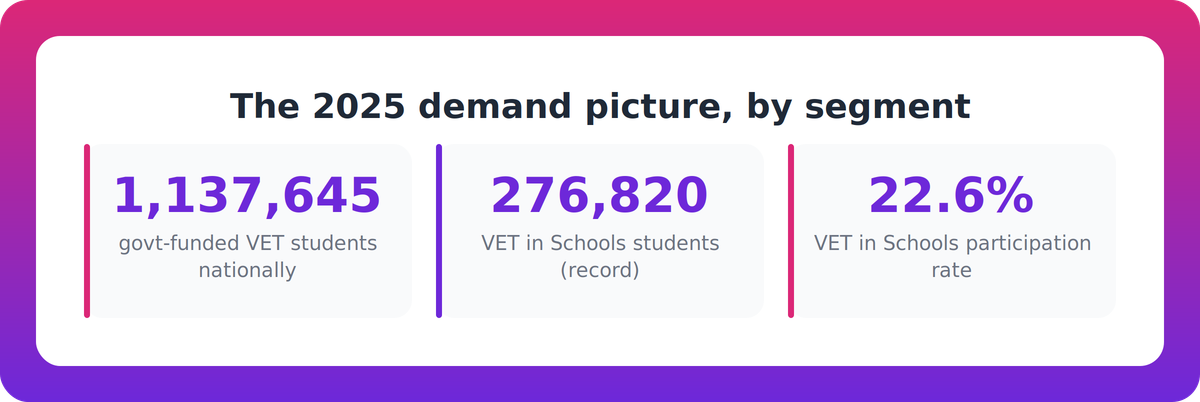
That's a genuine growth pocket, and it's exactly the kind of opportunity a constrained back office can't service. The cost of a slow assessment-development pipeline isn't abstract underperformance. It's a specific, growing segment you can see in the data and can't onboard fast enough.
Key takeaways
- The Standards for RTOs 2025 test demonstrated evidence, not written policy — narrowing the margin between "compliant on paper" and "compliant at audit."
- ASQA has cancelled 15+ RTO registrations and revoked tens of thousands of qualifications since late 2024, with findings reaching Fit and Proper Person and Financial Viability requirements — board-level risk, not just an audit note.
- Registration lapses automatically after 12 months without delivery, and ASQA treats critical trainer/assessor shortages as valid grounds for extension — an official acknowledgment that workforce capacity, not demand, can be the true limiter.
- Resource development costs ($5,000–$15,000 per qualification, plus customisation) are largely fixed per unit of competency, squeezing cost-per-student economics regardless of enrolment volume.
- Growth pockets are real — record VET in Schools participation among them — but only convert to revenue if your compliance and assessment pipeline can actually service them.
Our take
The sector keeps framing this as a compliance problem. We think that's the wrong frame for a CEO. Compliance capacity is now a growth input, on the same footing as marketing spend or trainer headcount. If you can't build, map and quality-assure a unit of competency fast enough, you don't have a growth strategy — you have a growth aspiration sitting behind a queue.
The uncomfortable part is that most RTOs can't currently measure this constraint with any precision, because the sector-wide workforce data that would help you benchmark yourself doesn't exist. That means the honest starting point for a growth plan isn't a demand forecast. It's an internal audit of exactly how many hours, and how many people, it takes your organisation to take one unit of competency from training package to audit-ready assessment tool — and whether that number is one your growth plan can actually survive.
FAQ
Does the Standards for RTOs 2025 apply to all RTOs immediately? Yes — the Standards for RTOs 2025 commenced 1 July 2025, restructuring the framework into Outcome Standards and Compliance Standards and applying to registered training organisations across their scope of registration (ASQA, DEWR).
Can ASQA cancel our registration even if we've never had a formal non-compliance finding? ASQA's recent cancellations, including cases against SPES Education and Melbourne Training Centre, have been grounded in findings against the Fit and Proper Person and Financial Viability requirements, alongside inadequate assessment evidence — showing enforcement action can follow a pattern of issues, not a single incident (ASQA).
What happens if we can't deliver against a qualification for 12 months? Under the National Vocational Education and Training Regulator Act, registration for that scope lapses automatically after 12 months without delivery — although ASQA recognises critical VET workforce shortages as valid grounds for an extension (ASQA).
Is demand actually falling across the VET sector? It's uneven. NCVER's 2025 data shows government-funded VET activity fell nationally to 1,137,645 students, with declines concentrated in NSW and modest growth in SA and WA, while VET in Schools reached record participation of 276,820 students (22.6%) (NCVER).