RTO Learner Completion Rates: Why the Signal Lags
7 September 2026 · 7 min read

Every number you're handed to prove learner outcomes was already out of date before it reached you. Your Training and Assessment Strategy gets reviewed once a year. Validation samples half your training products across a three-year cycle. NCVER publishes national completion rates a full four years after a cohort starts. None of that is a design flaw you can fix with better spreadsheets—it's the structure of the reporting rhythm itself, and it means disengagement and assessment drift are almost always invisible until they've already cost you a cohort.
Why this lands on your desk
You own trainers, timetables, TAS currency and the quality of delivery and assessment across every unit of competency your RTO runs. Under the Standards for RTOs 2025, which commenced 1 July 2025, ASQA has shifted its audit philosophy from checking that policies exist on paper to checking demonstrated outcomes and evidence of practice in real delivery contexts—with audits from 2026 assessed against the new Outcome Standards and Compliance Standards instruments.
That sounds like it should reward the work you're already doing. The catch is that the tools you rely on to demonstrate those outcomes are structurally backward-looking. TAS version control is a live, real-time discipline in guidance—but audit findings still routinely cite incomplete, generic or inconsistent TAS documentation as one of the most common non-compliances, which tells you most RTOs are treating it as an annual paperwork task rather than a running ledger. Validation and moderation sit squarely in your accountability, yet NCVER's own interviews with RTOs found the activity is largely driven by regulatory requirement rather than a genuine quality-improvement mindset. And the completion metric you're ultimately measured against nationally is published four years after the fact. You're accountable for what's happening in classrooms this term, using instruments designed to tell you what happened years ago.
The TAS is a live document, not a filing cabinet entry
Current guidance on TAS version control is specific: record every change with a rationale, update the version number, notify and train affected staff, review at least annually, and—critically—ensure every active cohort is linked to the exact TAS version that governed its commencement. That last point is the one most RTOs quietly skip. If you've updated a TAS mid-cycle but can't say which cohorts started under which version, you don't have version control—you have a filing system that happens to have dates on it.
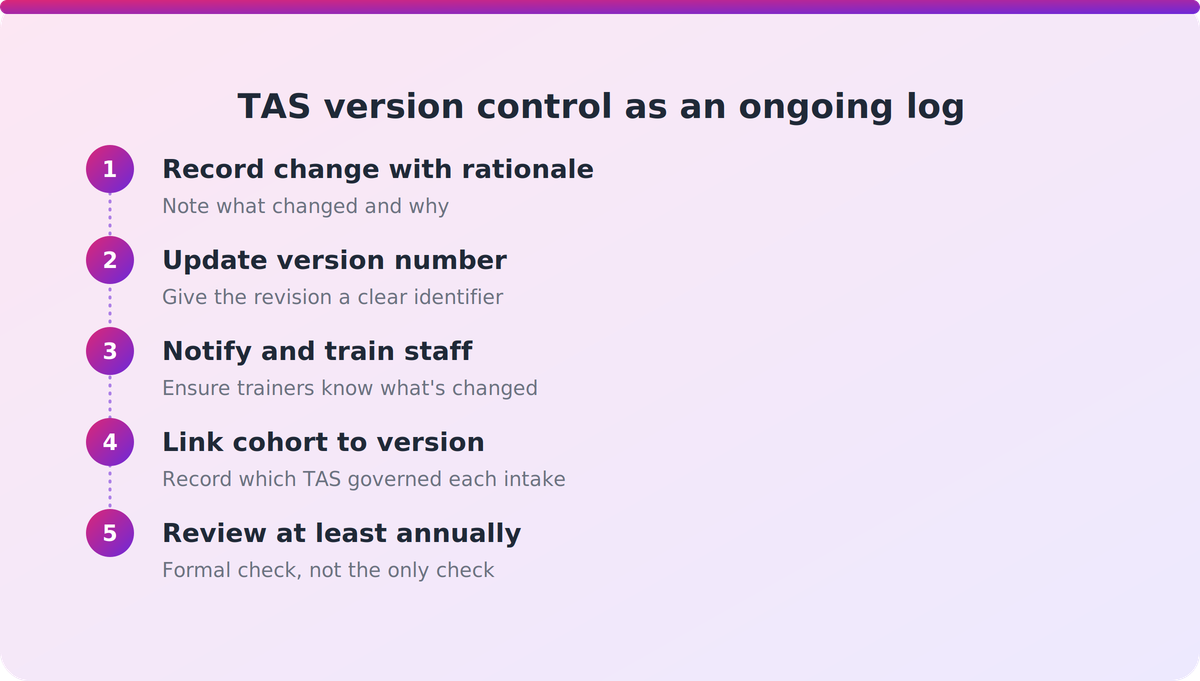
Treat that linkage as an ongoing log, not a compliance box ticked once a year, and you get something genuinely useful: a running record of exactly which learners were trained against which strategy, updated in near real time.
Validation catches paperwork gaps, not the Judgement Gap
Independent validation matters, and under the current cycle at least half of all training products must be validated within three years. But NCVER's research with RTOs found validation activity often generates over-assessment—repeated assessment of common elements across units—without necessarily improving the quality of training itself. Validation, done as a compliance exercise, tells you whether the paperwork is consistent. It doesn't reliably tell you whether Trainer A and Trainer B are applying the same judgement to the same unit of competency.
That gap between assessors—sometimes called the Judgement Gap in industry commentary—is the thing that actually produces inconsistent graduate outcomes. It's also the thing a once-every-three-years sample is structurally poor at catching early. If moderation only happens when a product comes up in the validation schedule, you're relying on chance to surface a problem that might be affecting learners right now.
The completion rate you're judged on is already history
NCVER's national qualification completion rate methodology deliberately reports observed completions four years after a commencing cohort starts—a choice NCVER frames as trading timeliness for statistical stability. Nationally, 2025 recorded 845,165 qualification completions, down 4.8% on 2024, while the domestic VET participation rate for 15–64 year olds slipped to 26.4%. For apprentices who started in 2018, 58.2% completed within six years.
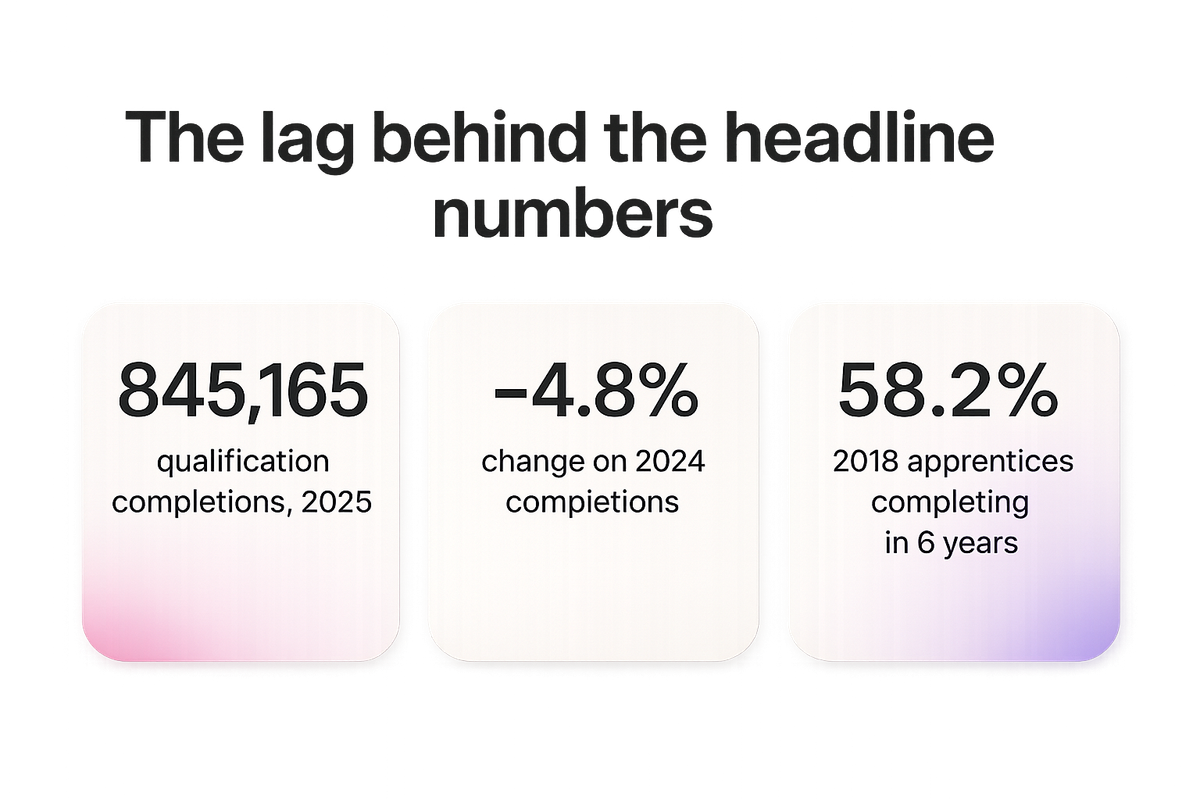
Those figures are real and worth watching at a sector level. But if you're waiting for a signal like that to tell you a cohort is disengaging, you're reading a headline about a class that finished years ago. By the time a completion dip shows up nationally, whatever caused it inside your RTO happened long before.
The workforce squeeze that's shrinking your early-warning window
Layer this on top of a trainer workforce under real pressure. Jobs and Skills Australia's VET workforce research finds trainers are older than the broader teaching workforce—nearly half are over 50—more casualised, and lower paid, with an estimated 3,800 additional VET teachers needed over the next five years. Every hour a trainer spends on currency maintenance, casual timetabling gaps or paperwork is an hour not spent noticing that a learner has quietly stopped engaging. Capacity constraints and lagging data compound each other: fewer hours to watch closely, worse instruments to watch with.
Key takeaways
- The Standards for RTOs 2025 judge providers on demonstrated outcomes, but TAS reviews, validation cycles and NCVER completion data are all structurally lagging indicators.
- TAS version control should mean logging every change with rationale and linking each active cohort to the exact version it commenced under—an ongoing task, not an annual one.
- NCVER's own research found validation is often compliance-driven and can produce over-assessment without catching inconsistent assessor judgement between trainers.
- National completion rates are published four years after a cohort starts—useful for benchmarking, useless as an early-warning system.
- An ageing, casualised trainer workforce (nearly half over 50, roughly 3,800 additional teachers needed nationally) narrows the time trainers have to notice disengagement before it shows up in lagging figures.
Our take
The honest reading of the 2025 Standards is that ASQA wants evidence of outcomes, but hasn't handed the sector any faster way to generate that evidence. The fix isn't waiting for better national data—it isn't coming. It's redesigning your own internal rhythm so TAS version control, validation and moderation function as a genuine early-warning system rather than three separate compliance dates on a calendar. That means shorter, more frequent moderation touchpoints on high-risk units rather than saving all of it for the three-year sample, and a TAS log that's checked against live enrolments, not reviewed once a year and filed. None of this requires new headcount. It requires treating the paperwork you already own as a signal, not a submission.
FAQ
Does the TAS still need to exist under the Standards for RTOs 2025, even though it isn't named explicitly? Yes. Compliance guidance confirms every RTO must still maintain a TAS that meets training package requirements, even though the 2025 Standards describe the obligation in outcome-based language rather than naming the document directly. An incomplete, generic or inconsistent TAS remains one of the most commonly reported non-compliances at audit.
How often does a training product need to be validated under the current cycle? At least half of all training products must be independently validated within a three-year cycle. NCVER's research with RTOs found this activity is often driven by regulatory requirement rather than a genuine quality-improvement mentality, which is worth factoring into how much weight you place on validation alone as an early-warning tool.
Why is the national completion rate published four years after a cohort starts? NCVER's methodology explicitly balances timeliness against statistical stability, and settles on a four-year observation window for reporting national qualification completion rates. It's a defensible statistical choice, but it means the headline figure you're ultimately measured against reflects delivery decisions made several years earlier.
What's driving the trainer capacity squeeze that affects how closely I can track learner progress? Jobs and Skills Australia's VET workforce research shows trainers are older, more casualised and lower paid than the broader teaching workforce, with an estimated 3,800 additional VET teachers needed over the next five years. That constrains the time available for the kind of close, ongoing observation that catches disengagement early.