RTO Learner Progress Tracking: A Head of Training's Guide
12 October 2026 · 7 min read
The national data will tell you which cohorts stalled, but not until years after the damage is done. For a head of training, that delay is more than a reporting inconvenience. When stalled learners surface late, the rescue work lands on your trainers as unplanned workload, in a workforce that is already short.
Why this hits your desk
You own trainer allocation, timetables and the quality of delivery and assessment. You answer for progress and completion. Yet the main national measure can't tell you which cohort is slipping this term.
NCVER's method allows four years after commencement before observed completion rates are reported. The latest release I could retrieve, VET qualification completion rates 2023, was published on 24 October 2024. It's a useful benchmark, but it describes learners who started long before your current roster existed.
Meanwhile, Jobs and Skills Australia (JSA) reported on 3 October 2024 that VET teachers had been in shortage nationally, and in every state and territory, for the previous two years. Almost 50% of the VET workforce is over 50, against 30% of the wider workforce. The workforce is highly casualised, VET teachers are paid less than teachers in other education sectors, and many leave for better-paid roles in industry or higher education.
Put those facts together and the cost of late news is easy to see.
The national numbers are benchmarks, not instruments
Treat NCVER data as a rear-vision mirror. The 2022 data, released on 30 August 2023, put completion at 49.2% for private providers and 44.1% for TAFE institutes. Subject pass rates in training package qualifications fell from 84% to 81% between 2019 and 2022. These are dated figures, not current ones. They're worth knowing for context, but they can't flag the Certificate III group that has gone quiet in week five.
If you're waiting for lagging indicators to tell you where to look, you're finding out in time to write a report, not in time to help a learner.
The retention link is an inference, and worth testing
Here is the claim I'm making, with its limits stated. I found no authoritative public data on trainer burnout rates, trainer workload in hours, or time spent on assessment paperwork. So I can't tell you that late visibility of learner progress drives trainers out.
What I can say is that it's a reasonable hypothesis. A trainer who learns in week ten that a third of the group hasn't submitted anything faces catch-up sessions, chasing, remarking and resubmissions, all on top of a full load. That is workload nobody planned for.
You don't need a national study to check this. Compare your last two or three cohorts: when did you first know a learner had stalled, and what did the recovery effort cost the trainer? Then set that against your own resignations, leave patterns and overtime. Your rosters will tell you more than a survey will.
Why late news also narrows your options
Late discovery limits how you can respond. Under the Standards for RTOs 2025, Standard 3.3 requires trainers and assessors to hold industry competencies, skills and knowledge at least to the level of the product they deliver or assess. You can't simply drop any available body into a struggling cohort.
Validation adds another constraint. As summarised by eSkilled (attributing the points to ASQA, so verify against ASQA guidance), the five-year maximum cycle remains but is now risk-based, and validation must be done by people independent of design or delivery. That limits who can review weak assessment evidence without a conflict.
Auditors, in turn, are commonly described as expecting validation and review records alongside trainer credentials and currency evidence. If you find out about a progress or evidence problem late, you often meet it first as a compliance exposure, not a delivery issue.
ASQA's FAQ notes that workforce planning can help providers work out current and future needs, including staff numbers and the mix of roles. Progress visibility feeds that directly: you can't plan cover for a cohort you didn't know was struggling.
Build your own early-warning view
The fix sits inside your delivery and assessment cycle, not outside it. You don't need a grand system to start. You need a small set of in-term signals, reviewed on a fixed rhythm, with a named person who acts on them.
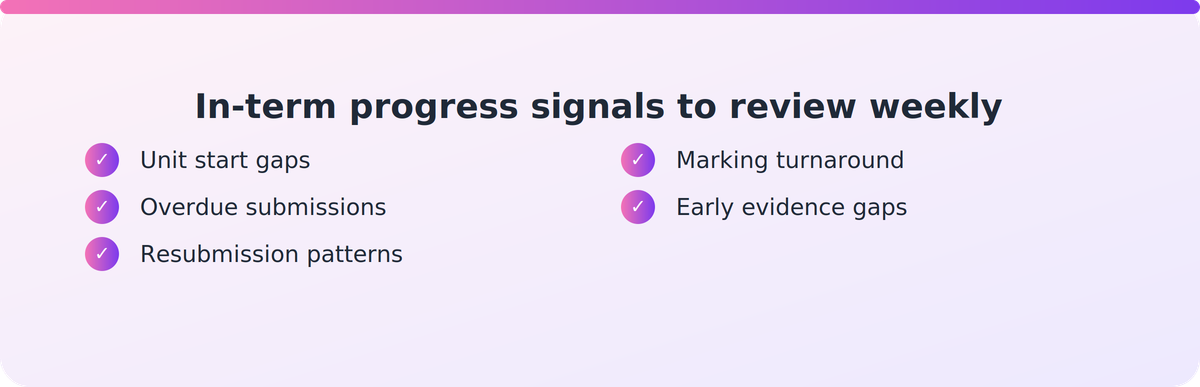
Signals worth watching
- Start gaps: learners who haven't opened or attempted their first unit of competency by an agreed point.
- Submission lag: assessments overdue against the timetable, by cohort and by trainer.
- Resubmission patterns: unusually high "not yet competent" outcomes on one task, which may point to the task rather than the learner.
- Marking turnaround: how long completed work waits for assessment.
- Evidence gaps: missing or thin evidence found early, before it's found at validation.
The point is to separate learner problems from design problems. A cluster of resubmissions across several trainers is a signal about the assessment tool. A cluster under one trainer is a conversation about support, not blame.
Make it a rhythm, not a report
Review these signals weekly with your trainers, in ten minutes. Decide at that meeting who contacts which learner and what support is needed. The aim is to spread small interventions across the term so they never pile up as one large rescue at the end.
Our take
Heads of training are often told to protect their trainers and lift completions as if they were separate goals. We think they are the same job, seen from two sides. Late-stage rescue work is how a progress problem turns into a retention problem.
We can't prove that link with public data, and we'd rather say so. But the shortage is documented, the lag in national completion data is built in, and the Standards for RTOs 2025 limit how freely you can reshuffle staff. Together, those make an in-term view of progress a leadership responsibility, not an administrative nicety.
Key takeaways
- NCVER completion data allows four years after commencement, so it can't show you which cohort is stalling this term.
- JSA found VET teachers in national shortage, with many leaving for better-paid roles, which makes avoidable unplanned workload costly.
- The link between late progress visibility and trainer burnout is a reasoned inference. No public workload data confirms it, so test it against your own rosters.
- Standard 3.3 and independence requirements in validation limit how freely you can reallocate trainers when problems surface late.
- A short list of in-term signals, reviewed weekly, gives you the early warning the national data cannot.
FAQ
Why can't I use NCVER completion rates to track learner progress?
Because they're retrospective by design. NCVER's method allows four years after commencement before observed completion rates are reported. They're useful as benchmarks, but they can't show which of your cohorts is slipping now.
Is there proof that poor progress visibility causes trainer burnout?
No. The research found no authoritative public data on trainer burnout, workload hours or time spent on assessment paperwork. The connection is a reasonable inference, and you can check it by comparing cohort stall dates with your own roster and turnover data.
What should RTO learner progress tracking include at minimum?
Start with unit start gaps, overdue submissions, resubmission patterns, marking turnaround and early evidence gaps. Review them weekly by cohort and by trainer, and assign one person to act on each flag.
How does the Standards for RTOs 2025 affect how I respond to a struggling cohort?
Standard 3.3 requires trainers and assessors to hold industry competencies, skills and knowledge at least to the level of what they deliver or assess. Validation must also be done by people independent of design or delivery, as summarised by eSkilled. Verify the validation points against ASQA guidance.
One place to start
Pick your most recent completed cohort. Work out the week a learner first stalled and the week you found out. If the gap is measured in weeks, ask your trainers what it cost them. What you hear is your retention data.