RTO Process Documentation: A COO's New Audit Risk
7 September 2026 · 8 min read

Ask five staff how a student withdrawal actually gets logged and you'll likely get five different answers — a note in the SMS, an email to admin, a verbal heads-up that never makes it anywhere. Until mid-2025 that inconsistency was a quiet inefficiency. Under the Standards for RTOs 2025, it's an audit finding waiting to happen, because ASQA is no longer checking whether a policy exists — it's checking whether the practice matches it.
Why this lands on your desk
Compliance has traditionally sat with the training and assessment team, and for content-level questions — mapping, validation, assessor judgement — it still does. But process integrity is different. You own the systems that enrolments, delivery records, withdrawals and reporting move through, and you own the people who operate them day to day. When ASQA asks how a process runs in practice, the honest answer is often "it depends who you ask" — and that answer traces straight back to operations, not training design.
Three things make this unavoidable for a COO specifically. First, audit readiness for demonstrated practice is fundamentally an operational question, not a curriculum one. Second, you answer for AVETMISS data quality today and VET Information Standard data quality from 2026 onward, and data drift is a symptom of undocumented handoffs between staff and systems. Third, you report financial viability and governance to the board, and ASQA's own guidance draws a straight line from small operational gaps to serious governance findings.
The standard changed the question
The Standards for RTOs 2025 commenced on 1 July 2025 and place greater emphasis on demonstrated outcomes and evidence of practice, rather than reliance on written policies alone, according to ASQA. Audits conducted through 2026 will assess providers against these standards, and operators who haven't updated their systems, documentation and delivery models to match sit at higher risk of non-compliance findings.
That's a meaningful shift in what "being compliant" means operationally. A withdrawal policy that says the right thing on paper no longer protects you if the actual sequence of events — who logs it, in what system, within what timeframe — varies by staff member or by day of the week. The auditor isn't reading your policy manual for reassurance. They're asking a random staff member to walk them through what happens, and comparing the answer to what the file shows.
Where the drift actually happens
Enrolment data tends to look clean because it's captured once, at the front door, usually by someone following a set intake sequence. Completion and withdrawal records are a different story — they need ongoing updates as circumstances change, and that's exactly where data drift creeps in. An informal withdrawal — a student who simply stops attending — never gets formally logged, and the record quietly goes stale.
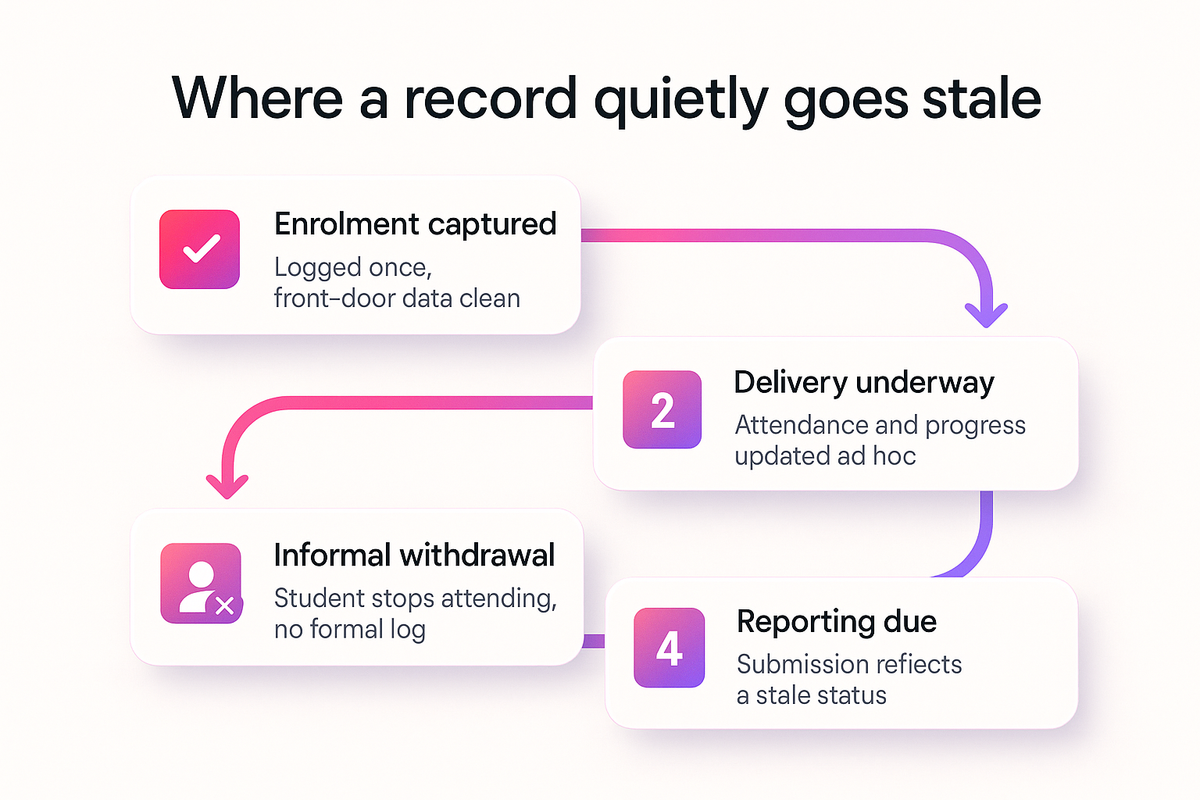
This isn't a training-and-assessment failure. It's an operations failure: a handoff between a trainer noticing an absence, an admin team member updating a record, and a reporting process pulling from that record, with no single documented path connecting the three. Sector-wide, RTOs commonly run disconnected LMS, SMS, CRM and accounting systems, which independent RTO systems consultancies identify as a direct driver of duplicate data entry and exactly this kind of drift.
The workforce shortage makes tribal knowledge riskier
Relying on individual memory to keep a process consistent has always been fragile. It's becoming untenable. Certificate IV in Training and Assessment enrolments have fallen by almost 25% since 2016, with regional, rural and remote shortages compounded by accommodation costs and the cost and complexity of the qualification itself.
Every time a trainer or assessor who "just knows how we do it" leaves — and in a shrinking talent pool, they will leave more often, not less — an undocumented process leaves with them. You're expected to scale delivery without scaling headcount one-for-one. That's not achievable if critical operational knowledge exists only in the heads of people you can't guarantee will still be there next semester.
Governance doesn't stop at the process
ASQA's compliance guidance explicitly connects small operational gaps to serious governance findings. A weak trainer file can become an assessment integrity problem. A poor board decision can become a fit-and-proper or financial viability issue. The Governance practice guide expects documented systems and strategies to anticipate and treat financial risks, plus evidence that governing persons are actively involved in reviewing the financial plan and position — not just a signed-off document sitting in a board pack once a year.
The throughline is simple: undocumented operational practice is where governance failures start. If you can't show the board — or an auditor — how a process actually runs, you can't credibly claim you're managing the risk it carries.
The compliance calendar you can't defer
The reporting environment is shifting under you at the same time. 2025 Total VET Activity AVETMISS data is still due to NCVER by 28 February 2026, including nil returns for RTOs that delivered no accredited training. In parallel, AVETMISS is being progressively replaced by the VET Information Standard, published by NCVER on 13 July 2026, with full sector transition required by 31 December 2028.
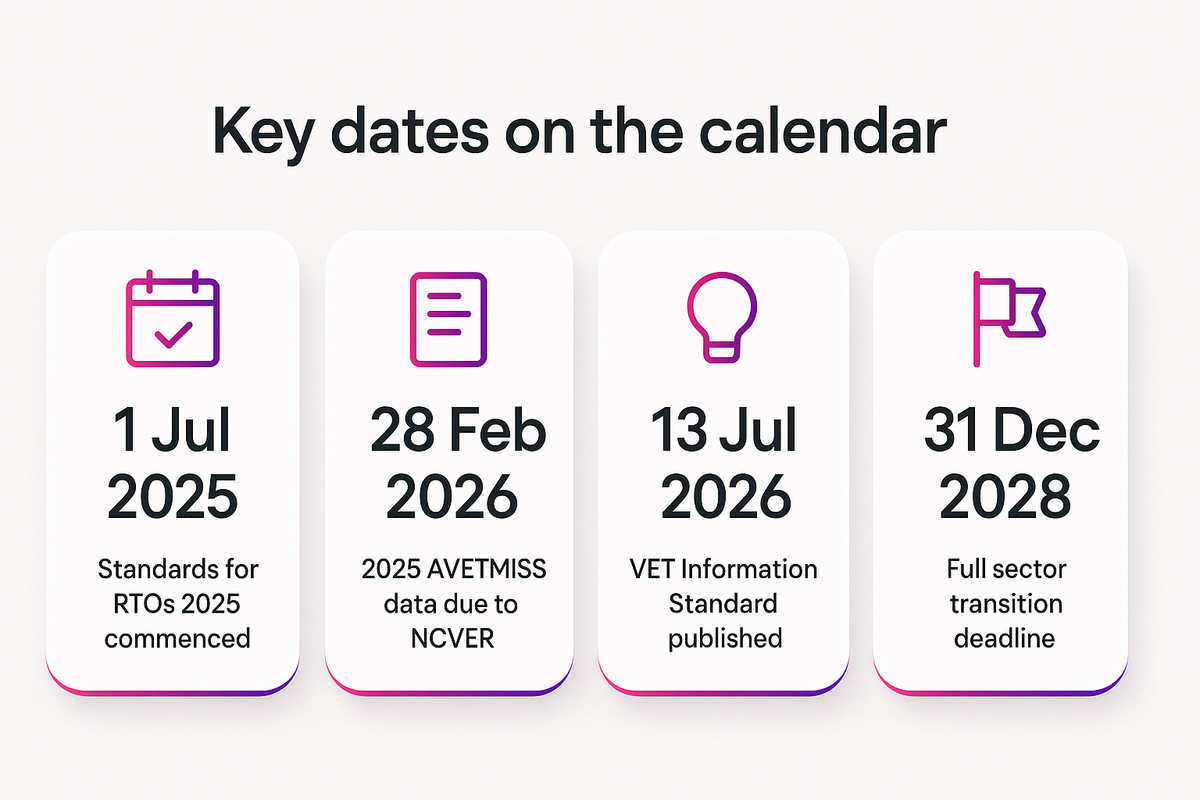
That's a multi-year window where you're maintaining accuracy under the old standard while preparing systems and staff for the new one — with no grace period for processes that only one person understands.
Key takeaways
- The Standards for RTOs 2025 shifted the compliance test from "do you have a policy" to "can you demonstrate the practice," and 2026 audits will be assessed against it.
- Data drift concentrates in completion and withdrawal records, not enrolments, because those need ongoing updates through informal handoffs that often aren't logged anywhere.
- A structural shortfall in trainers and assessors (TAE enrolments down almost 25% since 2016) means tribal-knowledge processes are a scaling risk, not just an audit risk.
- ASQA's own guidance links small operational gaps directly to governance, assessment integrity and financial viability findings.
- 2025 AVETMISS data is due 28 February 2026, and the VET Information Standard arrives 13 July 2026 with full transition by 31 December 2028 — a long window with no tolerance for undocumented handoffs.
Our take
The instinct in most RTOs is to treat this as a compliance-team problem: update the policy manual, brief the trainers, move on. That misses what actually changed. ASQA isn't asking for better paperwork — it's asking whether the operation runs the way you say it does, consistently, regardless of who's on shift. That's an operations question, and it sits with you.
The practical starting point isn't a documentation project that takes six months. It's picking the two or three processes with the highest exposure — withdrawal handling, trainer file completion, escalation handling — and writing down, precisely, what actually happens today, not what the policy says should happen. Then testing it: ask three different staff members to walk through the same process and see where the answers diverge. Wherever they diverge is your real audit risk, and it's fixable this quarter without touching a single system.
FAQ
What changed under the Standards for RTOs 2025 that affects process documentation? The Standards for RTOs 2025 commenced 1 July 2025 and place greater emphasis on demonstrated outcomes and evidence of practice, rather than reliance on written policies alone, per ASQA. Audits conducted through 2026 assess RTOs against this standard, so a policy document alone no longer satisfies an auditor asking how a process actually runs.
How does undocumented process knowledge affect AVETMISS or VET Information Standard reporting? Enrolment data is usually accurate because it's captured once, at intake. Completion and withdrawal records need ongoing updates, and that's where drift happens — commonly because an informal withdrawal was never formally logged. 2025 AVETMISS data is still due to NCVER by 28 February 2026 (including nil returns), and the VET Information Standard, published by NCVER on 13 July 2026, requires full sector transition by 31 December 2028.
Can a documentation gap really become a governance or financial viability finding? Yes, according to ASQA's own compliance guidance, which explicitly links small operational gaps to serious governance outcomes — a weak trainer file can become an assessment integrity issue, and a poor board decision can become a fit-and-proper or financial viability issue. The Governance practice guide also expects documented systems for financial risk and evidence that governing persons actively review the financial plan and position.
Is this a training-and-assessment problem or an operations problem? It's an operations problem. Training and assessment content is one layer; the systems and handoffs that keep records accurate and consistent are another, and that's the layer under audit pressure now. With Certificate IV in Training and Assessment enrolments down almost 25% since 2016, relying on individual staff memory to keep a process consistent is no longer a viable way to scale delivery.