The Real Reason RTO Program Development Time Blows Out
23 September 2026 · 6 min read
A new training program at most Australian RTOs takes months to launch, not weeks — and the usual explanation is that writing assessments and learning materials takes too long. The real delay typically shows up later, when coverage gaps against unit of competency requirements surface at validation or audit, forcing rework, re-issued resources and stalled cohorts.
Where the Delay Actually Hides
Ask most training managers why a program took four months instead of six weeks, and they'll point at content. Assessments took too long to write. Learning materials needed another draft. It's the visible work, so it gets the blame.
But the friction that actually stalls a launch tends to sit one step later, in the compliance mapping and validation stage — the point where someone has to prove, unit by unit, that an assessment genuinely covers every:
- Element and performance criterion
- Piece of knowledge evidence
- Piece of performance evidence
If that mapping wasn't built in from the start, gaps don't get caught until a validator or an ASQA auditor goes looking. By then, the cost isn't just a rewrite. It's re-issued resources, a paused cohort, and — for every learner who disengages while the program sits in limbo — a completion, and its funding, that never lands.
TPOF 2025 adds another layer. The new Application of Skills and Knowledge (ASK) unit format is starting to appear on training.gov.au, and any RTO whose templates and tools were built for the old unit structure now has extra conversion work to do on top of everything else.
Where the Fix Actually Needs to Sit
The fix isn't faster drafting. It's mapping that's built in before validation, rather than checked for gaps after the fact.
That's the shift VETos is built around: instead of treating a training package as a pile of separate documents, it models an RTO's whole scope — training package, qualifications, units, elements and performance criteria — as one connected structure. When an assessment is generated inside that structure, it's already tied back to the specific unit of competency requirement it's meant to prove, not checked against it afterwards.
The VETos site frames the cost of not doing this plainly: "Every qualification that takes months instead of weeks delays workforce readiness," and "every validation failure creates costly rework." That's the gap between a program that launches clean and one that limps through audit findings.
What This Looks Like in Practice
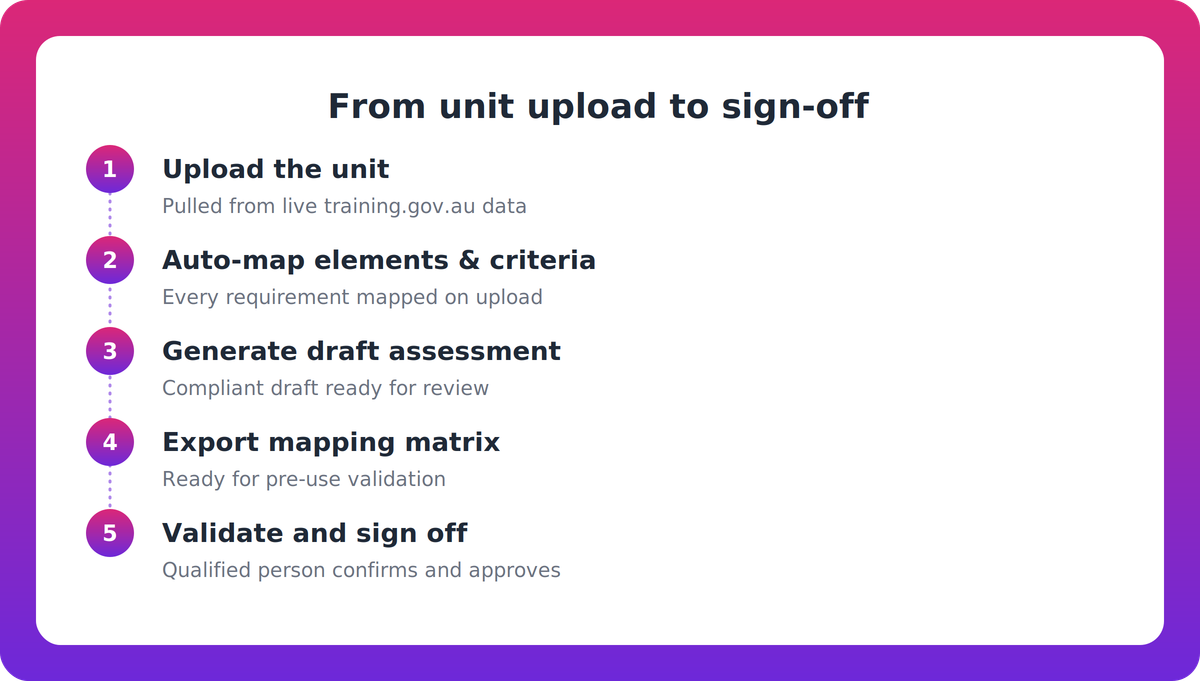
Concretely, this is what changes for a provider building a new program:
- A unit is pulled in using live training.gov.au data — covering both traditional units and the new ASK format.
- Every element and performance criterion in that unit is mapped automatically on upload.
- A compliant draft assessment is generated in minutes for an educator to review and refine — not from scratch.
- A mapping matrix is generated and can be exported for pre-use validation, with version history retained as an evidence trail as tasks are adapted.
- A qualified person still validates and signs off — the tool's job is making sure what they're validating is accurate, current and traceable.
Assessment design, learning material generation, compliance documentation and the operational workflow around them sit in one workspace, rather than across a general LMS, a separate authoring tool and a spreadsheet tracking coverage. That distinction matters more than it sounds: VETos's own buyer guide for unit of competency assessment software calls traceability against elements, performance criteria, knowledge evidence and performance evidence "the first thing an RTO should test before buying anything" — because a tool that drafts fast but can't prove coverage back to the unit just moves the risk further down the line.
It's also worth naming what this isn't. VETos describes itself as software built specifically for Australian training packages and ASQA compliance — not, in its own words, "US or UK software adapted for our market." For a sector with its own regulator, its own framework and its own unit structure, that's not a minor detail.
Key takeaways
- The bottleneck most RTOs name — slow drafting — is rarely the real cause of a months-long launch.
- Coverage gaps against elements, performance criteria, knowledge evidence and performance evidence are usually what turn into rework, once they surface at validation or audit.
- TPOF 2025 and the new ASK unit format add fresh conversion overhead for providers whose tools weren't built to handle it.
- Traceability back to the specific unit of competency requirement — not just fast content — is what a validator or ASQA auditor actually needs to see.
- Mapping that's built in as assessments are generated, with an exportable matrix and version history, moves the compliance check earlier, before it can stall a launch.
Our take
Most of the sector's process improvement effort over the past few years has gone into content speed — faster drafting, better templates, more reusable resources. That's useful, but it's solving the part of the problem that was never actually the constraint. The constraint is proving coverage against a unit of competency in a way that survives contact with a validator, and that's a structural problem, not a writing-speed problem. Providers who treat mapping as the thing to fix first, rather than the thing to check last, are the ones who'll feel TPOF 2025 and the ASK transition as a manageable update rather than a scramble.
FAQ
What actually slows down RTO program development time? Most providers point to slow drafting of assessments and learning materials, but the material points to compliance mapping and validation as the real friction — coverage gaps against unit of competency requirements that only surface once a program reaches audit or validation, triggering rework and re-issued resources.
Why are validation failures so costly compared to a slow first draft? A slow draft delays a launch by days or weeks. A validation failure discovered late means resources have to be reworked and re-issued after they've already been built, cohorts can stall mid-program, and non-completions turn into funding that isn't recovered.
How does TPOF 2025 change the workload for RTOs? TPOF 2025 introduces the new Application of Skills and Knowledge (ASK) unit format on training.gov.au. Providers whose templates and assessment tools are built for the older unit structure face extra conversion work as units transition to the new format.
What should an RTO check before buying assessment software to fix this? According to VETos's own buyer guide, the first thing to test is traceability — whether the tool can map an assessment directly back to specific elements, performance criteria, knowledge evidence and performance evidence, not just draft content quickly.
Does automated mapping remove the need for a qualified person to validate assessments? No. VETos's mapping matrix is exportable for pre-use validation and keeps version history as an evidence trail, but a qualified person still validates and signs off — the mapping simply ensures what they're reviewing is accurate, current and traceable.
If your last program launch stalled at validation rather than at drafting, it's worth looking at where in your process coverage actually gets checked — before it gets checked for you at audit. VETos's assessment mapping and pre-use validation guide walks through how that mapping works in more detail.