RTO scalability and delivery costs: a COO's hidden ratio
14 October 2026 · 7 min read
Most RTOs can't say what one extra enrolment costs them to deliver, support and report. That's the hidden ratio: how fast headcount grows when enrolments do. No public benchmark exists, so you have to build your own baseline, ideally before a reporting rebuild and a shrinking trainer workforce make the answer expensive.
Why this lands on your desk
You own the cost base. If every additional enrolment needs proportionally more trainers, assessors, admin and reporting effort, margin doesn't improve with growth. It just moves sideways at a bigger scale.
Three pressures sharpen the question right now:
- Reporting. ASQA states that all RTOs must report all delivery activity to NCVER at least annually. NCVER says AVETMISS is being replaced by the VET Information Standard under the VET Data Streamlining Program, with transition by 1 January 2029 and new API-based reporting technology.
- Capacity. Jobs and Skills Australia's VET Workforce Study (October 2024) found VET teacher numbers fell by 11–18%. It projects 3,800 more teachers are needed in five years, and describes a workforce that is older, highly casualised and paid less than other education sectors.
- Compliance. The 2025 Standards for RTOs took effect on 1 July 2025, with a focus on outcomes and flexibility. ASQA's Statement of Regulatory Expectations (v1.0, 6 May 2026) says Fit and Proper Person Requirements rely on timely, accurate disclosure and are a continuing obligation.
Put together, adding people in a straight line is getting harder, not just dearer.
A ratio nobody has published
Let's be straight about the evidence. We couldn't find an authoritative public source that quantifies RTO delivery or admin cost per enrolment, or how admin headcount moves with enrolments. Anyone quoting a sector-wide figure is guessing.
That's useful, not frustrating. It means the ratio is an internal measurement problem, and the RTO that measures it first gets an advantage. Your board can't compare you to a benchmark that doesn't exist, but it can ask whether this year's growth cost more or less per enrolment than last year's.
Where the ratio is likely to bite
National volume is flat. NCVER's Total VET students and courses 2025 reports 5.1 million students, up just 1,585 on 2024, and a domestic participation rate of 26.4% for ages 15–64. The mix is what's moving. Qualification enrolments fell, while short course and stand-alone subject enrolments were strongest in fee-for-service training.
NCVER also reports growth among younger students, including those still in school, regional and remote students, students with disability and First Nations students.
Here's the inference, and it is an inference: a short course enrolment and a full qualification enrolment probably don't carry the same admin load per head. Neither do cohorts with different support needs. Headline enrolments can stay flat while effort per enrolment climbs. If you only track volume, you'll miss it.
The reporting rebuild is a ratio test
If your annual AVETMISS submission eats weeks of manual effort, that's your ratio showing up in a single task. Disconnected systems, duplicate data entry and process knowledge held by one or two people all inflate it.
One secondary source, RTO Resource Australia, says the new standard moves from annual batch to event-based reporting, from ANZSCO to OSCA occupation coding, and adds fields such as qualification specialisation and third-party provider details. Treat that as unverified until you've checked NCVER's guide. If it holds, reporting stops being an annual crunch and becomes a continuous operational process. A team built around a yearly scramble would struggle with that.
Two more details matter for planning. The Data Provision Requirements Amendment (Data Streamlining) Instrument 2026 takes effect on 1 October 2026. And NCVER notes that AVETMISS compliance doesn't assure that software output meets state or territory requirements, which means duplicated effort if you report across jurisdictions. We couldn't find individual RTO transition dates publicly, so ASQA's advice stands: check the transitional arrangements for your own organisation.
Sort the work into three buckets
The useful question isn't "how do we cut admin?" It's which work genuinely needs a person, and which only needs one because the process is manual.
1. Scales with people, and should
Judgement-heavy work: competency decisions, industry engagement, pastoral support for learners who need it. JSA reports that 48.5% of the VET workforce is in Teach, Train and Assess roles. Protect that capacity. Don't spend it on re-keying data.
2. Scales with people only by habit
Re-entering the same learner details across systems, chasing evidence by email, building reports by hand each cycle, answering the same enrolment queries. JSA says administration and operations is the next largest segment of the VET workforce, so this is where much of your headcount sits.
3. Scales with people because nobody wrote it down
Processes that live in individuals' heads. This is an efficiency problem and a compliance exposure. Under the 2025 Standards, ASQA's emphasis on outcomes and accurate disclosure makes repeatable, documented processes a priority. One vendor view (CCP, not ASQA) says information management and recordkeeping face closer scrutiny. Weigh that accordingly, but the direction is hard to argue with.
Bucket one is where your people should spend their time. Buckets two and three are where the ratio can be broken.
What to measure this quarter
You don't need a data project. You need a few honest numbers, split by delivery type, so short courses, fee-for-service and funded qualifications don't blur together.
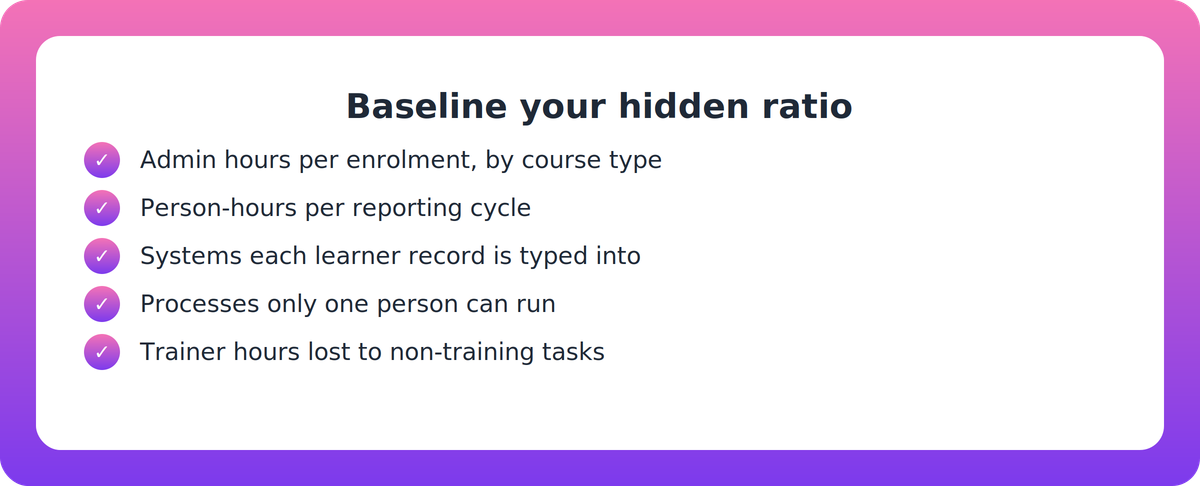
- Admin and support hours per enrolment, by course type
- Calendar days and person-hours for each reporting cycle
- Number of systems a single learner record is typed into
- Processes that only one person can run
- Trainer and assessor hours spent on tasks that aren't training or assessing
Run it for two periods. If hours per enrolment fall as volume grows, you're scaling. If they hold steady, you're in lockstep.
Key takeaways
- No public benchmark quantifies RTO cost or admin headcount per enrolment, so the hidden ratio has to be measured inside your own organisation.
- National enrolments are flat at 5.1 million. The shift towards short courses, fee-for-service and varied cohorts may change effort per enrolment (an inference, not a published finding).
- NCVER is replacing AVETMISS with the VET Information Standard by 1 January 2029. Check your own transition arrangements with ASQA and NCVER.
- JSA reports a shrinking, ageing, casualised VET workforce, so linear headcount growth is harder to sustain.
- Undocumented process knowledge is a compliance risk under the 2025 Standards for RTOs, not just an efficiency one.
Our take
The ratio isn't a law of nature. It's a result of how work has been designed, usually by accident, one workaround at a time.
We'd argue the 2029 transition is a deadline you can use. Treat it as a forced audit of how data moves through your organisation, and as the excuse to fix the duplicate entry and tribal knowledge that were costing you anyway. The RTOs that wait for the standard to dictate the fix will rebuild under pressure. The ones that measure now can choose what to rebuild.
And be wary of the opposite mistake. Not everything should be decoupled from people. The goal isn't fewer humans in delivery. It's fewer humans doing work that doesn't need one.
FAQ
Is there a benchmark for RTO admin cost per enrolment?
Not that we could find. No authoritative public source quantifies delivery or admin cost per enrolment, or how admin headcount scales with enrolments. Build an internal baseline by course type and track it over time.
When does the VET Information Standard replace AVETMISS?
NCVER says RTOs transition by 1 January 2029 under the VET Data Streamlining Program, with new API-based reporting technology. Individual RTO dates weren't publicly found, so check your transitional arrangements with ASQA and NCVER.
Does the 2025 Standards for RTOs change operations?
The 2025 Standards took effect on 1 July 2025 with a focus on outcomes and flexibility. ASQA's Statement of Regulatory Expectations stresses timely, accurate disclosure as a continuing obligation under the Fit and Proper Person Requirements. That raises the value of documented, repeatable processes.
Why can't we just hire more trainers as we grow?
Supply is tightening. Jobs and Skills Australia found VET teacher numbers fell 11–18%, projects 3,800 more teachers are needed in five years, and describes a workforce that is older and highly casualised.
One first step: pick your most manual reporting task this week and ask who would run it if its owner left tomorrow.