RTO Scope of Registration Risk: A Manager's Guide
4 October 2026 · 6 min read
ASQA hasn't defined 'scope creep', but the idea holds: every unit, delivery mode and cohort you add is something you must evidence as quality. Under the Standards for RTOs 2025, your most controllable audit-risk decision is not how well you prepare for audit day. It's what you choose to carry.
One caveat first. ASQA has not published any finding linking scope growth to audit outcomes. That link is my reasoning, built on the scope rules, the outcome-focused Standards and documented workforce pressure. Treat it as a management lens, not a regulatory claim.
Why this lands on your desk
You decide what goes on scope and what stays there. You also decide what actually gets delivered. Each addition lands on a team that is already short of trainers, assessors and compliance time.
Since 1 July 2025 you have been answerable under the 2025 Standards for whether quality shows up in practice across the whole portfolio. Having the documents is no longer enough. Reporting keeps shifting too, with the Data Streamlining Instrument taking effect on 1 October 2026. Each extra line of delivery adds to the administrative load you carry.
What the scope rules actually say
ASQA's published position on scope, as far as the research found, is limited to the scope rules. Its legacy legislative changes page says two things:
- Twelve consecutive months of nil delivery leads to lapse of registration, unless an extension is obtained.
- Scope cannot be changed in the first 24 months of registration.
That page may be an older version, so check the current ASQA page before you rely on it. The point stands either way: what you hold on scope carries consequences, and registration is a commitment, not a trophy.
Secondary-source notes from an 11 March 2026 ASQA sector workshop, published by Skills Education, add a signal. ASQA reportedly monitors large scope reductions and looks to confirm financial viability. Treat that as secondary, but it suggests scope is watched in both directions.
Why outcome-focused Standards raise the price of a broad scope
DEWR describes the 2025 Standards in three parts: the Outcome Standards, the Compliance Standards (including the Fit and Proper Person Requirements and the NRT Logo Conditions of Use Policy), and the Credential Policy. ASQA's Corporate Plan 2025–26 says the Standards emphasise quality outcomes rather than merely complying with minimum requirements.
An ASQA webinar transcript says the Credential Policy is enforceable because it links through to the Outcome Standards. So a broad scope means more outcomes to demonstrate, not just more paperwork. A unit you hold on scope but cannot properly resource is a quality outcome you may struggle to show.
The constraint is people, not paperwork
Industry Skills Australia's work on the VET Workforce Blueprint (transport and supply chain) documents the strain:
- Intensified pressure to attract and retain experienced professionals.
- A significant shortage of trainers and assessors in regional, rural and remote areas.
- A Certificate IV in Training and Assessment that deters entrants.
- Growing time and cost for trainers to maintain vocational currency.
This evidence is sector-specific, and no authoritative national figures on trainer vacancies or RTO resourcing turned up. Still, it points one way. Every new qualification needs assessors with current industry skills. Stretch a small team across too many of them and the first thing to thin out is the checking: moderation, currency, file review.
Broad scope makes completion data harder to read
Completion rates matter to you, and NCVER's caution applies here. Not all learners complete a qualification, and many leave after gaining the specific skills they need. NCVER's 'VET qualification completion rates 2024' report came out on 24 November 2025, though I haven't quoted its figures here.
The management problem is interpretive. Spread resources across many qualifications and cohorts and a low number could mean a genuine quality problem or ordinary learner behaviour. With a tighter portfolio you can tell the difference. With a sprawling one you often can't.
A scope-load test for this quarter
ASQA's Practice Guides for the revised Standards include compliance examples, known risks and self-assurance questions. They give you a regulator-sourced way to test the portfolio. Run this over each qualification or major cohort type:
Ask of every line of delivery
- Can we show, today, how quality is evidenced for this unit, delivery mode and learner group?
- Do we have assessors with current industry skills for it, without borrowing from another program?
- When did we last deliver it? Twelve months of nil delivery has consequences.
- Is the completion data readable, or buried under too many small cohorts?
- Would we add this line to scope again today, knowing what it costs?
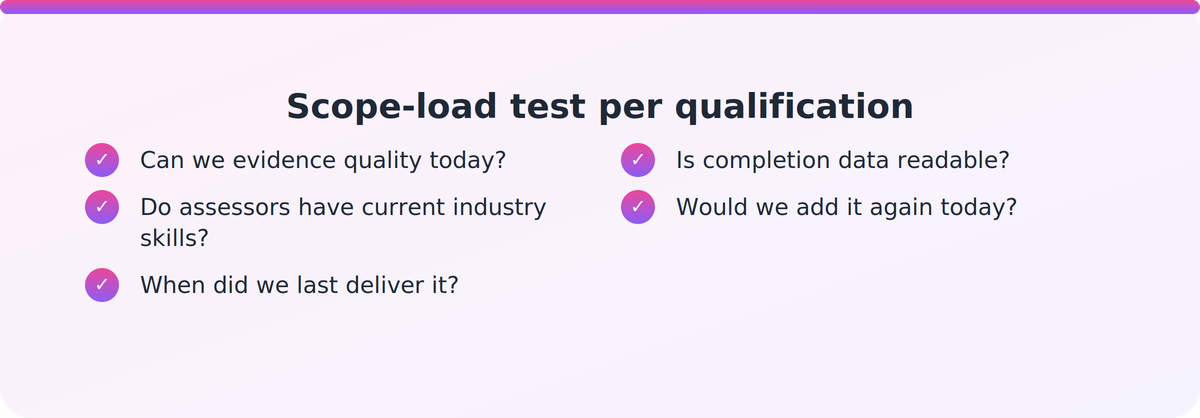
Anything that fails two or more is a candidate to consolidate, pause or resource properly before the next scope request lands on your desk.
Key takeaways
- 'Scope creep' is a management lens, not an ASQA term. The link to audit exposure is reasoning, not a regulator finding.
- The 2025 Standards (in effect since 1 July 2025) put quality outcomes ahead of minimum compliance, so each scope line is an outcome you must demonstrate.
- ASQA's published scope rules cover nil delivery (12 months) and the 24-month change restriction. Check the current ASQA page before citing them.
- Workforce pressure is documented by Industry Skills Australia, though not with national vacancy figures.
- Use ASQA's Practice Guides self-assurance questions to test the whole portfolio, not just audit-day files.
Our take
Most RTO audit-readiness advice starts after the commitment is made: tidy the files, rehearse the interviews. That helps, but it treats scope as a given. Scope is the one input you control before any auditor arrives.
In a climate of continued scrutiny, with the Skills and Training Minister saying on 5 June 2026 that the Standards are still being embedded and the Budget giving ASQA additional support for its crackdown on 'the bad apples', quiet over-extension is the risk I'd worry about. It rarely looks like a decision. It looks like saying yes to one more cohort. A smaller portfolio you can genuinely evidence beats a larger one you can only describe.
FAQ
Is 'scope creep' an ASQA term?
No. ASQA has not published a definition. It is a management lens for the way exposure grows when an RTO takes on units, delivery modes, cohorts or commitments without matching capacity to evidence quality.
What do ASQA's scope rules say about nil delivery and scope changes?
ASQA's legacy legislative changes page says 12 consecutive months of nil delivery leads to lapse of registration unless an extension is obtained. It also says scope cannot be changed in the first 24 months. The page may be outdated, so verify against current ASQA guidance.
Does ASQA say a broader scope increases audit risk?
No such statement was found. The argument is that the 2025 Standards emphasise quality outcomes, so more scope means more outcomes to evidence. That is reasoning, not an ASQA finding.
How can I test whether my scope is too broad?
Use the self-assurance questions and known-risk examples in ASQA's Practice Guides. Apply them to each qualification and cohort type, and check whether you can evidence quality with the assessors and compliance time you actually have.
The next time someone proposes adding a qualification, ask what you would stop doing to make room for it. If the answer is nothing, that's worth sitting with before you say yes.