RTO System Integration: What Duplicate Entry Costs You
21 September 2026 · 7 min read
RTO System Integration: What Duplicate Entry Costs You
Integration debt used to be a problem you could live with — a coordinator re-keying enrolments, a spreadsheet reconciling two systems that don't talk, a Friday afternoon lost to matching numbers. Under the Standards for RTOs 2025, that same gap is now a compliance liability with a fixed deadline and a real chance of failing an entire submission.
Why this hits your desk
You own the AVETMISS Total VET Activity submission to NCVER, due 28 February 2026, nil returns included. You own the quality indicator summaries ASQA expects by 30 June each year. Your CEO signs the Annual Declaration on Compliance, but the data behind it comes from your systems and your team.
The Standards for RTOs 2025, in effect since 1 July 2025, changed what ASQA is actually checking. It's no longer enough to have a policy that describes how enrolment data should flow between your student management system, your LMS and your finance platform. ASQA now wants evidence that it does flow that way, in practice, every submission cycle. Every manual workaround your team relies on to patch a gap between systems is a potential gap in that evidence.
From policy to evidence: what changed in July 2025
ASQA has also adopted a risk-based audit approach, concentrating scrutiny on providers with a track record of repeated shortcomings, unresolved complaints or governance concerns. That matters for operations leaders specifically, because reporting errors and submission delays are exactly the kind of operational fragility that builds that track record. A late AVETMISS file or a bungled reconciliation doesn't just cost you a week — it can flag your organisation for closer attention next time.
The AVETMISS deadline is a systems test, not a paperwork exercise
AVETMISS remains the mandatory national data standard for now, and the deadlines around it are unforgiving. All RTOs must submit 2025 Total VET Activity data to NCVER by 28 February 2026, regardless of whether you have anything to report. Separately, quality indicator summaries go to ASQA by 30 June.
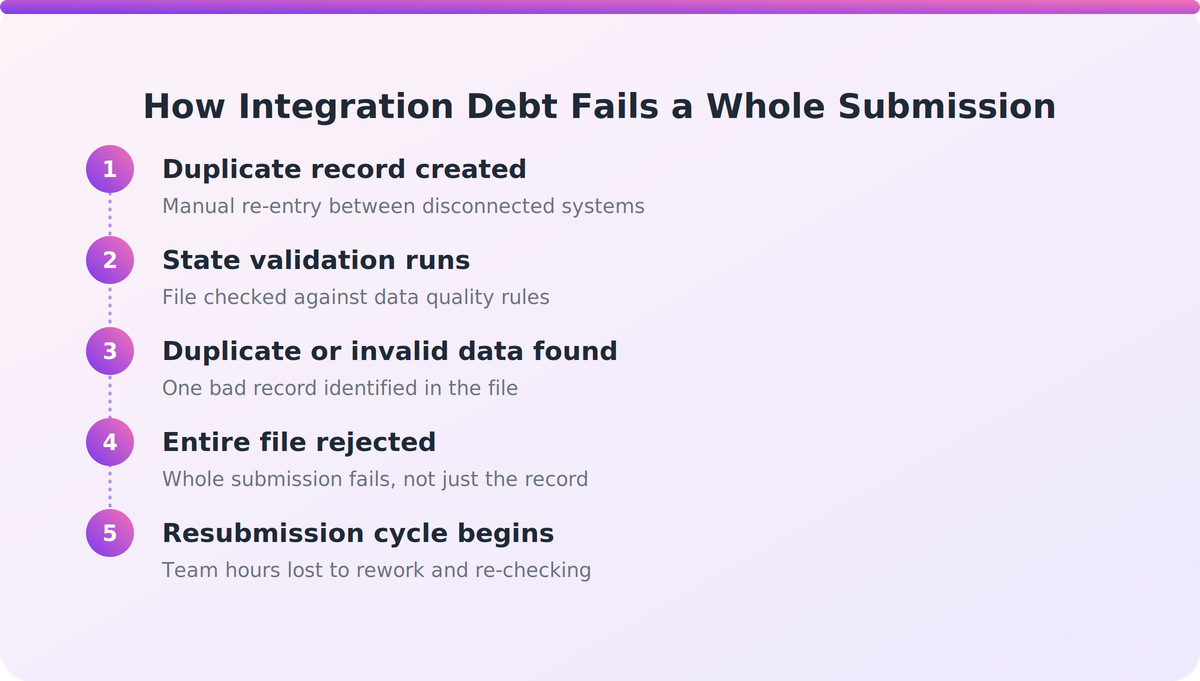
State-level validation is where integration debt bites hardest. Queensland's training department has been explicit: submissions containing duplicate records or invalid characters are automatically failed in full, not flagged and fixed at the record level. If your student management system and your delivery records don't share one clean source of truth, a duplicate created by re-entry somewhere in the chain doesn't cost you one line item. It costs you the whole file, and the resubmission cycle that follows.
Funded programmes multiply the failure points
If you deliver under state-funded arrangements, the exposure compounds. Victoria's Skills First programme and Queensland's Certificate 3 Guarantee and User Choice each layer their own reporting and eligibility rules on top of national AVETMISS requirements. Every extra reporting stream is another point where data has to be pulled, matched and reconciled by hand — and another place where a small mismatch becomes a funding or compliance problem, not just an internal annoyance.
The workforce cost: administration is eating delivery capacity
This isn't only a reporting risk. It's a capacity problem you're already managing. Skills Insight's 2025 VET Workforce Project report found that compliance, reporting and audit requirements can consume 50 to 60 percent of RTO staff workload — describing the administrative burden as one of the biggest threats to RTO viability and a driver of trainer attrition.
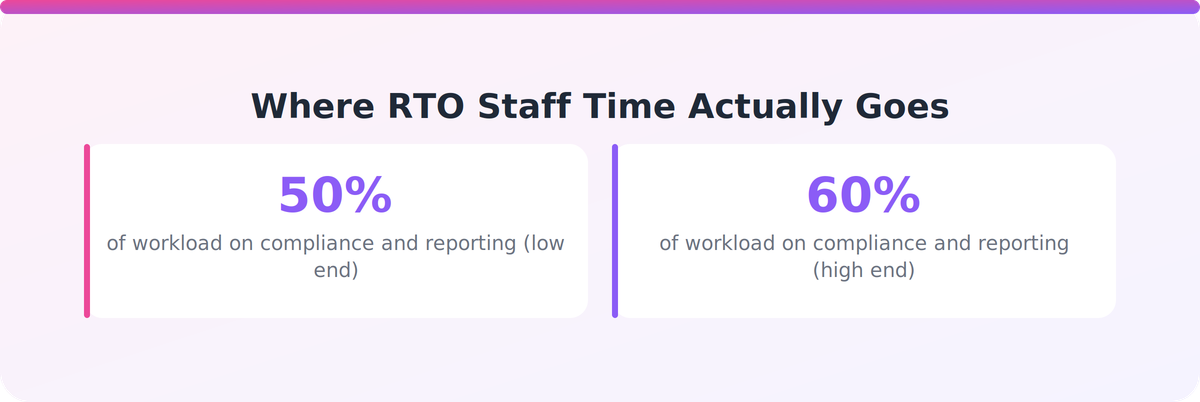
That number should land differently on your desk than on anyone else's. You're the one trying to scale enrolments without scaling headcount, and every hour a trainer or coordinator spends reconciling duplicate entries between systems is an hour not spent on delivery, quality improvement or the retention work that keeps good staff around. Fragmented systems don't just risk an audit finding — they quietly set the ceiling on how much your organisation can grow.
2026: the moment integration debt compounds or gets repaid
The ground is shifting again. The VET Information Standard has been released as the eventual replacement for AVETMISS, with a related Data Streamlining Instrument taking effect on 1 October 2026. Whatever pipeline currently feeds your student and reporting data — student management system, LMS, finance, compliance register — will need to be touched during that transition.
Sector commentary heading into 2026 has been blunt about the underlying risk: treating risk management, quality assurance and data validation as separate, disconnected functions is one of the biggest threats to RTO compliance. The argument is that these need to operate as a single integrated governance framework, not three teams doing three versions of the same job. For a COO, that's not an IT project. It's a governance decision about who owns data quality end to end, and whether your systems roadmap for 2026 is being built with the transition in mind or bolted on afterwards.
Key takeaways
- The Standards for RTOs 2025 test evidence of operating practice, not written policy — manual workarounds between systems are now direct audit exposure.
- Queensland's data validation rules show that duplicate or invalid records can fail an entire AVETMISS submission, not just the affected line.
- 2025 Total VET Activity data is due to NCVER by 28 February 2026 (nil returns included); quality indicator summaries go to ASQA by 30 June.
- Skills Insight's 2025 VET Workforce Project found compliance and reporting can consume 50–60% of RTO staff workload, a direct hit to delivery capacity and retention.
- The VET Information Standard and its Data Streamlining Instrument (effective 1 October 2026) will touch every system feeding your reporting pipeline — plan the transition now, not in September 2026.
Our take
Most RTOs treat integration debt as a backlog item — something to fix when there's budget, not something that threatens registration. That's no longer accurate. Under an outcomes-focused regulatory model, the evidence ASQA wants is the evidence your systems produce automatically, without someone reconciling it by hand at 11pm before a deadline.
The fix isn't simply more headcount to absorb the manual work — that just scales your admin burden alongside your enrolments, which is the exact trap the Skills Insight data describes. The real fix is treating data quality as a governance responsibility with a clear owner, not a shared assumption that "someone" checks the export before it goes to NCVER. If you can't currently name who owns the single source of truth for a student's enrolment record across your systems, that's the gap worth closing before the 2026 transition forces the question.
FAQ
Does the Standards for RTOs 2025 actually require system integration? Not explicitly by name, but it shifts ASQA's focus to evidence that your processes operate effectively in practice, not just written policy. Disconnected systems that rely on manual reconciliation make that evidence harder to produce reliably, which is where the exposure sits.
What happens if our AVETMISS submission contains duplicate records? It depends on the jurisdiction, but the trend is toward stricter whole-of-file validation. Queensland's training department, for example, automatically fails submissions containing duplicate records or invalid characters in full, rather than flagging individual rows — meaning the entire Total VET Activity file has to be corrected and resubmitted.
How does the move from AVETMISS to the VET Information Standard affect our systems roadmap? The VET Information Standard is set to replace AVETMISS, with a Data Streamlining Instrument taking effect 1 October 2026. Every system currently feeding student, enrolment or outcomes data into your AVETMISS pipeline will need to be reviewed against the new standard, so it's worth mapping those data flows well ahead of the 2026 deadline.
Is integration debt really a compliance risk, or just an efficiency issue? Both, but the compliance angle is now sharper. ASQA's risk-based audit approach concentrates scrutiny on providers with a track record of shortcomings — and reporting errors or delays caused by disconnected systems can itself contribute to that track record, on top of the direct AVETMISS submission risk.