RTO Third Party Arrangements: Where Compliance Breaks
4 October 2026 · 7 min read
Under the Standards for RTOs 2025, signing a third-party agreement doesn't move accountability anywhere. The CEO's annual declaration on compliance (ADC) has to cover everything delivered on the RTO's behalf, and ASQA's May 2026 Statement of Regulatory Expectations expects due diligence on the partner's people as well as the contract. Compliance breaks after signing, in monitoring and evidence.
Who is accountable when a third party delivers?
The principal RTO. ASQA's third-party fact sheet says the RTO is accountable for all the actions of the third party relating to the written agreement.
One caveat. That fact sheet was written against the 2015 Standards, so any clause reference in it needs checking against the 2025 text before it goes into your policies.
The principle hasn't moved, though. Your partner can deliver, assess or recruit. The regulator will still come to you.
What did ASQA's 2026 signals add?
Two things stand out. Neither is a new rule aimed squarely at third-party arrangements, but both point the same way.
The Statement of Regulatory Expectations (v1.0, 6 May 2026). It covers fit and proper person requirements and material changes. It expects robust due-diligence arrangements that extend to VET delivered through third-party arrangements. Non-compliance with those requirements will be found non-compliant with the 2025 Standards. In practice, that means vetting the partner's people, not only the paperwork.
The Accountability Practice Guide. It says ADC preparation should cover the RTO's entire scope, including all services delivered by third parties. Where third-party arrangements exist, the CEO completes the ADC having verified the compliance of the third party's systems, practices and processes. The most recent ADC window ran 3–31 March 2026.
ASQA's 2026-27 priorities also name transparency, accountability and assurance in complex and international delivery models. Read together, the direction is clear: verify first, declare second.
Where does compliance quietly break?
Not at signing. The failures sit in the gaps afterwards:
- Thin monitoring. Under the 2015 Standards, an RTO had to keep strategies and resources to monitor the services delivered. A monitoring plan that exists on paper but produces no records won't hold up.
- Unclear scope. Secondary sources describe risk where arrangements are unclear, undocumented or misaligned with the RTO's scope.
- Missed notifications. Under the 2015 Standards, notice was due within 30 days of entering a written agreement. A secondary source says the 2025 Standards retain a formal agreement and 30-day notice, but confirm the exact wording on ASQA's site.
- Partner people nobody vetted. The Statement of Regulatory Expectations puts fit and proper person checks, and material-change notifications, squarely in view.
- Weak evidence of oversight. The CEO has to verify before declaring. If the verification isn't recorded, it didn't happen as far as an auditor is concerned.
Do learners know who is training and assessing them?
Transparency to learners is a live enforcement theme. In its media release on an ART decision affirming a qualification cancellation, ASQA's position is that RTOs must tell students about any third-party arrangements. That includes who trains and assesses them, and who issues the qualification.
If a learner can't tell who is responsible for their training, your marketing, enrolment documents and learner information are the first things to review.
What should you verify after the agreement is signed?
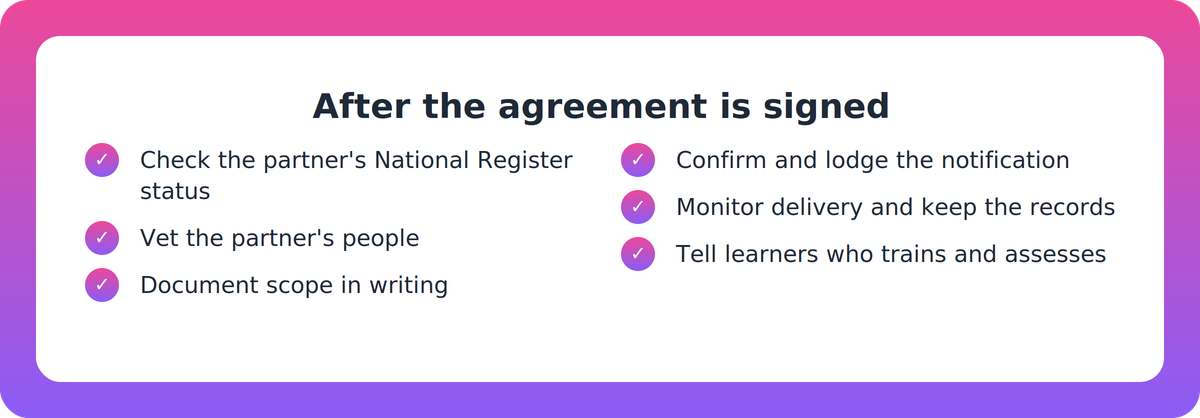
A practical sequence, drawn from the regulator's own expectations:
- Check the partner's standing. Look at their status on the National Register and on ASQA's Qualification Integrity Regulatory Action page.
- Vet their people. Apply fit and proper person checks to the individuals involved, not only the entity.
- Pin down scope. Document exactly which training products and which activities the partner delivers on your behalf.
- Notify on time. Confirm the current notification requirement and lodge it using ASQA's Third Party Service Arrangement notification form.
- Monitor and record. Schedule reviews of delivery and assessment, and keep the outputs.
- Tell learners. State who trains, who assesses and who issues the qualification.
- Feed it into the ADC. Record what you verified about the partner's systems, practices and processes before the CEO declares.
Is every supplier a third party?
Not necessarily. On the 2015 wording, contractor trainers and workplace supervisors who help collect assessment evidence were not treated as third parties. The 2025 definitions should be verified directly rather than assumed.
Funding contracts add another layer. State contracts can be stricter than ASQA. One secondary source describes a NSW arrangement that treats the relationship as brokering and does not allow the third party to do reporting. It's about 459 days old, so treat it as a prompt to read your own contract, not as current guidance.
What is still uncertain?
Be honest about the gaps:
- No ASQA decision or rule change in the last 90 days is specifically about third-party arrangements.
- Several clause-level details still come from 2015-era or secondary sources.
- ASQA's recent cancellations, such as ACG Global Australasia (Nationwide Academy) on 8 September 2026 and Melbourne Training Centre (Studywise College) on 23 July 2026, show active enforcement. We haven't confirmed whether either involved third parties, so don't read them as third-party cases.
Check the 2025 Standards text and ASQA's practice guides before you rewrite anything.
Key takeaways
- Accountability stays with the principal RTO. A third-party agreement doesn't transfer it.
- The ADC covers everything delivered on your behalf, and the CEO should verify the partner's systems, practices and processes first.
- ASQA's May 2026 Statement of Regulatory Expectations extends due diligence to the partner's people, not just the contract.
- Compliance fails after signing: thin monitoring, unclear scope, late notices and no record of oversight.
- Confirm 2025 clause wording and definitions directly with ASQA. Much of the commentary is still built on the 2015 Standards.
Our take
Most RTOs treat a third-party arrangement as a contract problem. It's an evidence problem. The agreement is a single document. Oversight is hundreds of small records that either exist or don't when the CEO signs the ADC. We'd argue the RTOs that fare best will be the ones whose monitoring produces evidence as a normal by-product of the work, rather than something assembled the week before a declaration or audit.
FAQ
Is an RTO still responsible when a third party delivers training and assessment?
Yes. ASQA's third-party fact sheet says the RTO is accountable for all the actions of the third party relating to the written agreement. That fact sheet was written against the 2015 Standards, so confirm clause references against the 2025 text.
Does the annual declaration on compliance cover third-party delivery?
Yes. ASQA's Accountability Practice Guide says ADC preparation should cover the RTO's entire scope, including all services delivered by third parties. The CEO completes the ADC having verified the compliance of the third parties' systems, practices and processes.
What did ASQA's May 2026 Statement of Regulatory Expectations change for third parties?
The statement (v1.0, 6 May 2026) covers fit and proper person requirements and material changes. It expects robust due-diligence arrangements that extend to VET delivered through third-party arrangements. That means vetting the partner's people, not only the agreement.
Do I need to notify ASQA about a third-party arrangement?
Under the 2015 Standards, notice was due within 30 days of entering a written agreement. A secondary source says the 2025 Standards retain a formal agreement and 30-day notice. Confirm the exact wording on ASQA's site and use its Third Party Service Arrangement notification form.
Do I have to tell learners about third-party arrangements?
ASQA's position, in its media release on an ART decision affirming a qualification cancellation, is that RTOs must tell students about any third-party arrangements. That includes who trains and assesses them and who issues their qualification.