RTO Trainer Timetabling After the 2025 Standards
21 September 2026 · 7 min read
Most Heads of Training still build the roster around one number: contact hours. The Standards for RTOs 2025 quietly changed what a trainer's hour is actually for — and if your timetable hasn't caught up, you're burning hours on the wrong evidence while the two things that actually protect you on audit day go under-resourced.
Why this lands on your desk
The Standards for RTOs 2025 commenced on 1 July 2025, replacing the 2015 Standards, and they're built around Outcome Standards, Compliance requirements, and a dedicated Credential Policy covering everyone who delivers, assesses or validates training (ASQA; DEWR). Standard 3.3 makes trainer industry currency an explicit compliance requirement, not a professional development nicety. If a trainer's skills and knowledge have drifted below the level of the training product they're delivering, that's a finding with your name attached, not a footnote in a PD register.
At the same time, validation and moderation quality sits squarely in your remit, and the numbers aren't flattering. One industry analysis of ASQA's 2024–25 regulatory data reports that 78% of performance assessments across Australia's 4,000-plus RTOs returned at least one non-compliance finding. Whatever RTOs are currently doing with trainer time, it isn't consistently meeting the bar.
And NCVER's own research on independent validation — *Begin with the end* — found that validation is often driven by regulatory obligation rather than a genuine improvement goal, and that the evidence-collecting and reporting burden is described by practitioners as onerous. That's not a paperwork problem. It's a rostering decision you make every term.
The Standards changed the test, not just the rulebook
The shift under the 2025 Standards is from written policy to demonstrated outcomes. Industry commentary on the reform describes ASQA's audit focus moving toward evidence that systems actually operate in real delivery and assessment contexts — not just that a policy document says they should. That means your timetable needs to visibly produce evidence of current practice, coached assessment and effective validation, not simply log hours against a training and assessment strategy.
Standard 3.3 is the sharpest expression of this. Trainers and assessors must hold industry competencies, skills and knowledge current to at least the level of the training product being delivered or assessed. A trainer who hasn't been back in industry, hasn't handled a live scenario relevant to their unit of competency, or hasn't had structured practice time built into their week is a currency gap waiting to be found.
Validation is eating trainer time without earning its keep
Under current validation cycle guidance, every training product on scope must be validated at least once every five years, with at least 50% validated in the first three years. That's a rolling obligation competing directly against delivery time, term after term.
NCVER's findings suggest the problem isn't too little validation — it's the wrong kind. Practitioners describe a compliance mentality that produces over-assessment rather than better assessment, with reporting overhead that consumes trainer hours without demonstrably improving outcomes. If your validation timetable is built purely to satisfy the five-year cycle rather than to genuinely test and improve assessment tools, you're paying the time cost without collecting the compliance benefit.
The hours you're not protecting
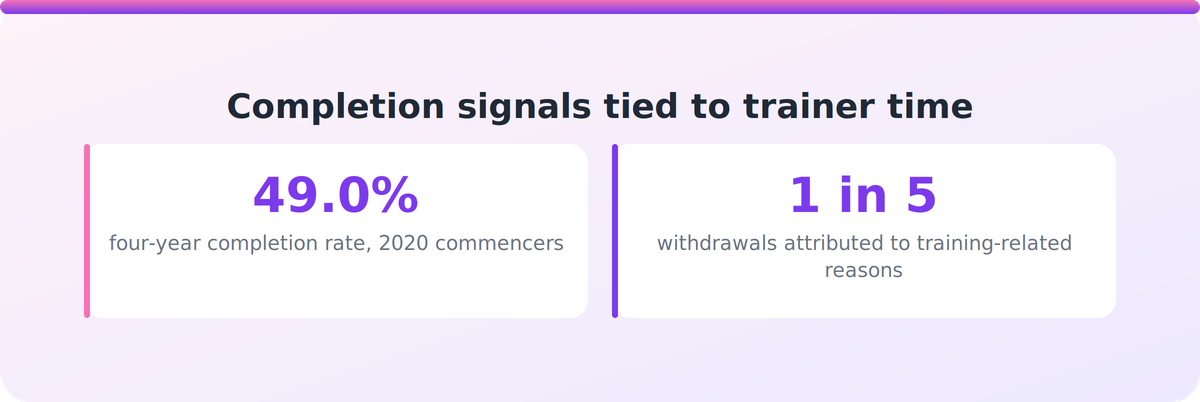
Completion is the other half of this ledger. NCVER's most recent data shows the four-year completion rate for qualifications commencing in 2020 was 49.0%, up from 47.5% for 2019 starters — and roughly one in five withdrawals were attributed to training-related reasons. That figure sits downstream of how much real teaching and coached practice time trainers actually have left once currency maintenance and validation paperwork are accounted for.
Meanwhile, the workforce picture you're planning against is old. NCVER's 2019 workforce survey — still the most recent comprehensive national data set — found trainers and assessors made up 29% of the VET workforce, and NCVER has flagged that there's been no regular, updated national collection on this workforce since. You're timetabling trainer capacity for 2025 against a supply picture that's years out of date.
Three buckets worth defending on the roster
The practical fix isn't a bigger timetable — it's a more honest one. Instead of treating currency maintenance and validation as leftover time squeezed around contact hours, timetable them as their own protected blocks:
- Delivery hours — face-to-face or online contact time against the training and assessment strategy.
- Currency maintenance hours — scheduled industry engagement, updated skills evidence, and practice time mapped against Standard 3.3.
- Validation and coached assessment hours — genuine review of assessment tools and coached practice, spread across the year rather than clustered before an audit.
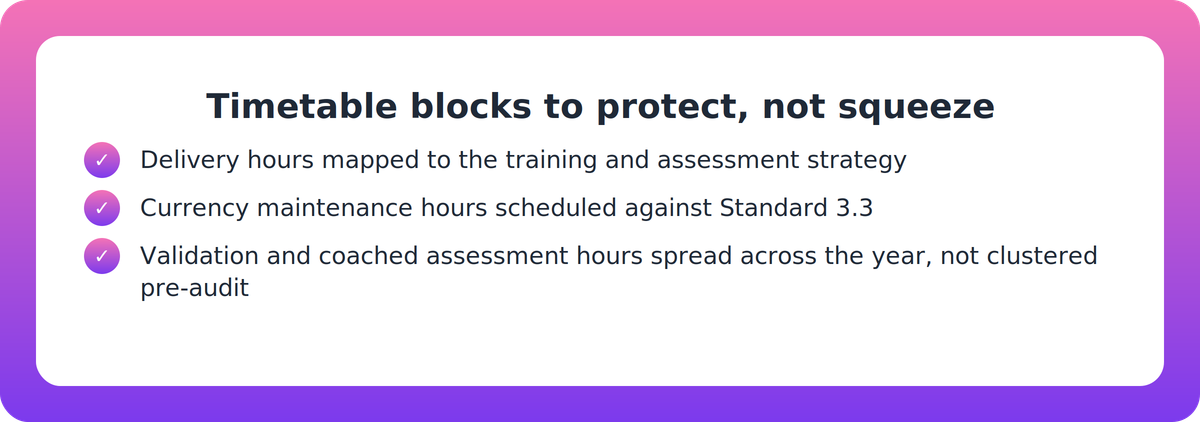
When all three show up on the roster as named, defensible time, you can point to the timetable itself as evidence of current practice — which is exactly the shift the 2025 Standards are asking for.
Key takeaways
- Standard 3.3 puts trainer currency inside the compliance perimeter under the 2025 Standards' Credential Policy — it's now an audit finding, not a PD gap.
- Industry analysis of ASQA's 2024–25 data shows 78% of performance assessments returned at least one non-compliance finding across 4,000-plus RTOs.
- NCVER research warns that validation driven purely by regulatory obligation produces over-assessment and an onerous reporting burden, not better assessment practice.
- National four-year completion sits at 49.0% for 2020 commencers, with about one in five withdrawals training-related — tied directly to how much genuine teaching time trainers retain.
- Workforce planning data is stale: the last comprehensive national VET workforce survey is from 2019, so trainer capacity planning is running on an outdated map.
Our take
The timetable is the actual compliance document now, whether or not you've labelled it that way. A roster that only tracks contact hours is answering last decade's audit question. The 2025 Standards are asking a different one: can you show, in the way trainer time is actually structured, that currency is current and that validation improves assessment rather than just documenting it? That's not solved by adding more validation meetings — NCVER's own findings suggest that's part of the problem, not the fix. It's solved by being deliberate about what each block of trainer time is for, and defending the non-delivery blocks with the same seriousness you defend class hours.
FAQ
Does Standard 3.3 require a documented currency plan for every trainer? Standard 3.3 requires trainers and assessors to hold industry competencies, skills and knowledge current to at least the level of the training product they deliver or assess. The Credential Policy under the 2025 Standards makes this a compliance requirement, so demonstrable, scheduled currency maintenance — not just a claim in a trainer file — is what audit evidence now needs to show.
Is more validation the answer to the 78% non-compliance figure? Not necessarily. NCVER's *Begin with the end* research found that validation driven mainly by regulatory obligation tends to produce over-assessment and a compliance mentality rather than genuinely better assessment. The fix is validation that's timetabled to actually test and improve assessment tools, not simply to satisfy the five-year cycle.
How does trainer timetabling connect to completion rates? NCVER data shows the four-year completion rate for 2020 commencers was 49.0%, with about one in five withdrawals attributed to training-related reasons. How trainer hours are split between delivery, currency maintenance and validation affects how much genuine coaching and teaching time learners actually get — which is a lever this role controls directly.
How should I plan trainer capacity given how old the workforce data is? The most recent comprehensive national VET workforce survey is from 2019, when trainers and assessors made up 29% of the workforce, and NCVER has noted there's been no regular update since. Treat sector-wide workforce figures as a general backdrop only, and build your own current picture of trainer currency, workload and capacity at the RTO level rather than relying on the national snapshot.