RTO Training Portfolio Management Software: Unit by Unit
5 October 2026 · 6 min read
When a unit of competency is superseded, most RTOs go hunting. The assessment tool is in one folder, the assessor guide in another, the mapping in a spreadsheet, the training and assessment strategy somewhere else. The links between them live in someone's memory. That's what makes a routine update expensive.
Why do RTOs lose track of individual units?
Not through carelessness. It's structural.
Each unit on scope sits behind several documents:
- The assessment tool
- The assessor guide
- The mapping document
- The study or learner guide
- The training and assessment strategy (TAS)
In most RTOs these are separate files that share a unit code in the title and not much else. Multiply that by dozens of qualifications and hundreds of units. Nobody can say with confidence what else a given unit touches.
That's fine until something changes. Training package updates and supersessions happen regularly. When one lands, the question is "what depends on this?" and the honest answer is often "let's search the shared drive." The result is rework across the catalogue, and the risk of a stale resource slipping through to a learner or an auditor.
What does good RTO training portfolio management actually need?
More documents won't fix it. Neither will another register of documents. A tracker tells you a file exists. It doesn't tell you which performance criterion the file addresses.
The principle that works is simpler: treat scope as one connected record. That record runs from training package and qualification down to units, elements and performance criteria. Every resource you create is tied to the exact part of the unit it covers.
With that in place, three things become possible:
- Find what depends on a unit by following links, not searching folders.
- Prove coverage because each resource maps to specific elements and criteria.
- Update with precision because you know which resources a change affects.
The unit stays the anchor. The portfolio is just many anchors, connected.
How VETos holds scope as a connected record
VETos models scope as a connected graph, a centre of record. It covers the training package, qualifications, units, elements and performance criteria. On the Australian side it's anchored to ASQA and pulls live qualification and unit data from training.gov.au.
When you upload or select a training package, VETos maps every element and performance criterion automatically. You don't build the structure by hand before you start.
From there, what you generate stays attached to it:
- Assessment packages in standalone, clustered, grouped or integrated form, produced with a matching assessor guide and mapping document
- Study guides, SCORM packages and training and assessment strategies
- Learner guides and session plans, per the resource-developer page
- Learning content (Nova), generated from training products, with each activity traceable to its unit
Everything is mapped back to the relevant unit and standard. That mapping is built so a validator can check coverage without taking your word for it.
What happens when a unit is superseded or converts?
This is where the connected record earns its keep.
VETos flags superseded units when they change. According to the VETos FAQ, because assessments, study guides and TAS are joined to the graph and to each other, changing a unit on the register means everything grounded in it knows. Updating becomes targeted rather than a manual hunt.
The same applies to format changes. When a unit on your scope converts to TPOF 2025 / ASK format, existing tools are upgraded and re-mapped to the new structure, with the version trail intact. You keep the history of what changed and when.
A realistic picture of the workflow
- A unit on scope is superseded or converts.
- VETos flags it.
- You see which linked resources are affected.
- Existing tools are upgraded and re-mapped, and your people review them.
- The version trail records the change.
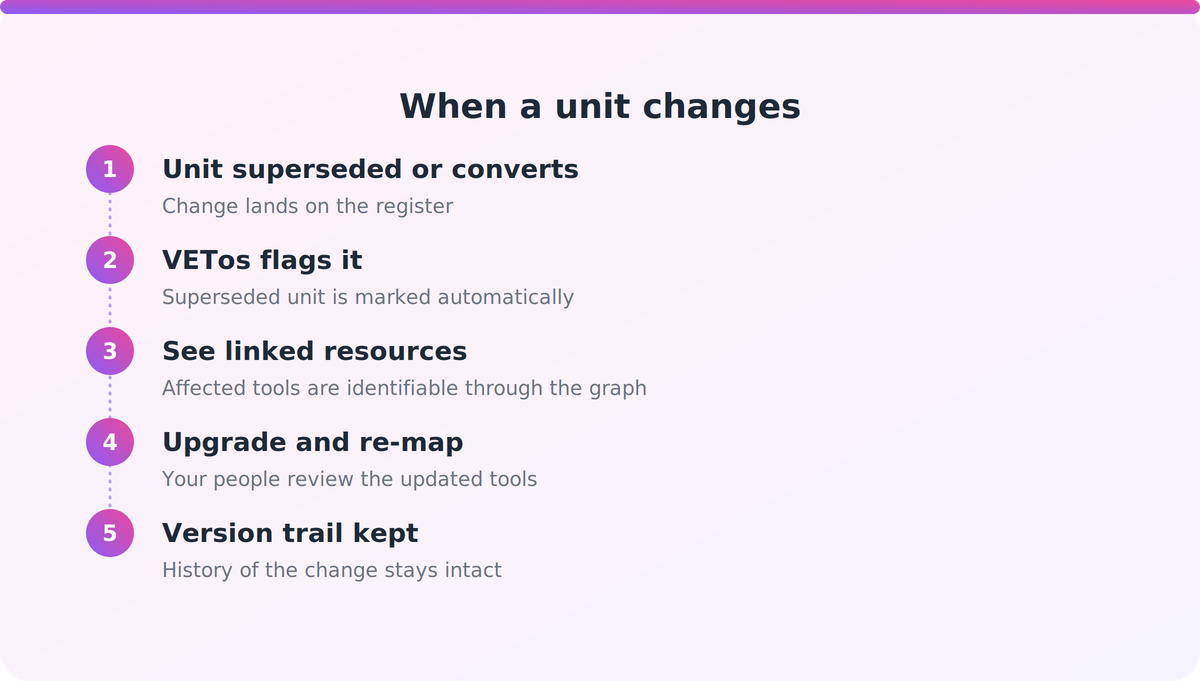
Step four matters. VETos doesn't remove professional judgement. Nova never marks, and assessors keep every competency decision.
What VETos doesn't claim to be
Be clear-eyed here. The VETos sites don't describe a dashboard, a per-unit status tracker or a named reporting feature. The unit-level visibility comes from the graph, the mapping, the traceability and the supersession flags.
If you want a project-management board for your portfolio, that's a separate question. If your problem is "I can't tell what depends on this unit," the connected record is aimed squarely at it.
The resource-developers page also cites up to 80% less content development time and a 95% first-time validation pass rate. Those are the vendor's own claims, with no method or sample published. Ask for evidence that matches your scope before you rely on them.
Questions to ask any portfolio tool
Whether you're weighing VETos or something else, test these:
- Does it model units down to performance criteria, or just store files against a unit code?
- Can you trace a single assessment question back to the element it addresses?
- What happens to linked resources when a unit is superseded?
- Is the version trail kept when a unit converts to a new format?
- Where does the human sit in the decision-making?
Key takeaways
- RTOs lose track of units because the documents behind each unit are separate files linked only by a title.
- A connected record of scope, from training package down to performance criteria, makes it possible to see what a unit touches.
- VETos maps elements and performance criteria automatically and ties each generated resource to its unit and standard.
- Superseded units are flagged, and TPOF 2025 / ASK conversions re-map existing tools with the version trail intact.
- Assessors keep every competency decision. Treat efficiency figures as vendor claims and ask for proof.
Our take
Most compliance pain in RTOs isn't a knowledge gap. It's a findability gap. People know the unit changed. They can't quickly see what that means for everything built on it. We think the structure matters more than the tooling around it: get scope into one connected record first, and reporting and workflow get easier. A dashboard on top of loose files just shows you the mess more clearly.
FAQ
What is RTO training portfolio management software?
It's software that helps a Registered Training Organisation manage its scope of units, qualifications and the resources behind them. The useful kind links each assessment, guide and strategy to the specific unit and standard it addresses, rather than just storing files.
How does VETos handle superseded units of competency?
VETos flags superseded units when they change. Because resources are joined to the graph and to each other, you can update the affected ones in a targeted way instead of searching manually.
What happens when a unit converts to TPOF 2025 / ASK format?
Per the VETos FAQ, existing tools for that unit are upgraded and re-mapped to the new structure, with the version trail intact. Your people still review the outcome.
Does VETos replace assessors?
No. VETos doesn't remove professional judgement from the loop. Nova never marks, and assessors keep every competency decision.
Does VETos use live unit data?
Yes. On the Australian side, VETos is anchored to ASQA and pulls live qualification and unit data from training.gov.au. Mapping of elements and performance criteria is automatic when a training package is uploaded or selected.
Take a closer look
If you're weighing how to manage your scope, pick one qualification and trace a single unit through its assessment, guide and mapping. That test shows you quickly whether the links are real. You can see how VETos handles it at vet.supahuman.com.