RTO Validation Meetings: A Head of Training's Guide
7 October 2026 · 7 min read
A validation meeting that produces only minutes is a record of attendance, not evidence of quality. Under the 2025 Standards, ASQA gives you flexibility and no template, so the test is simple. Did the meeting change a tool, a trainer's practice or a delivery decision, and can you trace that change afterwards?
Why this lands on your desk
You answer for assessment quality across every trainer. Validation is the main way you find inconsistency between trainers before a regulator or a learner outcome finds it for you.
The context has moved. The 2025 Standards for RTOs took effect on 1 July 2025. ASQA says they give providers greater flexibility in how they achieve outcomes and demonstrate compliance. ASQA also says it will not provide a training and assessment strategy (TAS) template (ASQA 2025 Standards FAQs, version 3). The design of validation, and the definition of good, sit with you.
The stakes are visible. ASQA's regulation reporting for July 2025 to March 2026 (updated 4 June 2026) records 116 performance assessments, and 45 of them (39%) had a finding of non-compliance. We can't say what drove each finding. But a meeting that records attendance and changes nothing is a weak answer to a regulator asking how you review and act on your assessment system.
Then there is the cost. Validation competes with delivery for trainer hours. Industry Skills Australia's transport and supply chain study is industry-specific, not sector-wide. It reports that experienced trainers and assessors are harder to attract and retain, that regional shortages exist, and that technological change raises the time and cost of keeping vocational currency. If you pull trainers into a room, the room has to pay them back.
Confirm the requirements before you redesign
Some of what circulates about validation under the 2025 Standards comes from vendor commentary, not the regulator. Check it before you rebuild your process around it.
What ASQA's FAQs do say is that anyone undertaking validation must hold an AQF qualification or skill set at least to the level being validated. "At least to the level" refers to the skills and knowledge level of the training product being validated, not AQF-level equivalence. The Credential Policy sets out credentials for delivering, assessing and validating. The FAQ text on TAE products under Standard 1.5 was partly garbled in the version we reviewed, so read the original PDF.
Secondary commentary, from eSkilled rather than ASQA, makes four claims worth verifying against the legislation and ASQA Practice Guides:
- Validation now has a formal legislative definition as a review of the assessment system.
- The five-year maximum cycle remains, but validation is risk-based and more frequent where risks, product changes or stakeholder feedback point to it.
- Standard 1.3 requires assessment tools to be reviewed before use.
- Validators must be independent of design or delivery.
Treat these as questions for your compliance lead, not settled rules. If they hold, they all push the same way. Validation is a working review, not a ceremony.
What a meeting that changes practice looks like
The difference is in what you bring and what you leave with. Here is a structure you can use this quarter.
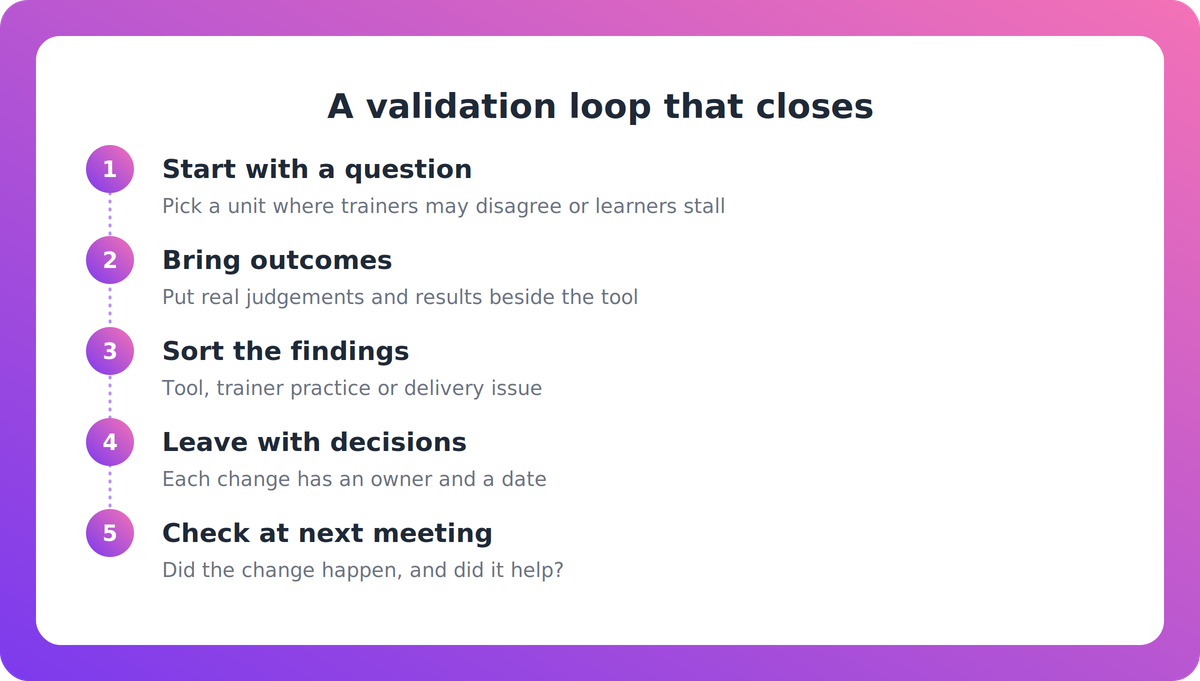
- Start with a question, not a schedule. Choose a unit of competency where you suspect trouble. Maybe trainers disagree on what counts as competent, or learners stall at one task, or a tool changed recently.
- Bring outcomes, not just documents. Put real assessment judgements, learner results and trainer feedback on the table next to the tool. A tool can be perfectly mapped and still produce uneven decisions.
- Separate the findings. Sort each issue into tool, trainer practice or delivery. Each needs a different fix, and a different owner.
- Leave with decisions. Every action gets a name, a date and a described change. "Review the benchmark" is not a decision. "Rewrite the observation checklist and brief all assessors" is.
- Close the loop at the next meeting. Start by checking whether last time's changes happened, and whether they made a difference.
The closed loop
The fifth step is the one most RTOs skip. Without it, you have a list of good intentions. With it, you have the traceable change that serves both quality and inspection.
Use validation to learn the new outcomes
In an ASQA webinar, staff said providers will need some time to become fully proficient in the new Outcome Standards, such as wellbeing and diversity and inclusion. That is an honest signal. Nobody has a finished answer yet.
Validation is a sensible place to work it out. Ask what these outcomes look like in your learners' experience of assessment, and where trainers interpret them differently. You build understanding from your own evidence instead of waiting for someone else's template.
Look at outcomes, not only paperwork
A vendor summary of ASQA's 2026 priorities (eSkills Australia, not confirmed on ASQA's own page) lists the quality and sufficiency of training and qualification integrity among regulatory risks. It interprets this to mean that a compliant TAS does not prove sufficient training was delivered. That is the vendor's reading, not an ASQA quote.
It is still a useful discipline. If your validation only checks that documents line up, you are validating the paperwork. Ask whether the assessment decisions your trainers actually make match the standard in the unit.
Protect the trainers' time
Shorter, sharper and more frequent beats long and annual, if your risk picture supports it. Keep the room small. Send the evidence beforehand. Tell trainers afterwards what changed because of their input.
That last step matters more than it looks. Trainers who see their feedback turn into a better tool will turn up willingly. Trainers who see minutes disappear will not, and they will be right.
Key takeaways
- Under the 2025 Standards (in effect since 1 July 2025), ASQA provides no TAS template, so you design what good validation looks like.
- ASQA's regulation reporting shows 45 of 116 performance assessments (39%) from July 2025 to March 2026 with a non-compliance finding.
- Judge each meeting by whether it changes tools, trainer practice or delivery, and whether you can trace that change.
- Verify vendor claims about validation cycles, independence and Standard 1.3 against the legislation and ASQA Practice Guides.
- Close the loop. Open each meeting by checking whether the last meeting's actions happened.
Our take
Most RTOs treat validation as evidence for an auditor. We think that gets it backwards. The better evidence for an auditor is a trail showing you found a problem and fixed it. That trail only exists if the meeting was built to produce change.
We also think the instinct to wait for a template is a trap. ASQA has said it won't supply one. A copied template gives you the look of a system without the judgement behind it.
One caution. We have not seen proof that any particular meeting format reduces non-compliance findings, and the brief behind this piece doesn't claim it. Treat the structure above as a reasoned approach to test in your own RTO, not a guarantee.
FAQ
Does ASQA provide a template for validation or the TAS under the 2025 Standards?
No. ASQA says providers can decide how to compile and present their training and assessment strategies, and it will not provide a TAS template (ASQA 2025 Standards FAQs, version 3). That puts the design of validation on the RTO.
Who is qualified to validate?
Per ASQA's FAQs, anyone undertaking validation must hold an AQF qualification or skill set at least to the level being validated. This refers to the skills and knowledge level in the training product, not AQF-level equivalence. The Credential Policy sets out credentials for delivering, assessing and validating. Check the original FAQ PDF on TAE products under Standard 1.5, because the text we reviewed was partly garbled.
How often should we validate?
Check the legislation and ASQA Practice Guides before you decide. Vendor commentary (eSkilled, not the regulator) says the five-year maximum cycle remains but validation is risk-based and more frequent where risks, product changes or stakeholder feedback indicate. Treat that as a claim to confirm, then set your schedule around your own risks.
How do I show that validation changed practice?
Record each finding as a tool, trainer-practice or delivery issue, then log the owner, the date and the specific change made. At the next meeting, record whether the change happened and what it did to assessment outcomes. That trace is what separates a working system from minutes.
Your next step is small. Pull the action list from your last validation meeting and check which items changed what a trainer did. The answer tells you what your meeting is really for.