RTO Validation Schedule: Why Annual Isn't Enough
14 October 2026 · 5 min read
An annual RTO validation schedule isn't wrong, but it's no longer enough on its own. The Standards for RTOs 2025 keep a five-year maximum cycle, make it risk-based, expect assessment tools to be reviewed before use, and link validation to continuous improvement. Those are event triggers, not calendar dates.
Does the 2025 Standards say validation must be annual?
No. The regulatory text doesn't mention an annual cycle. It keeps a five-year maximum for validation, but makes it risk-based. So "annual isn't fast enough" is our reading of the rules, not an ASQA statement.
That distinction matters. If you tell an auditor "ASQA requires annual validation", you'll be wrong. If you tell them "our schedule responds to risk, product change and pre-use review", you're describing what the Standards actually push towards.
What triggers validation under the 2025 Standards?
A fixed annual date covers none of the following. Each is a trigger in its own right:
- Pre-use review. ASQA's 2025 Standards FAQs (v3.0) say assessment must be consistent with the training product's requirements, and that assessment tools must be reviewed before use. Validation starts before a tool reaches a learner, not only through retrospective sampling.
- Risk. eSkilled's 2025 vs 2015 comparison says RTOs must validate more often where risks, product changes or stakeholder feedback call for it.
- Product change. When a training package updates, tools built on the old version are suspect until re-checked.
- Cohort adaptation. An ESOL or LLN version of an assessment is a different tool. It needs the same coverage check as the original.
Why does the five-year maximum mislead?
Five years is a ceiling, not a plan. AICP advises RTOs not to wait that long, because smaller, regular validations mean fewer surprises.
CAQA describes a more workable model. Risk "heat maps" feed a five-year plan that's updated each quarter. Higher risk means sooner and more frequent validation. The plan is live, not a spreadsheet filed in January.
What are auditors finding?
Coastwide Training, a consultancy, has published its reading of ASQA audit findings. It isn't ASQA itself, so treat it as informed commentary. It reports validation that:
- isn't run against a genuine cyclical schedule
- lacks independent input
- is done by people without the right credentials
Its recommendation is a rolling schedule with named, credentialled validators. The Credential Policy now covers who may validate, so that last point has teeth.
How do ASK units change the picture?
The DEWR Training Package Organising Framework, effective 1 July 2025, introduces the Application of Skills and Knowledge (ASK) unit format. It sits alongside traditional elements-and-performance-criteria units.
If a unit on your scope changes format, the tool needs re-mapping and re-validation. Adapted versions, such as ESOL or LLN variants, must be checked for the same coverage. One annual event can't absorb that across a whole portfolio.
What does a rolling, event-triggered schedule look like?
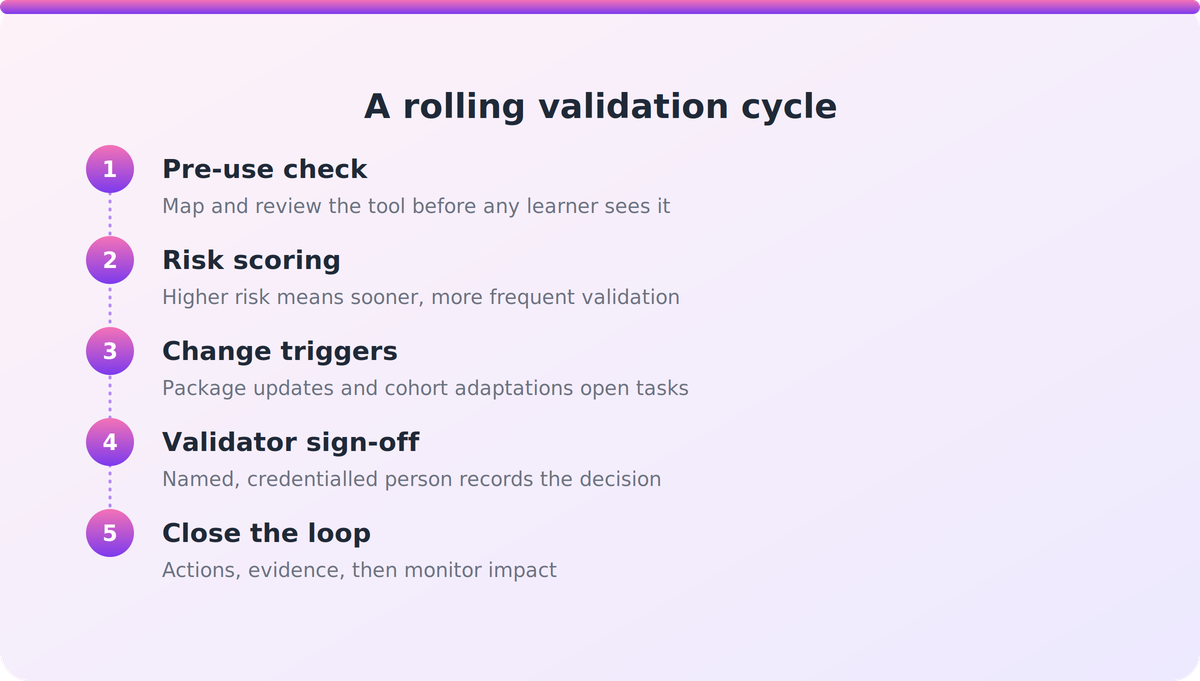
A practical version has five parts:
- Pre-use check. Map the tool to the unit and review it before any learner sees it.
- Risk register. Score units and tools by risk. Higher scores get validated sooner and more often.
- Change watch. Training package releases, ASK format changes and new cohort adaptations open a validation task.
- Named validators. Assign credentialled people, with independent input where it counts.
- Closed loop. eSkilled says RTOs will need this in 2026: findings, improvement actions, implementation evidence, then monitoring of impact.
Every step should leave a traceable record. If you can't show what changed, why, and who signed off, it didn't happen as far as an audit is concerned.
Where does AI fit?
Secondary sources report that ASQA ran 2026 sector workshops on AI use under the 2025 Standards. Their message: AI-generated tools must still be valid, contextualised and properly mapped. AI can't make assessment decisions or complete validation.
The useful role is preparation, traceability and version history, with a qualified validator signing off. Check this against ASQA's own practice guidance before you build policy on it. The evidence here is commentary, not regulation.
Key takeaways
- The 2025 Standards don't mention "annual". They keep a five-year maximum and make it risk-based.
- Assessment tools must be reviewed before use, so validation begins before delivery.
- Training package changes, including the ASK unit format, and adapted ESOL or LLN tools are triggers a fixed date misses.
- A rolling schedule with named, credentialled validators and a closed improvement loop is the more defensible model.
- AI can support preparation and records. A qualified human validator still signs off.
Our take
Most RTOs don't have a validation problem. They have a calendar problem. A single annual event feels tidy, but it gets validation done at the wrong time: too late for new tools and too early for the next package change. We'd rather see a smaller, constant stream of validation tied to real events, with a clear record of each one. Fewer big days, fewer nasty surprises.
It's worth asking when your last unscheduled validation happened, and what triggered it. If the answer is "never", the schedule is probably running you.
FAQ
Does ASQA require RTOs to validate annually?
No. The 2025 Standards don't mention an annual cycle. They keep a five-year maximum for validation and make it risk-based, so higher-risk areas call for earlier and more frequent validation.
What is the maximum validation cycle under the Standards for RTOs 2025?
Five years. It's a ceiling, not a target. Check the current ASQA FAQs before quoting any older rule about the share of units validated by a given year, as that detail may have changed.
Do assessment tools need review before they're used?
Yes. ASQA's 2025 Standards FAQs (v3.0) say assessment tools must be reviewed before use and that assessment must be consistent with the training product's requirements.
What should an RTO do when a unit changes to the ASK format?
Re-map the assessment tool to the new unit and re-validate it. Any adapted versions, such as ESOL or LLN, need checking for the same coverage.
Can AI complete validation for an RTO?
Not according to secondary sources reporting on ASQA's 2026 workshops. AI can help with preparation, traceability and version history, but a qualified validator must sign off. Confirm against ASQA practice guidance.