Sales Role-Play Training Software: An AU Buyer's Guide
30 August 2026 · 9 min read

Buying sales role-play training software in Australia comes down to three checks: does the AI counterpart genuinely adapt to what a rep says, are you buying a focused practice tool or a full enablement suite, and does the vendor's data handling hold up against the Australian Privacy Principles and the OAIC's AI guidance. Get those three right and the rest is comparison shopping.
What does AI sales role-play software actually do?
The category is now mainstream. Platforms let a rep talk through a full selling conversation with an AI "buyer" that has its own personality, objection patterns and pressure points, then hand back a scored assessment of how the conversation went (Mindtickle, 2026). Some tools are voice-based, some are chat, a growing number layer video or avatars on top.
The pitch is consistent across vendors: unlimited practice reps, no scheduling a manager or a peer, and repetition on the exact scenarios a team struggles with — cold opens, price objections, procurement pushback, the "difficult customer" conversation. The execution quality varies enormously, which is why the evaluation criteria below matter more than the demo.
The single best test: does the AI counterpart really adapt?
Every vendor now claims their tool is "AI-powered". The question that actually separates good tools from decorated scripts is adaptiveness: does the AI counterpart change its responses based on what the rep says, or does it follow a predetermined path regardless of input?
Yoodli's buyer guidance recommends a concrete test before you sign anything: run the same scenario two or three times, giving deliberately different answers each time, and watch what happens. A genuinely adaptive AI counterpart will branch — it objects differently, concedes differently, escalates differently. A weak one is generic and predictable, and reps figure out how to "beat" it within a few sessions rather than building real skill.
Run this test with actual reps in the room, not just the L&D team. Reps spot a scripted bot faster than anyone, and their trust in the tool is what determines whether they'll actually use it once the pilot ends.
Dedicated role-play tool or full enablement suite?
Not every vendor selling "AI sales role-play" is selling a role-play tool. Some, like Mindtickle, are broader sales enablement and readiness platforms where role-play is one module sitting alongside content management, coaching workflows and analytics dashboards.
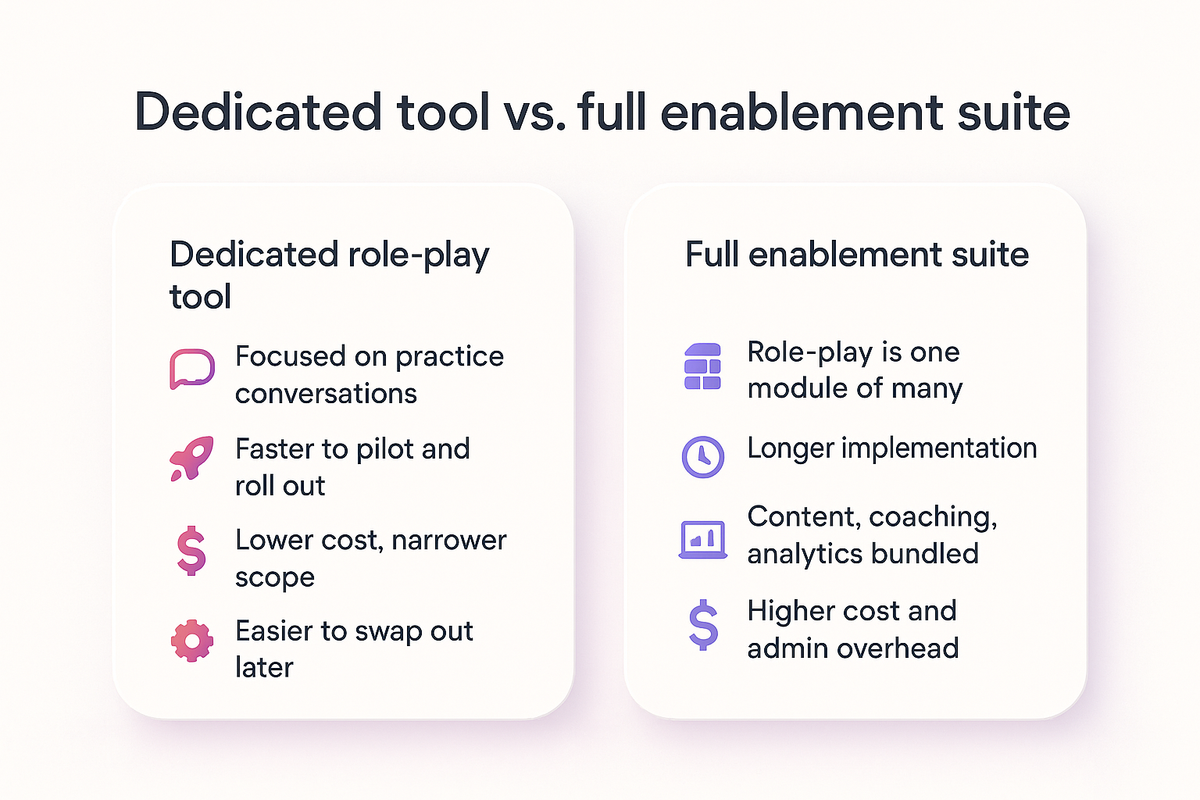
That's not necessarily a problem — but it changes the buying decision. A dedicated role-play tool is usually faster to pilot, narrower in scope, and cheaper to run. A full suite can deliver more value long-term, but it also means a longer implementation, more admin overhead, and a bigger commitment if all you actually needed was better practice reps for the sales team.
Be honest with yourself about what problem you're solving before you sit through a suite demo. If the answer is "our reps need more practice before live calls", start with vendors who solve that specifically.
Privacy and AI governance: what to check before you sign
There's no Australia-specific regulation written for sales role-play software. Due diligence instead rests on two existing frameworks.
The first is the Privacy Act, via the Office of the Australian Information Commissioner's guidance on privacy and commercially available AI products, published in October 2024. The OAIC's position is that the Australian Privacy Principles (APPs) apply to any tool processing rep voice or conversation data — and it has stated this guidance applies broadly, including to organisations that sit below the Privacy Act's $3 million turnover threshold. If your role-play tool records, transcribes or scores rep conversations, that's personal information under the APPs, and it's worth a direct question to the vendor about how it's stored, retained and used.
The second is the Department of Industry, Science and Resources' Voluntary AI Safety Standard, released in September 2024. It's not mandatory, and sales role-play tools are unlikely to fall under any proposed high-risk category, but its ten guardrails — covering data governance, human oversight, transparency to users, and record-keeping — are a sensible checklist to run through with any AI training vendor regardless.
For enterprise buyers, add the standard vendor-security questions: SOC 2 Type II compliance, data residency and retention terms, SSO/SCIM support, and a direct answer to whether your team's practice conversations are used to train the vendor's own models.
Evaluation checklist for Australian buyers
Before you shortlist, weigh each vendor against:
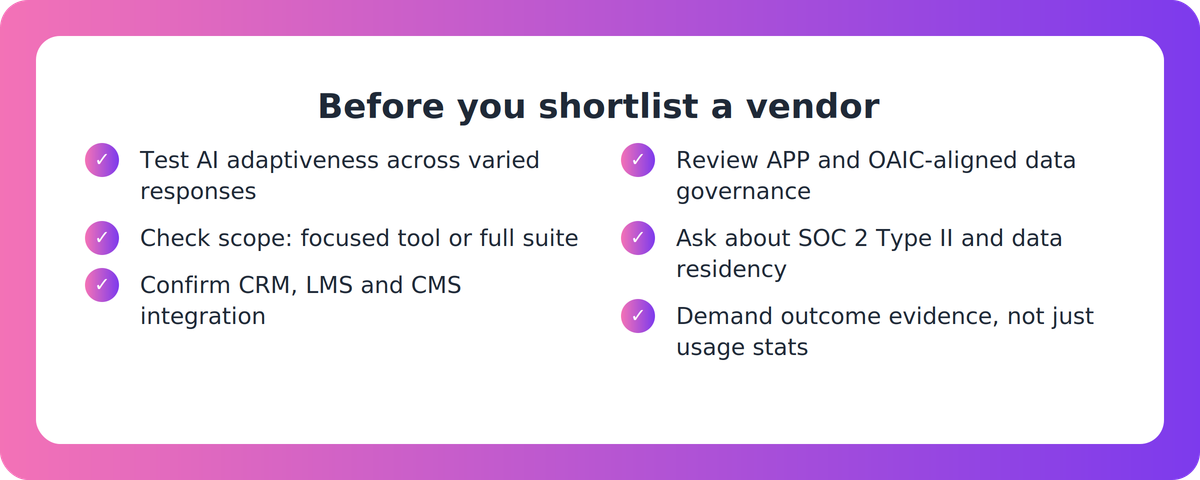
- AI realism and adaptiveness — tested with different rep responses, not taken from the demo script
- Customisation to your actual sales motion, buyer personas and objections, not generic templates
- Scope fit — a focused practice tool versus a full suite that adds implementation and admin burden
- Integration with your existing CRM, conversation intelligence and LMS/CMS stack
- Data governance aligned to the APPs and the OAIC's AI guidance, plus SOC 2 Type II, data residency and clarity on model training use
- Alignment with the Voluntary AI Safety Standard's guardrails on transparency and human oversight
- Evidence of skill or behaviour-change outcomes, not just sessions-completed dashboards
- Pricing transparency and a willingness to run a real, rep-led pilot before you commit
Where a VET-focused tool like Nova fits (and doesn't)
Worth a brief note for readers comparing tools built for training providers rather than corporate sales floors. Nova, built by Supahuman, generates role-play scenarios — including a "difficult customer" scenario type — with an AI counterpart, and gives learners formative, criterion-by-criterion feedback on practice attempts. Assessors retain every competency decision; Nova assists the practice, it doesn't replace human sign-off.
That's relevant to the adaptiveness and customisation criteria above, and for Registered Training Organisations (RTOs), scenarios can be mapped to elements, performance criteria and evidence requirements within an AQF-aligned unit of competency. But Nova is positioned on its own site as a broader instructional-design engine — role play is one of twenty activity types — rather than a dedicated sales-enablement product, and there are no published Australia-specific sales-role-play case studies. Weigh it as a reference point for VET-context buyers, not a like-for-like alternative to purpose-built sales role-play vendors.
Does practice with an AI counterpart actually build skill, or just look good in a demo?
This is the honest gap in the category. Sessions completed and minutes logged are easy to report and easy to game — a rep can rack up usage without getting measurably better at handling objections. Usage is not the same as skill development.
Ask vendors directly how they measure outcome impact, not activity. Do they track scoring improvement across repeated attempts on the same scenario type? Do they correlate practice with live-call performance? If the answer is vague, treat the usage stats in their case studies with some scepticism.
The most reliable check is still the oldest one: pilot with a handful of real reps, not just their managers, for a few weeks before you buy. Watch whether they keep using it once the novelty wears off.
Key takeaways
- Test adaptiveness directly — run the same scenario with different responses and check whether the AI counterpart genuinely branches or just follows a script.
- Know whether you're buying a dedicated practice tool or a full enablement suite before you sit through the demo.
- Treat data governance as a live compliance question: check alignment with the APPs, the OAIC's October 2024 AI guidance, and the Voluntary AI Safety Standard's guardrails, even though no sector-specific rule governs this category.
- Ask enterprise-grade vendors for SOC 2 Type II status, data residency terms, and a direct answer on whether your conversations train their models.
- Insist on outcome evidence beyond usage dashboards, and pilot with real reps before committing.
Our take
The category has matured fast, and the AI-buyer conversation experience is genuinely useful when it's done well — reps get repetition they'd never get from a manager's calendar. But "has AI" tells you almost nothing anymore; adaptiveness, scope and data governance are where the real differences sit, and they take more effort to check than watching a polished demo. Australian buyers don't have a sector-specific regulation to lean on here, which puts more weight on your own due diligence, not less.
FAQ
What should an Australian L&D or sales enablement team look for when evaluating AI sales role-play software? Prioritise genuine AI adaptiveness (test it with varied rep responses), clarity on whether you're buying a focused tool or a broader enablement suite, integration with your existing CRM and LMS, and evidence of skill outcomes rather than just usage metrics.
Is AI-driven role-play training compliant with Australian privacy and AI governance expectations? There's no sales-role-play-specific regulation in Australia. Compliance rests on the existing Privacy Act and the OAIC's October 2024 guidance on AI products, which applies the Australian Privacy Principles to any tool handling rep conversation data, plus the Department of Industry's voluntary AI Safety Standard guardrails as a due-diligence checklist.
What's the difference between a dedicated AI role-play tool and a broader sales enablement platform? A dedicated tool focuses on practice conversations and scoring, with faster rollout and lower cost. A broader suite, like Mindtickle, bundles role-play alongside content management, coaching and analytics — more capability, but more implementation effort and cost if role-play is all you need.
Can AI role-play practice actually be trusted to build real skill? Only if it's genuinely adaptive and the vendor can show how practice correlates with performance improvement, not just sessions completed. Usage metrics alone don't prove skill development — pilot with real reps and ask the vendor directly how they measure outcome impact.
Does a tool like Nova count as sales role-play training software? Not directly. Nova is an instructional-design engine built for training providers, with role-play as one of twenty activity types and formative feedback that assists learners without replacing assessor sign-off. It's a useful reference point for adaptiveness and customisation criteria in an AQF-aligned VET context, but it isn't a dedicated corporate sales-enablement product.
If you're evaluating this category for a training provider context rather than a pure corporate sales floor, it's worth a look at how Nova approaches AI counterpart role-play and formative feedback — alongside, not instead of, the purpose-built sales-enablement vendors on your shortlist.