Why UK Sales Teams Rehearse Less Than Actors Do
30 July 2026 · 7 min read

An actor wouldn't walk on stage after one read-through, but that's roughly how much rehearsal most UK sales reps get before a high-stakes call. Employer training investment has fallen to its lowest level in over a decade, and national skills funding is about to withdraw support from the generic courses many sales teams leaned on. The result is a widening gap between how much practice reps get and how much the job now demands.
The funding squeeze nobody's talking about
UK employers have cut training investment to its lowest level in more than a decade, according to research reported by People Management and sourced from the CIPD. That's not a one-off dip — CIPD's own skills factsheets describe persistent, structural weakness in UK workplace training and vocational skills development going back years.
At the same time, the funding floor under generic training is being pulled away. Skills England is removing funding for 16 generic leadership and skills standards from 1 September 2026, a change flagged in SRSCC's 2026 skills briefing. Many of these standards are exactly the kind of off-the-shelf course sales teams have historically used to tick the training box.
This is happening while adaptability, according to the same skills-gap analysis, has overtaken every technical skill as the UK workforce's single biggest capability shortfall. Sales teams are being asked to handle more ambiguity, with less structured support, and a shrinking pool of funded generic content to fall back on.
Why rehearsal culture is thin in UK sales teams
Actors have directors in every rehearsal. Athletes have coaches at every session. Most UK sales reps have neither a coach nor the protected time to practise even if one were available.
The coaching gap
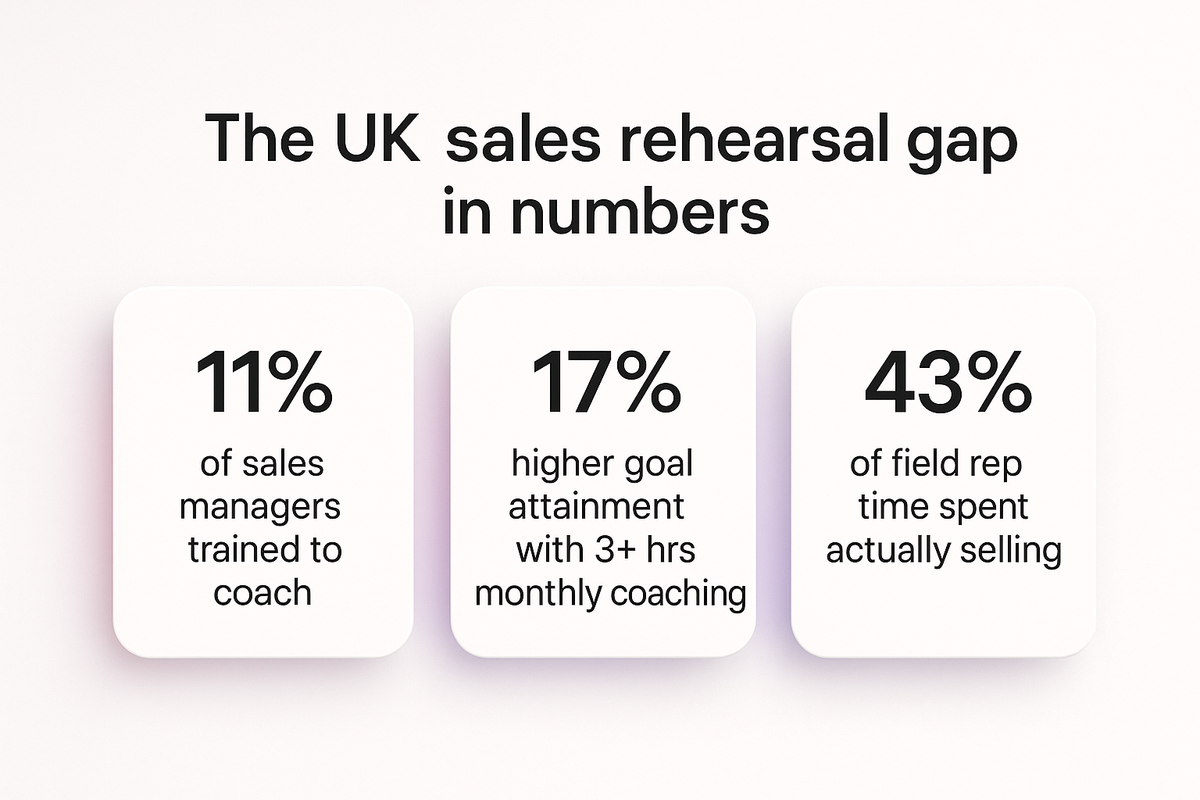
Industry data compiled by wifitalents.com puts a hard number on this: only 11% of sales managers are properly trained to coach their teams. That's despite the same research showing reps who get three or more hours of monthly coaching achieve 17% higher goal attainment. The mechanism that would close the rehearsal gap — a manager acting as director, reviewing performance and running deliberate practice — barely exists for the vast majority of UK sales organisations.
The time gap
Even where the will to rehearse exists, the time often doesn't. Benchmarking data from SPOTIO finds field sales reps spend only 43% of their time actually selling, with roughly a fifth of the working week absorbed by admin. Deliberate practice — the kind that separates a competent rep from a genuinely confident one — needs dedicated time, and that time is one of the first things squeezed out of a busy diary.
What actors and athletes do that sales teams don't
The comparison between sales and performance is already circulating in UK-adjacent commentary — Sure Train has drawn the athlete parallel, and StratX has argued sales is a performance discipline in its own right. What none of this commentary has yet connected is the funding backdrop making the gap worse, not just visible.
Three things separate rehearsal-heavy disciplines from most UK sales training:
- Repetition, not a single event. Actors run a scene dozens of times before opening night. Most sales training is a single workshop day, and vendor-reported figures (treat these as promotional rather than independent, given the source) suggest one-off training loses most of its impact within days.
- Realistic conditions. Rehearsal happens under conditions that mimic the real performance — same script, same pressure, same stakes. Generic soft-skills courses, by contrast, rarely reflect a specific product, buyer, or objection a rep will actually face.
- A coach or director present. Feedback happens in the room, in real time, not in an annual review months later.
UK sales teams typically get none of these three consistently. That's the structural reason the rehearsal gap exists — not a lack of appetite, but a lack of the conditions that make rehearsal possible.
Closing the gap without a bigger budget
The uncomfortable truth for L&D and sales leaders is that this gap can't be closed by asking for more training budget. Budgets are moving in the opposite direction, and the policy environment is actively withdrawing support from the generic courses that used to fill the gap cheaply.
What's left is making repeated, realistic practice cheap and fast enough to run routinely, rather than treating it as an expensive, occasional event. That means:
- Building practice scenarios that reflect a rep's actual product, buyers and objections — not generic role-play scripts written for any industry.
- Running short, frequent sessions rather than annual workshop days, so practice compounds rather than decays.
- Giving every rep something closer to a coaching relationship — feedback in the moment, not months later.
- Freeing up the time currently lost to admin so practice has somewhere to sit in the working week.
This is precisely where a new generation of AI-generated role play and coached practice tools is starting to matter for corporate learning and development teams and vocational training providers alike — because the traditional route to this kind of rehearsal, hiring facilitators, actors or coaches for every scenario, has always been too slow and too expensive to run at the frequency actors and athletes take for granted.
Key takeaways
- UK employer training investment has fallen to its lowest level in more than a decade, per CIPD-sourced research covered by People Management.
- Skills England is withdrawing funding from 16 generic leadership and skills standards from 1 September 2026, squeezing exactly the courses many sales teams relied on.
- Only 11% of UK sales managers are trained to coach, even though reps getting 3+ hours of monthly coaching see 17% higher goal attainment (wifitalents.com).
- Field reps spend just 43% of their time selling, per SPOTIO benchmarking — leaving little room for deliberate rehearsal even where the appetite exists.
- Closing the gap now depends on making realistic, repeated practice cheap and frequent, not on securing a bigger training budget.
Our take
The funding story and the rehearsal story are usually told separately, but they're the same problem. A shrinking training budget and a policy shift away from generic courses don't just mean less training — they mean less of the wrong kind of training gets replaced by nothing, because the alternative has always looked expensive: hiring coaches, writing bespoke scenarios, running facilitated sessions at scale. That cost structure is the real reason UK sales teams rehearse less than actors do, not a lack of belief in the value of practice. Any credible response has to attack the cost of realistic, repeated rehearsal directly, rather than hoping budgets recover.
FAQ
Why has UK sales training investment fallen? Research reported by People Management, drawing on CIPD data, shows UK employer training investment has dropped to its lowest level in more than a decade. CIPD's skills factsheets point to a longer-running structural weakness in UK workplace training investment, not a single-year dip.
What is Skills England changing in 2026? According to SRSCC's 2026 skills briefing, Skills England is removing funding for 16 generic leadership and skills standards from 1 September 2026. This affects the type of general-purpose course many UK sales teams have historically used for training.
How much sales coaching do UK reps actually get? Industry data from wifitalents.com finds only 11% of sales managers are properly trained to coach their teams, despite reps receiving three or more hours of monthly coaching showing 17% higher goal attainment.
Why don't sales reps get more time to practise? Benchmarking from SPOTIO shows field sales reps spend just 43% of their time on actual selling activity, with roughly a fifth of the week lost to admin — leaving limited protected time for rehearsal.
Does one-off sales training work as well as ongoing rehearsal? The evidence here is more limited and includes vendor-reported claims that should be read cautiously, but the broader pattern across the research is consistent: single workshop-style training days don't sustain behaviour change the way repeated, realistic rehearsal does.