Scalable Coached Practice Software NZ: A Buyer's Guide
5 October 2026 · 7 min read
Scalable coached practice software, usually sold as AI role-play or AI coaching, lets learners rehearse realistic scenarios on demand by voice, chat or video and get feedback after each attempt. It works as formative support alongside your facilitators, not instead of them. In NZ, test it on your own scenarios and check how it handles learner voice and video data.
What is scalable coached practice software?
It's software where an AI plays the counterpart: the difficult customer, the anxious patient, the new team member who needs feedback. The learner practises as often as they like, and the tool responds and gives feedback. Vendors such as ELB Learning (Rehearsal) and EducateMe describe practice that happens on demand rather than around a facilitator's diary.
That is the real appeal. Role-play with a live facilitator or an actor is one of the most effective ways to build skills, and one of the hardest to scale. Software changes the economics of repetition. It doesn't change who is accountable for the outcome.
Does it replace facilitators and assessors?
No, and you shouldn't buy it on that promise. Mindtickle frames the split sensibly: AI handles scalable practice and first-pass feedback, while managers focus on targeted coaching. That is a trade-off worth taking, because facilitators spend their time on the conversations that need a person.
For education providers the line is sharper. Practice feedback is formative. Competency and grading decisions stay with qualified assessors, under your own moderation and academic integrity processes. NZQA's published AI guidance covers academic integrity and assessment. We found nothing from NZQA approving or assessing coached-practice tools, so the responsibility to keep the two separate is yours.
What should a NZ buyer evaluate?
There is no NZ standard, certification or independent benchmark for this category. Everything below is a test you run yourself.
Practice quality
Trade sources such as Easygenerator commonly cite realistic conversation simulations, repeatable scenarios and personalised feedback after each interaction. Run a scenario from your own programme. Is the feedback specific enough that a learner knows what to change on the next attempt?
Contextualisation
Generic scenarios are easy. Ask how quickly you can build one around your learners' roles, industry, unit standards or workplace situations, and how quickly it can be changed when the work changes. Custom scenarios and language support are also commonly listed criteria.
Privacy and data handling
This is where NZ buyers should spend the most time. Recorded learner voice, video, transcripts and scores are personal information under the Privacy Act 2020. The Office of the Privacy Commissioner's 2023 AI guidance expects senior leadership approval, privacy impact assessments, transparency and human review of decisions that affect people. It also expects that AI providers don't retain or disclose personal information without a lawful basis.
Ask each vendor:
- Where are recordings, transcripts and scores stored and processed?
- How long are they kept, and are they reused to train models?
- Will the vendor support your privacy impact assessment?
- Does the tool analyse voice or facial features to categorise people?
That last question matters because of the Biometric Processing Privacy Code 2025, in force since 3 November 2025, with existing users having until 3 August 2026. Rule 10 places limits on gathering information about emotional state. Whether an "empathy" or "confidence" score drawn from voice counts as biometric categorisation isn't settled in the sources we found. Get a clear written answer from the vendor, take legal advice, and check the OPC's own page, which also refers to an amendment whose effect we couldn't confirm.
There is no AI-specific law in NZ. The Government has said it will rely on existing law, and MBIE's responsible AI guidance for businesses (released 8 July 2025) is voluntary. That makes your own due diligence more important, not less.
Evidence for claims
Outcome figures in this category are vendor-published. Virti, for example, claims 44% score higher on soft-skill assessments. Docebo says its tool is designed to replicate the effectiveness of live coaching at scale. These are vendor descriptions, and we couldn't independently verify them. Ask for the methodology, sample size and who ran the study. Ask for references from comparable NZ providers.
Integration, reporting and cost
- Delivery: does it run inside your LMS (SCORM or LTI), on mobile, or by link?
- Reporting: can educators see how skills are developing without AI scores being presented as validated competency measures?
- Cost model: does pricing scale per seat or by credits, and how does that compare with facilitator, actor and instructional design costs?
- Quality fit: does it support your NZQA-aligned moderation rather than quietly sidestepping it?
How do you test a vendor in practice?
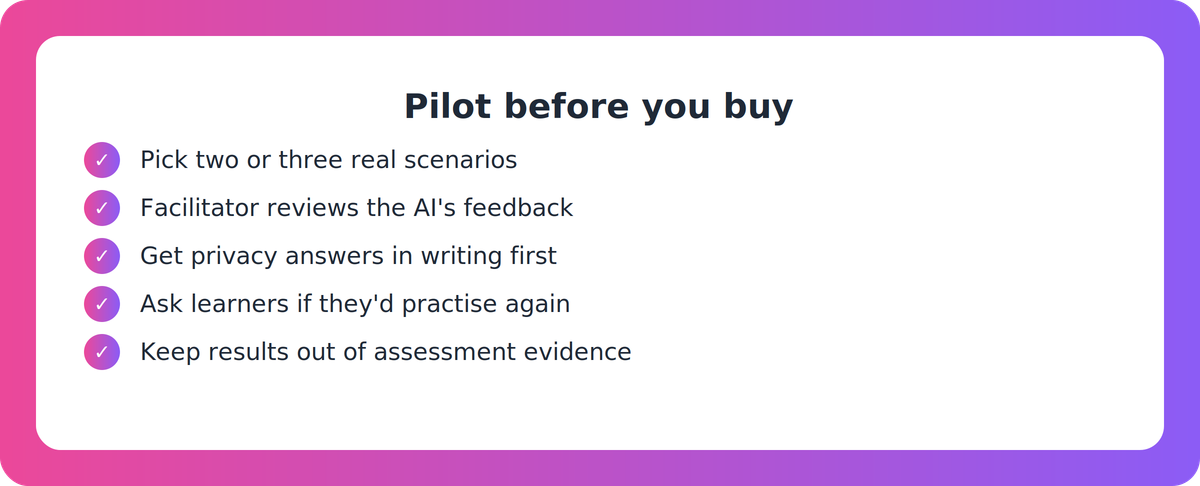
Run a short, structured pilot rather than a demo.
- Pick two or three real scenarios from your programme, including one that's hard.
- Have a qualified facilitator review the AI's feedback against what they would have said.
- Put privacy questions in writing before any real learner data goes in.
- Ask learners whether they would practise again, and how often they actually did.
- Confirm how results are reported, and that nobody treats them as assessment evidence.
Where does Supahuman's Nova fit?
Nova, from Supahuman (headquartered in Auckland), is one option in this category. Its material describes an AI that plays the counterpart by voice, a personal AI coach on every activity by voice and chat, and simulations that respond to what the learner does. The coach is described as formative: it guides rather than grades, and assessors make competency decisions. Scenarios are generated in your own context, and changes are requested in a sentence. Delivery is by hosted link, phone app or your existing LMS, with SCORM and LTI 1.3 supported.
Some honest caveats. We found no Nova-specific figures on facilitator hours saved, learner results or cost per learner. Its "coaching at scale" framing is implied rather than claimed. Check its privacy and compliance posture directly with the vendor, using the questions above. Product details are at supahuman.com.
Key takeaways
- Scalable coached practice software is usually sold as AI role-play or AI coaching. It gives on-demand rehearsal and feedback after each attempt.
- Treat it as formative support. Qualified assessors and facilitators keep competency and grading decisions.
- Learner voice, video, transcripts and scores are personal information. Check storage, retention, reuse and biometric categorisation under the Privacy Act 2020 and the 2025 Code.
- There is no NZ standard or independent benchmark, so test with your own scenarios and ask for methodology behind outcome claims.
- Judge cost against what you spend now on facilitators, actors and instructional design.
Our take
The pitch of "a coach for every learner" is the least useful thing to buy on. What matters is whether learners get more good repetitions than they do today, and whether your people still own the judgement calls. We think NZ providers should be sceptical of vendor statistics, firm on privacy, and relaxed about starting small. A pilot on one hard scenario will teach you more than any comparison table, including this one.
FAQ
What software gives every learner 1:1 coached practice without more facilitators?
AI role-play or AI coaching platforms. Learners rehearse scenarios by voice, chat or video whenever they like and receive feedback after each attempt. They reduce dependence on facilitator availability. They don't remove the need for facilitators to oversee quality and handle the conversations that need a person.
What should a NZ PTE or polytechnic check before buying?
Check practice quality, how easily scenarios are tailored, where voice and video data is stored and retained, whether the vendor supports a privacy impact assessment, LMS integration, reporting, cost model and evidence for its claims. Also get a clear answer on biometric categorisation under the Biometric Processing Privacy Code 2025.
Does AI coached practice replace assessors?
No. It should stay formative. Qualified assessors make competency decisions, and your existing moderation and academic integrity processes still apply. NZQA's published AI guidance addresses academic integrity and assessment, and we found nothing on NZQA approving coached-practice tools.
How do I know if a vendor's outcome claims are credible?
There is no independent NZ evaluation of the category, and published figures are mostly vendor-reported. Ask for the methodology, sample sizes and who conducted the study. Ask for references from comparable NZ providers, then test the tool on your own scenarios before committing.