Scaling PTE Operations in NZ: The Enrolment Growth Trap
2 August 2026 · 8 min read

Enrolment growth is not the achievement your board thinks it is. It's a stress test — and the sector has already seen what happens when a PTE passes the intake test and fails the systems one: NZQA's own history shows registrations getting revoked, not enrolments getting rewarded.
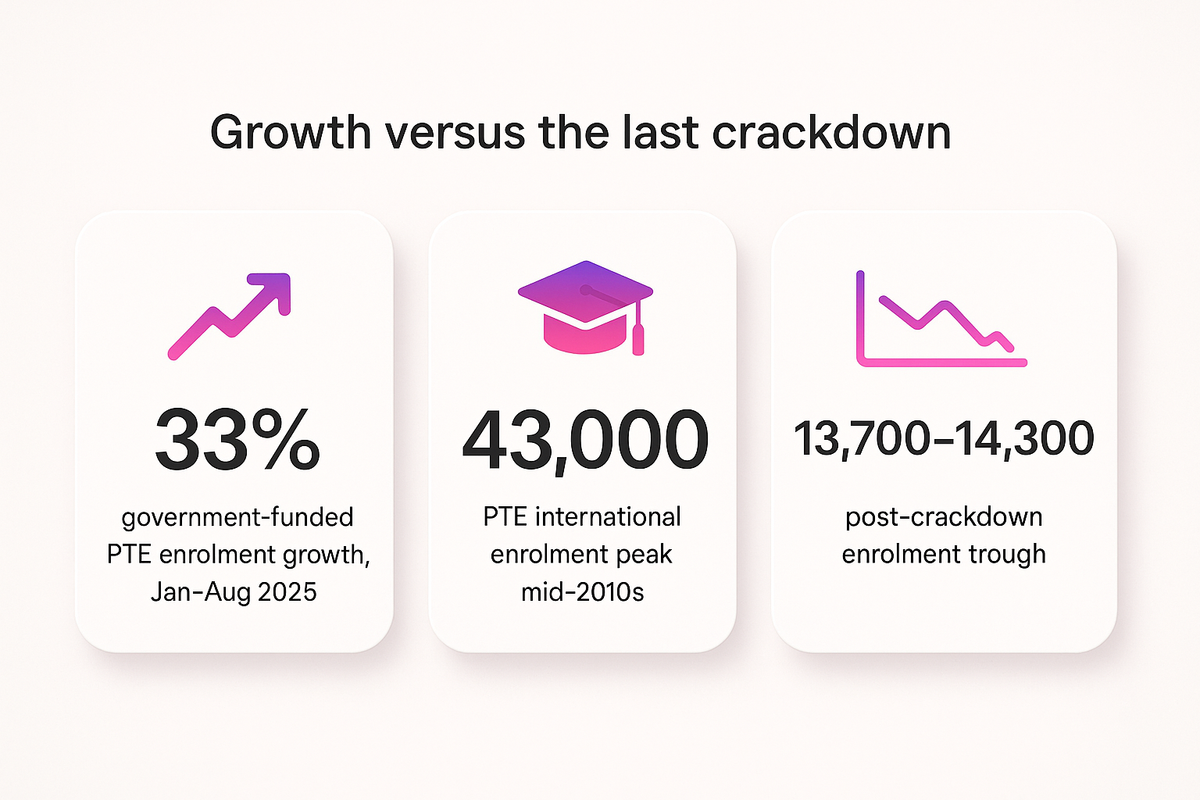
Government-funded PTE enrolments grew roughly 33% in the January–August 2025 period compared with the same window in 2024, while total international enrolments across New Zealand rose 11% year-on-year to 92,580. PTEs are, right now, the fastest-growing subsector in the system. That's good news for your CEO's board pack. It's a different kind of news for you.
Why this lands on your desk, not delivery's
Growth shows up as an intake number. It gets absorbed as an operations problem. Every new enrolment touches your student management system, your reporting cycle, your assessment and moderation queue, your finance function, and your compliance documentation — usually all at once, usually without a proportional increase in the people managing those systems.
And this growth isn't landing in isolation. You're absorbing it at the exact moment three separate regulatory shifts are converging:
- The Private Training Establishment Rules 2026 come into force on 19 January 2026, replacing both the 2025 registration rules and the 2022 enrolment and academic records rules. Non-funded PTEs move from annual to biennial financial returns, and the old GAAP requirement is replaced by an obligation to maintain "adequate internal financial controls" — a genuine back-office redesign, not a paperwork tweak.
- The SDR and IND file specifications — the formats the Tertiary Education Commission and Ministry of Education use for the Single Data Return and Indicative Enrolment Collection — changed as of August 2025. If your student management system hasn't been updated to generate and submit in the new format, that's a reporting failure waiting to happen, not a future risk.
- The Education and Training (Vocational Education and Training System) Amendment Act 2025 disestablished Te Pūkenga, established ten regional polytechnics and eight Industry Skills Boards (replacing Workforce Development Councils) from 1 January 2026, and NZQA has already updated its qualification and micro-credential rules to reflect the new terminology. That means your programme documents, consent references and compliance paperwork need remapping — a discrete project sitting on top of business as usual.
None of that is optional, and none of it scales down because you're also processing more enrolments than last year.
The precedent every COO is quietly being measured against
This is not the first time the PTE sector has grown fast. International PTE enrolments peaked at roughly 43,000 in the mid-2010s. Then NZQA moved on quality concerns, and numbers fell to somewhere around 13,700–14,300 — a fall of more than two-thirds, driven by a regulatory response to poor-performing providers who had scaled intake without scaling process control.
That's the cautionary case sitting behind every conversation NZQA has with a fast-growing PTE today. It's also, implicitly, the benchmark against which your own systems are being judged — whether anyone says so out loud or not.
Process maturity is now an audited artefact
Here's the part that should reframe how you think about this cycle. NZQA's External Evaluation and Review doesn't just look at outcomes. It explicitly assesses a provider's self-assessment capability — how well you understand your own performance, catch your own problems, and act on them before someone external has to.
Providers judged less capable in this area face increased oversight and activity limits. Providers who can demonstrate mature, reliable self-assessment get more flexible quality assurance and more room to move. In other words: the quality of your internal reporting and quality assurance processes is not just a background operational concern. It is itself the thing being evaluated, and it directly determines how much operating freedom NZQA gives you next.
That should change how you prioritise this year's operations agenda. A dashboard that catches a moderation backlog before it becomes a pattern is not a nice-to-have. It's evidence.
What actually needs fixing before the next EER, not after
A few things worth an honest internal audit right now:
- Where is process knowledge trapped in one person's head? Rapid enrolment growth exposes this fast — the assessor who intuitively knows the moderation quirks, the enrolments coordinator who manually reconciles two systems every Friday. That's a single point of failure NZQA will eventually notice too.
- How many systems require the same data entered twice? Duplicate entry between your student management system and your SDR/IND submission process is exactly where transition-period errors creep in.
- Can you produce self-assessment evidence on demand, or does it take a scramble? If a request for evidence of your quality assurance processes would require two weeks of assembly, that gap is your risk, not NZQA's.
- Have you actually delivered at least one NZQA-approved programme or micro-credential this year? It's a baseline registration requirement that's easy to lose track of amid onboarding surges — and losing it isn't a paperwork slip, it's a lapse.
Growth is also getting less predictable, not just bigger
Source-market volatility adds another layer. Nepali student numbers in New Zealand nearly doubled from 1,555 in 2024 to 2,660 in 2025, concentrated heavily in the PTE sector. That's a forecasting headache on top of an already steep growth curve — intake planning, resourcing and cash flow modelling all get harder when a single source market can swing that much in twelve months.
Key takeaways
- Government-funded PTE enrolments rose roughly 33% in the Jan–Aug 2025 period, while total international enrolments hit 92,580 nationally — PTEs are the sector's fastest-growing part right now.
- NZQA's history shows growth without proportional quality systems is what triggers intervention: international PTE enrolments fell from ~43,000 to ~13,700–14,300 after a mid-2010s crackdown.
- Three regulatory shifts land in the same window as this growth: the PTE Rules 2026 (19 January 2026), the SDR/IND data-format transition (from August 2025), and the Industry Skills Board terminology change (from 1 January 2026).
- EER explicitly evaluates self-assessment capability, meaning your internal reporting and quality processes are themselves an audited artefact, not just a background function.
- A PTE must deliver at least one NZQA-approved programme or micro-credential annually to keep its registration active — easy to overlook mid-growth, costly to miss.
Our take
The sector narrative right now is all upside — enrolments are up, international education is back, the growth story writes itself. That's true, and it's also the exact setup that preceded the last quality crackdown. The lesson from the mid-2010s isn't that growth is dangerous. It's that growth without matching investment in reporting, moderation and self-assessment capability is what regulators respond to, every time.
For operations leaders, this cycle rewards a specific discipline: treating systems maturity as a first-class project, not something that gets attention once enrolment growth slows down. It won't slow down on a convenient schedule. The PTEs that come out of this period with more registration freedom, not less, will be the ones who can show — on demand, not after a scramble — that their internal processes scaled with their intake.
FAQ
Does the Private Training Establishment Rules 2026 change apply to all PTEs, or only new registrations? The 2026 Rules replace both the 2025 registration rules and the 2022 enrolment and academic records rules from 19 January 2026, so they affect existing registered PTEs, not just new applicants — including the shift for non-funded PTEs from annual to biennial financial returns and the move from a GAAP requirement to "adequate internal financial controls."
What's actually changed in the SDR/IND file specifications, and does our student management system need updating? The Tertiary Education Commission and Ministry of Education updated the Single Data Return and Indicative Enrolment Collection file specifications as of August 2025. If your student management system generates or submits data in the old format, it needs updating to remain compliant with current reporting requirements.
Do we need to update our compliance documentation because of the Te Pūkenga disestablishment, even though we're not an ITP? Yes. NZQA has already updated its qualification and micro-credential listing and operational rules to reflect the new terminology from the Education and Training (Vocational Education and Training System) Amendment Act 2025 — the ten regional polytechnics and eight Industry Skills Boards replacing Workforce Development Councils from 1 January 2026. Any PTE documentation referencing the old structures needs remapping.
How does EER's focus on self-assessment capability actually affect our day-to-day operations? NZQA's External Evaluation and Review assesses how well a provider identifies and acts on its own performance issues, not just whether outcomes look good. Providers demonstrating weaker self-assessment capability face increased oversight and activity limits; those with mature, evidenced processes get more flexible quality assurance — which translates directly into how much operational freedom you're given going forward.