The Headcount Trap: Scaling Delivery Without More Staff
30 July 2026 · 7 min read

Every provider that scaled headcount in step with enrolment growth over the past decade is about to find that trade much harder to make. Ofsted's redesigned inspection framework, a funding-reporting regime now sitting with the Department for Education, and an apprenticeship funding overhaul are all landing inside the same operating year — right as the further education workforce becomes harder and more expensive to grow.
Why this lands on your desk
You own the systems that turn enrolments into accurate reporting, delivery capacity, and funding. When regulation adds new data demands or new rules, it's your desk where the extra admin either gets absorbed into existing processes or turns into unplanned headcount.
Three things are converging right now that make the old default — add a coordinator, add an administrator, add a data officer — a weaker option than it used to be:
- Ofsted's new framework asks for detailed operational data on demand, not once a year.
- The Individualised Learner Record still ties funding directly to admin accuracy, and the DfE's own funding assurance work keeps finding the same slip-ups.
- The Growth and Skills Levy reforms have added a fresh set of funding rules mid-cycle, with more due from Skills England as it settles into the role IfATE used to hold.
Each of these is solvable with a person. None of them scale well when the answer to "more enrolments" is always "more people to manage the paperwork."
Three regulatory shifts, one operating year
Ofsted's report card wants live data, not a paper trail
Ofsted's Education Inspection Framework, in effect from 10 November 2025, replaces single-word judgements with a multi-category report card. Providers now upload operational data — course lists, timetables, staffing structures, learner numbers by age and level — through Ofsted's portal, and Ofsted's own guidance explicitly warns against over-reliance on paperwork and treating inspection as a one-off event.
That's a direct instruction to build evidence of quality into everyday operating processes, not to assemble it under pressure the week before an inspection. If your course, timetable and staffing data lives across five spreadsheets and two people's inboxes, this framework will find that gap for you.
The ILR still ties your funding to your admin accuracy
The Education and Skills Funding Agency closed on 31 March 2025, with its functions moved into the Department for Education. The mechanics haven't changed: the Individualised Learner Record still calculates your funding and feeds official statistics, and DfE guidance is clear that errors trigger data returns for correction — with late resubmission delaying funding.
DfE's own funding assurance findings describe "lots of ways to slip up — mainly through admin error." That's a cashflow risk sitting on operations' desk, and it's exactly the kind of risk that monthly discipline manages far better than an annual clean-up sprint.
The Growth and Skills Levy just added a new rulebook mid-year
Skills England took over from the Institute for Apprenticeships and Technical Education in June 2025. Since then: minimum apprenticeship duration dropped from twelve to eight months from August 2025, levy funds now expire after 12 months instead of 24, and non-levy employer co-investment has risen from 5% to 25% once levy funds are exhausted. Each change is a new rule your reporting cycle has to absorb, on top of the ones already in place.
None of these changes are enormous on their own. Stacked together, inside twelve months, they're precisely the kind of change that breaks a manual, person-dependent process — the kind where one experienced coordinator knows the workaround and nobody else does.
The workforce math doesn't work
This would be manageable if the FE workforce were stable and easy to grow. It isn't. Sector data shows around 16% of college teaching staff leave their jobs annually, and over 40% of FE staff describe their workload as unmanageable — driven in large part by administrative work that survey respondents describe as excessive and unfulfilling. Some colleges are now spending into six or seven figures a year on agency staffing to keep classes running, with one college's agency spend reported at over £900,000 in a single year.
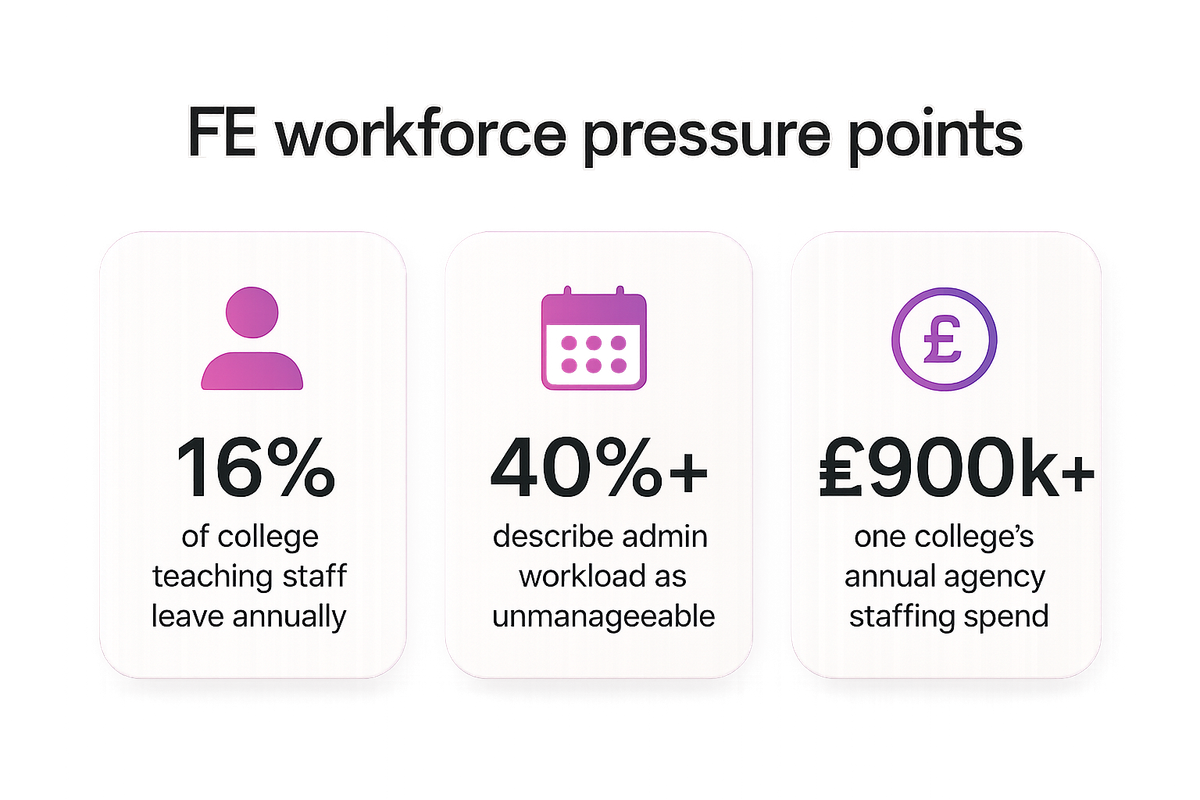
That's the trap: heavy manual admin drives the churn that then forces expensive agency hiring, which itself adds more onboarding and process overhead. Scaling headcount in proportion to enrolments doesn't just cost more — it feeds the exact retention problem making staff harder to replace.
What "systems over headcount" actually means
This isn't about doing more with less for its own sake. It's about recognising that the tasks multiplying fastest — data uploads, ILR checks, levy rule tracking — are exactly the tasks that don't need a proportionally bigger team if they're built into repeatable processes rather than repeated manually by whoever's available.
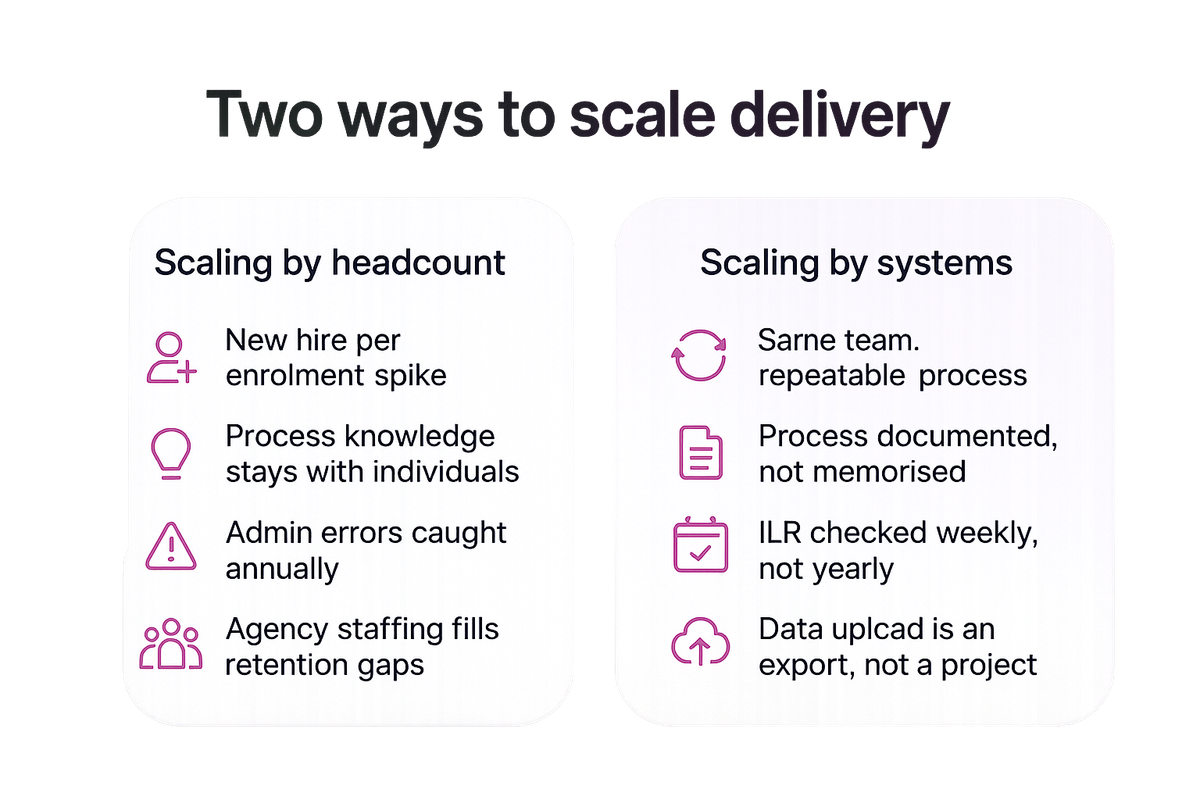
A few practical shifts worth testing this quarter:
- Treat ILR checking as a weekly habit, not a monthly event. Monthly discipline catches the admin errors DfE's assurance work keeps finding, before they become a resubmission that delays funding.
- Map your Ofsted data fields to a single source of truth. If course lists, timetables and staffing structures already sit in one place, an on-demand data upload is a export, not a project.
- Document the Growth and Skills Levy rule changes as they land, rather than relying on one person's memory of what changed in August versus what changes next.
- Track workload, not just headcount, when someone leaves. If the departing person was absorbing disproportionate admin, replacing them with another person just resets the clock on the same churn risk.
Key takeaways
- Ofsted's report-card framework, live from 10 November 2025, requires on-demand operational data through its portal — a systems capability, not an annual paperwork exercise.
- The ILR still calculates provider funding under DfE, and admin errors can delay funding through data return and resubmission cycles.
- Growth and Skills Levy reforms — shorter apprenticeship durations, 12-month levy expiry, higher co-investment ratios — are adding new rules to the reporting cycle mid-year.
- FE workforce data shows high annual attrition and unmanageable admin workload feeding a costly cycle of agency staffing.
- The sustainable response to enrolment growth is redesigned process and systems, not proportional headcount growth.
Our take
The instinct to hire against growth is understandable — it's the fastest lever a COO has, and it's visible to a board in a way that a process redesign isn't. But the maths in FE right now doesn't support it. Agency staffing costs running into six or seven figures at some colleges, alongside admin workload cited as a direct driver of the churn creating those gaps, means the cost of the old model is compounding faster than enrolment revenue can cover it.
The providers who come through this period in good shape will be the ones who treat reporting accuracy and data readiness as a built-in feature of daily operations, not a task assigned to a person. That's a genuinely different way of thinking about growth capacity — and it's worth testing on one process, this quarter, before the next round of Growth and Skills Levy changes lands.
FAQ
Does Ofsted's new framework actually require different systems, or just different reporting? Both. The framework, in effect from 10 November 2025, asks providers to upload detailed operational data — courses, timetables, staffing, learner numbers by age and level — through its portal. Ofsted's guidance warns against over-reliance on paperwork, which points to processes that generate this data continuously rather than manual compilation before an inspection.
Who do we report ILR data to now that ESFA has closed? The Education and Skills Funding Agency closed on 31 March 2025 and its functions moved to the Department for Education. The ILR mechanics — funding calculation, data returns for errors, resubmission timelines — continue under DfE.
What changed with the Growth and Skills Levy that affects our reporting? Skills England replaced the Institute for Apprenticeships and Technical Education in June 2025. Since then, minimum apprenticeship duration dropped to eight months, levy funds expire after 12 months rather than 24, and non-levy employer co-investment rose from 5% to 25% once levy funds run out — each a new rule to build into your reporting cycle.
Is agency staffing really a false economy for operations? Sector reporting shows some colleges spending into six or seven figures a year on agency staff, with one college's spend reported at over £900,000 in a single year, driven partly by attrition linked to unmanageable admin workload. Replacing headcount without addressing the underlying workload doesn't fix the churn causing the gap.