The Self-Assessment Report Trap for FE Compliance Managers
30 July 2026 · 7 min read

A Self-Assessment Report written to flatter is now the biggest liability sitting on your desk. Ofsted's renewed inspection framework, live since 10 November 2025, tests whether your SAR matches what happens in classrooms and workshops day to day — not whether it reads well. If the two don't match, inspectors find the gap before you do.
Why this lands on your desk
You own the SAR and the Quality Improvement Plan that sits beneath it. When an inspector picks apart last November's confident narrative against what they actually observe, you're the one reconciling the difference — not the principal, not the curriculum lead.
That job has got harder, not easier. Ofsted's renewed framework expects evidence to be lived, not laminated: current, traceable, and drawn from real practice rather than a curated file. If your proof still lives across shared drives, inboxes and spreadsheets, that expectation lands squarely on your process, not just your paperwork.
And the ground keeps moving. Skills England replaced the Institute for Apprenticeships and Technical Education from June 2025, the minimum apprenticeship duration dropped from twelve months to eight from August 2025, and Ofqual is expected to publish a new regulatory framework for apprenticeship assessment in spring 2026. Every one of those changes touches the evidence base your SAR is supposed to reflect — often before the document has even reached its January submission point.
What actually changed on 10 November 2025
Ofsted's renewed Education Inspection Framework replaced single-word overall judgements with a graded report card, covering areas such as curriculum, leadership, inclusion and personal development. Safeguarding sits apart, judged as a stand-alone 'met' or 'not met' rather than folded into the overall grade.
The reform also removes 'deep dive' evaluations. Inspectors now build their judgement from a broader evidence base across the whole provider, rather than a handful of intensive subject or provision reviews. That's a meaningful shift for self-assessment: there's no single deep dive to prepare for and pass. There's only the question of whether your account of the provider stands up wherever inspectors choose to look.
Ofsted's own Education Inspection Framework Implementation Review found that inspectors were applying the new framework effectively, but that evidence-gathering challenges persist — particularly in smaller or specialist settings. Those are exactly the settings where a SAR is most likely to have drifted ahead of what's actually happening on the ground.
The SAR habit that inspectors now distrust
Sector consultants have flagged the same problem for years: providers write their SAR in the shape of the Ofsted inspection handbook, working through it section by section. That produces a long, repetitive document that describes provision rather than evaluates it. The handbook tells inspectors what to look for. It was never meant to be a template for how you write your own self-assessment.
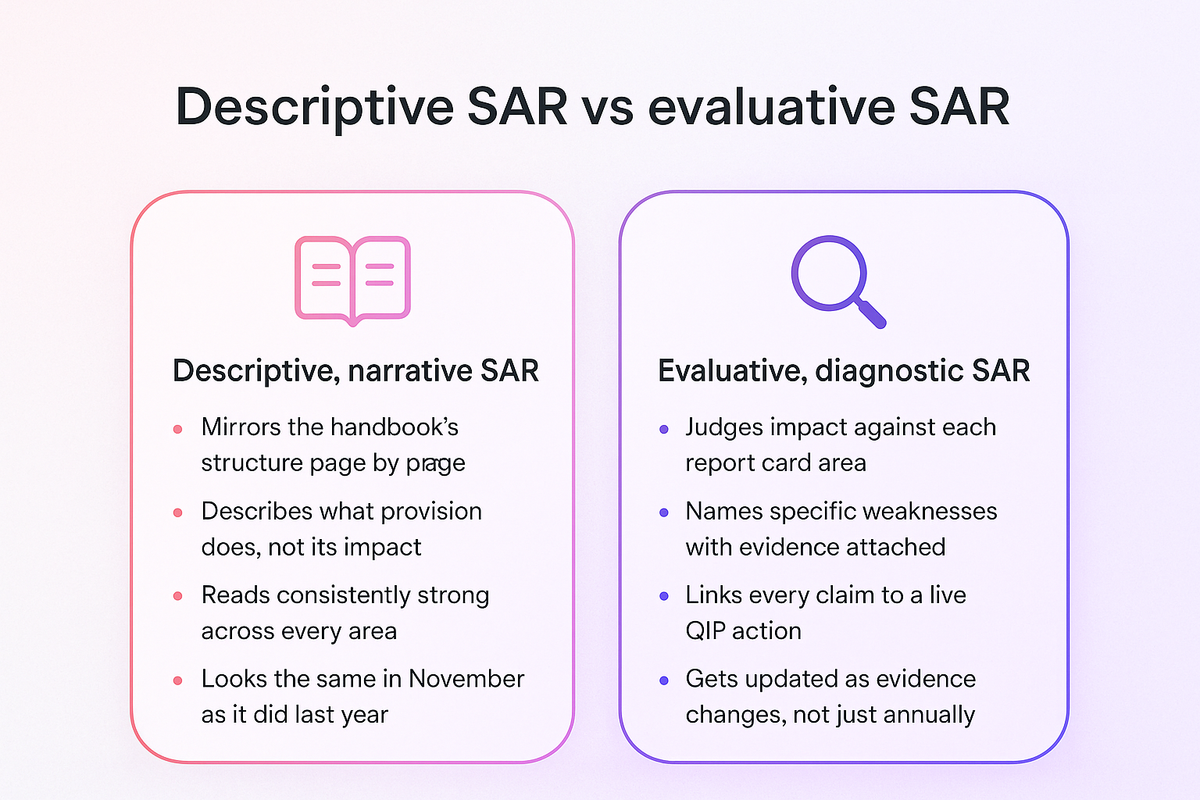
The fix isn't more detail. It's a shorter, more judgemental document that names weaknesses plainly, backs every claim with current evidence, and doesn't read the same from one year to the next.
Your QIP is probably part of the problem
The Quality Improvement Plan is where a weak SAR gets exposed. Common criticisms from FE quality reviewers include too many improvement areas listed at once, actions that lack a named owner or a real date, and a heavy focus on policy and process rather than teaching, learning and assessment. The result is a QIP where half the actions sit permanently at 'ongoing' — the exact status inspectors have learned to distrust, because it signals an action that was never really actioned.
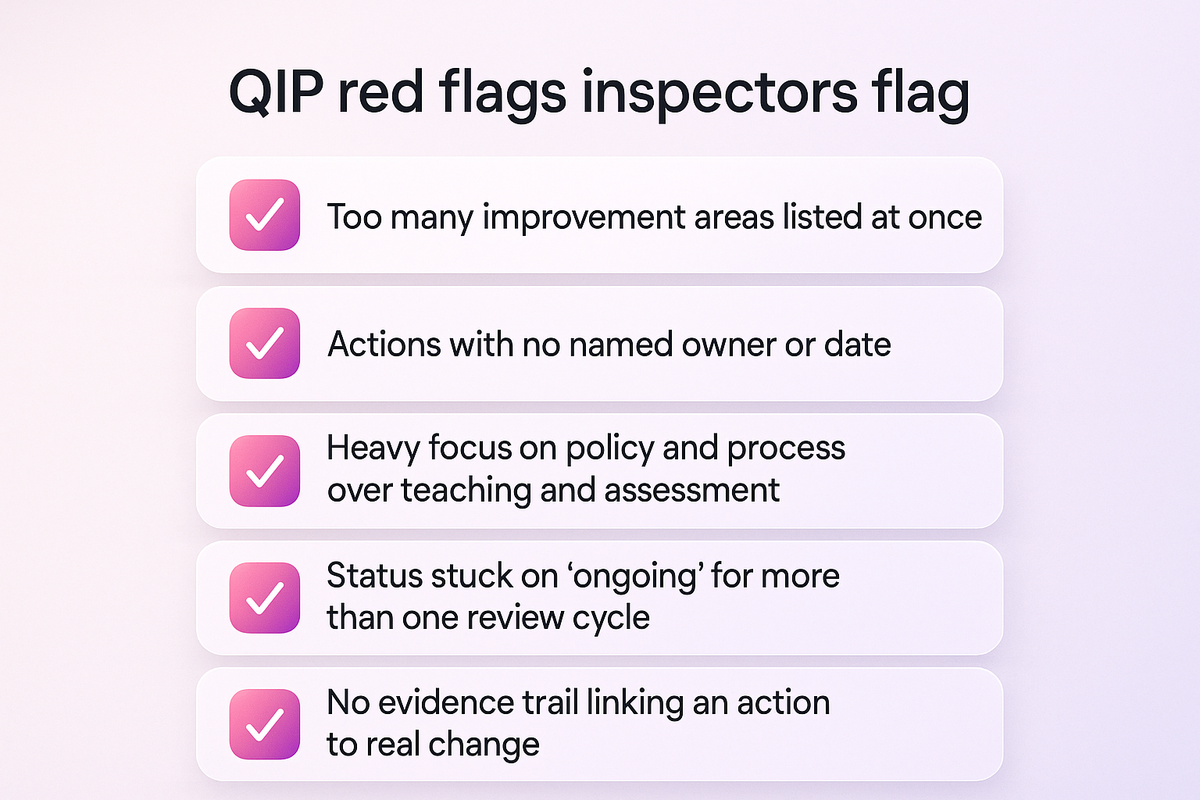
A QIP that survives scrutiny does the opposite: fewer priorities, each one owned, dated, and tied to a specific change in practice that you can point to and evidence.
The evidence base is moving beneath you
Providers are typically expected to have their SAR in final draft by the end of November, submitted the following January. That's a fixed compliance deadline sitting on top of a moving regulatory target. Between the creation of Skills England, the shortened minimum apprenticeship duration, and Ofqual's expected framework for end-point assessment arriving in spring 2026, the standards a SAR is measured against can shift materially within a single academic year.
That's not a reason to delay self-assessment until the picture settles. It's a reason to stop treating the SAR as an annual writing exercise at all.
Treat self-assessment as a live diagnostic, not an annual essay
A precedent worth remembering: a DfE ministerial letter once criticised a local authority's self-assessment as "overly optimistic in judgements about performance and insufficiently self-critical." Regulators are willing to call out self-assessment inflation directly, in writing, when they see it. Ofsted's renewed framework, with its broader evidence base and no deep dives to rehearse for, makes that same scrutiny far more likely to land on a provider's own SAR.
The practical answer is to build self-assessment into the calendar year-round rather than compressing it into the weeks before the November deadline: review evidence against each report card area on a rolling basis, retire QIP actions the moment they're genuinely closed rather than leaving them at 'ongoing', and re-test your SAR's claims every time a standard, duration, or assessment framework changes underneath you.
Key takeaways
- Ofsted's renewed framework, live from 10 November 2025, replaced single-word judgements with a graded report card and dropped deep dives — raising the stakes on whether your SAR reflects daily practice.
- SARs written to mirror the Ofsted inspection handbook's structure tend to become descriptive rather than evaluative — exactly the trait inspectors have learned to discount.
- QIPs with too many priorities, vague ownership, and actions stuck at 'ongoing' are a documented red flag, and that document sits on the Compliance Manager's desk.
- Standards themselves are moving — Skills England, the shortened apprenticeship duration, and Ofqual's spring 2026 assessment framework — so the SAR's evidence base needs re-testing more than once a year.
- Regulators have shown, in writing, that they will call out self-assessment that reads as overly optimistic rather than self-critical.
Our take
The SAR was never designed to be a report card in itself — it's a working diagnostic that either matches lived practice or doesn't. Removing deep dives makes the gap between narrative and reality more visible, not less, because there's no single set-piece to prepare for and everything is now fair game. The providers who stay calm on audit day are the ones who stopped writing the SAR once a year and started treating it as a document that gets corrected every time something changes — a standard, a duration, an assessment framework, or simply what a lesson observation actually showed.
FAQ
What changed in Ofsted's inspection framework from 10 November 2025? Ofsted replaced single-word overall judgements with a graded report card covering areas including curriculum, leadership, inclusion and personal development, judged safeguarding separately as 'met' or 'not met', and removed 'deep dive' evaluations in favour of a broader evidence base.
Why do inspectors distrust SARs that follow the Ofsted handbook structure? FE quality consultants note that mirroring the handbook section by section produces a descriptive account of provision rather than an evaluative one — the handbook is a guide to what inspectors look for, not a template for self-assessment writing.
What makes a Quality Improvement Plan weak in Ofsted's eyes? Common issues include too many improvement areas at once, actions without a named owner or date, an over-focus on policy and process rather than teaching and assessment, and actions left at 'ongoing' status for more than one review cycle.
How often should a SAR actually be reviewed, given how fast standards are changing? With Skills England replacing the Institute for Apprenticeships and Technical Education, apprenticeship minimum durations shortening, and a new Ofqual assessment framework expected in spring 2026, the evidence underpinning a SAR should be re-tested whenever a relevant standard changes, not held for an annual rewrite ahead of the November draft deadline.