Can Simulation-Based Training Close the AQF Skills Gap?
10 August 2026 · 9 min read

Can Simulation-Based Training Close the AQF Skills Gap?
Australia's Standards for RTOs 2025, in force since 1 July 2025 and now the basis for every ASQA audit, stopped prescribing exactly how practical skills must be taught and started asking only that outcomes are demonstrated. That shift arrives just as chronic shortages in healthcare, construction, aged care and advanced manufacturing make traditional placement-based training too slow and too costly to scale. Simulation-based assessment is moving from workaround to mainstream option.
What actually changed in the Standards for RTOs 2025?
For years, providers treated simulation as a fallback — something you used when a real workplace or client wasn't available, and hoped ASQA wouldn't ask too many questions about. The 2025 Standards change that calculus.
According to ASQA's own guidance and independent compliance summaries, the revised Standards move regulatory attention away from prescribing delivery methods and toward evidence of demonstrated competence:
- The Standards took effect 1 July 2025 and are now the framework ASQA uses in audits and monitoring.
- ASQA's Practice Guide on facilities, resources and equipment gives Registered Training Organisations (RTOs) clearer scope to justify simulated environments as valid assessment settings against units of competency, provided they reflect real workplace conditions.
- The focus is on whether a learner can demonstrate the skill to the required standard — not on ticking a box that says training happened in a specific physical location.
That's a meaningful change for any RTO delivering AQF-aligned training packages where real-world placement capacity is limited, expensive, or simply not available at the scale demand requires.
Why is this landing now, specifically?
The regulatory shift isn't happening in a vacuum. Skills shortages are entrenched across several sectors at once, and the traditional instructional design and placement model is visibly struggling to keep pace.
Commentary from the Forbes Business Council (February 2026) points to persistent shortages in healthcare, construction, aged care, hospitality and advanced manufacturing as vocational education providers try to blend in-person, virtual and simulated delivery with AI and immersive technology to close the gap at scale.
At the same time, analysts at Insources Group have flagged a structural problem: training packages and their units of competency can lag behind how fast industry actually changes. A graduate can complete every required unit and still arrive on the job without the practical capability an employer expects on day one.
Where is government already testing simulation in practice?
This isn't theoretical. Jobs and Skills Councils — the government-backed bodies advising on workforce needs — are running live pilots:
- A maritime-sector JSC project is trialling simulated training environments specifically to accelerate access to skilled workers, rather than waiting on vessel-based placements that are limited and expensive.
- A separate JSC initiative developed an AQF Level 7 vocational degree structure explicitly framed around "bridging the gap" between qualification and workplace capability. Its final report was accepted by the Department of Employment and Workplace Relations in January 2026.
Both projects appear in JSC quarterly updates from October 2025 and January 2026, which suggests this is an active, funded direction rather than a one-off experiment.
The cost case: what healthcare tells us about the old model
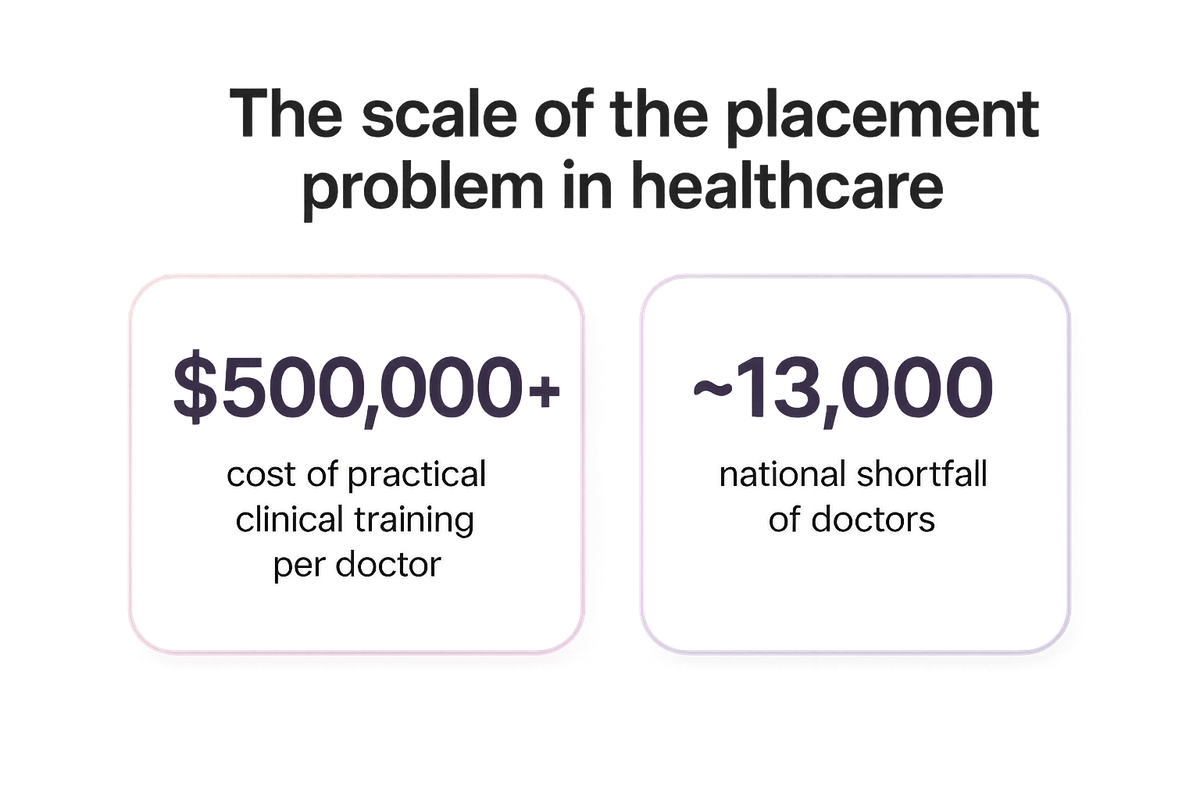
Healthcare offers the starkest numbers. Reporting in Pulse+IT puts the cost of practical clinical training — placements, cadaveric labs, procedural training and clinician supervision — at more than $500,000 per doctor. Against a national shortfall of roughly 13,000 doctors and documented junior-doctor burnout, scaling the traditional placement model further isn't realistic, financially or logistically.
Healthcare is an extreme case, but the underlying constraint is common to construction, aged care and advanced manufacturing too: real-world placements are finite, supervision is expensive, and demand for skilled workers keeps growing.
Does ticking off units of competency actually get you there?
Here's the harder question the Standards change doesn't answer on its own: does passing an assessment event mean a learner can actually perform under pressure, in a real workplace, months later?
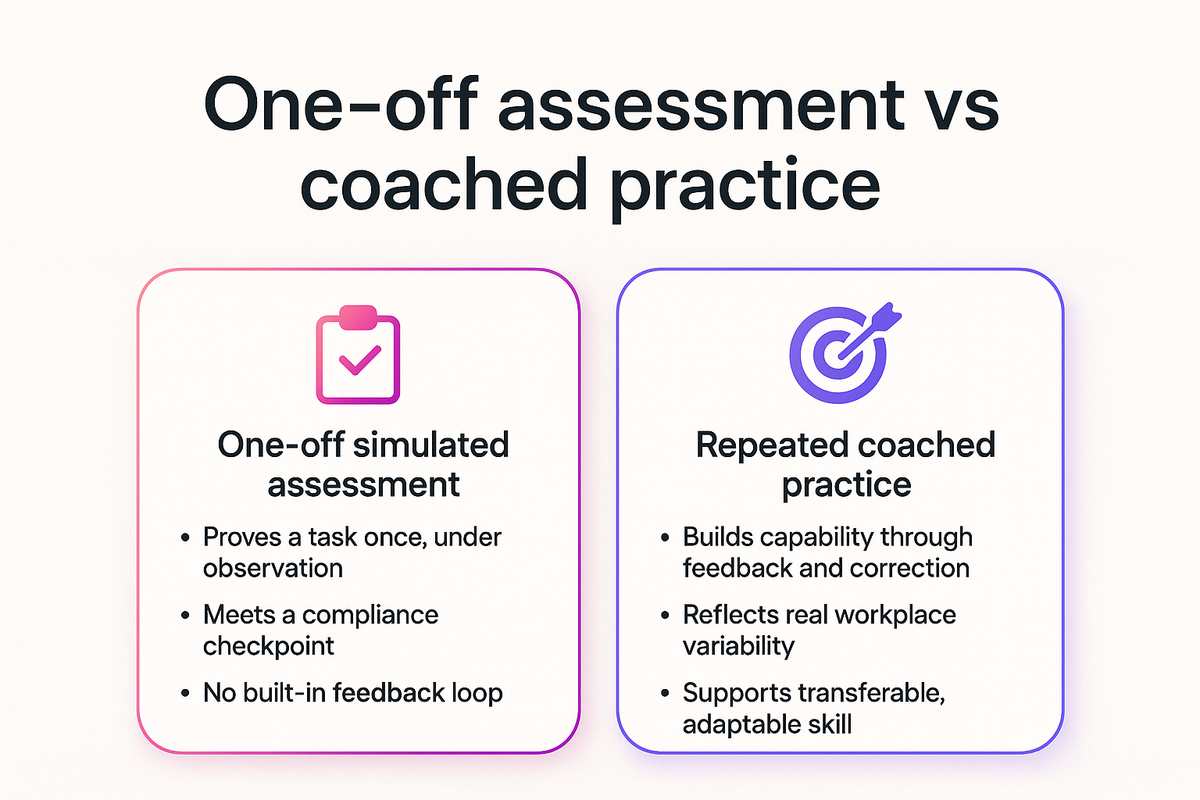
The Learning Resources Group's analysis, published as "The Bridge Problem", argues no. Its position is that competency-based "ticking" of individual units — one assessment, one sign-off, done — doesn't build the transferable, adaptable capability employers actually need. That capability, the argument goes, comes from repeated, coached practice, not a single pass/fail moment.
That's a useful distinction for any RTO designing simulation into its assessment strategy under the new Standards:
- A one-off simulated assessment proves a learner can perform a task once, under observation, on a good day.
- Repeated coached practice — with feedback, correction, and another attempt — builds the kind of capability that survives contact with a real client, patient, or worksite.
The Standards for RTOs 2025 make the first kind of simulation defensible. They don't require the second. That's where the real skills gap will be won or lost.
What this means for RTOs building AQF-aligned training
For providers, the practical implications sit in three places:
- Assessment design. Simulation can now sit at the centre of assessment evidence for many units of competency, not just as a supplement to placement hours — provided it's realistic and well-documented.
- Design cost. Building a genuinely realistic simulated environment, role play, or coached practice scenario has traditionally meant long instructional design cycles, actors, and facilitators — expensive to build and hard to keep current as training packages evolve.
- Personalisation at scale. A one-size-fits-all simulation module doesn't reflect the different contexts a learner might face — a construction supervisor and an aged care worker need very different scenarios, even under similar underlying competencies.
This is exactly the gap that newer AI-generated learning tools are aimed at: producing contextual audio, video and interactive role-play scenarios in a fraction of the time traditional instructional design takes, so coached practice becomes something an RTO can realistically offer at scale rather than only for a handful of flagship qualifications.
Key takeaways
- The Standards for RTOs 2025, effective 1 July 2025 and the basis for current ASQA audits, shift the regulatory test toward demonstrated outcomes, giving RTOs clearer scope to use simulation against units of competency.
- Jobs and Skills Council pilots — including a maritime project and an AQF Level 7 qualification accepted by DEWR in January 2026 — are already testing simulation as a workforce-readiness tool, not just a classroom exercise.
- Healthcare data (Pulse+IT) show traditional placement-based training can cost over $500,000 per doctor, against a shortfall of roughly 13,000 doctors — a scale problem simulation is being asked to help solve.
- Analysts warn training packages can lag industry needs, and The Learning Resources Group argues that ticking off units of competency alone won't close the practical skills gap.
- Repeated, coached practice — not a single simulated assessment event — is the distinction that determines whether simulation actually builds transferable capability.
Our take
The regulatory permission slip has arrived, but it solves the easier half of the problem. Any RTO can now point to the Standards for RTOs 2025 and justify a simulated assessment against a unit of competency — that was arguably already possible, just riskier to defend at audit. The harder, more valuable question is whether providers use this room to build genuine coached practice, with feedback and repetition, rather than a single well-produced simulation that still only tests a learner once. Given how fast training packages can fall behind industry reality, providers who treat simulation as an ongoing practice environment — not a one-time compliance event — will be the ones whose graduates actually perform when the qualification meets the real workplace.
FAQ
Does the Standards for RTOs 2025 explicitly permit simulation-based assessment for units of competency? The Standards, in effect from 1 July 2025 and now the basis for ASQA regulatory activity, focus on demonstrated outcomes rather than prescribed delivery methods. ASQA's Practice Guide on facilities, resources and equipment supports simulated environments as valid assessment settings where they realistically reflect workplace conditions, giving RTOs clearer grounds to use simulation against relevant units of competency.
Which industries are the government's Jobs and Skills Councils testing simulation in? Publicly reported pilots include a maritime-sector project trialling simulated training environments to accelerate access to skilled workers, and a separate initiative that developed an AQF Level 7 vocational degree framed around closing practical skills gaps, with its final report accepted by the Department of Employment and Workplace Relations in January 2026.
Why is healthcare cited as a case for simulation over placements? Reporting in Pulse+IT estimates the cost of practical clinical training — placements, cadaveric labs, procedural training and clinician supervision — at over $500,000 per doctor, against a national shortfall of roughly 13,000 doctors and reported junior-doctor burnout, making the traditional placement model difficult to scale further.
Is simulation alone enough to close the practical skills gap for AQF qualifications? Analysis from The Learning Resources Group argues no — ticking off individual units of competency through one-off assessment events doesn't build transferable, adaptable capability. It argues repeated, coached practice with feedback is what actually closes the gap between qualification and workplace performance.
Do training packages themselves need to change, or is this only a delivery method issue? Both. Analysts at Insources Group note that training packages and units of competency can lag behind how quickly industry needs shift, meaning simulation-based delivery has to be paired with training packages that stay current, not just a new way of assessing the same static content.