Simulation Training Software for RTOs: A Buyer's Guide
27 July 2026 · 9 min read

The best simulation training software for RTOs is whichever tool lets you trace every scenario straight back to the assessment conditions set out in the relevant training package, because ASQA applies the same Standards for RTOs 2025 requirements to simulated delivery as it does to any other mode, and a qualified assessor still has to validate every outcome.
That's the honest starting point for this category. VR headsets, AI avatars and chat-based role-play partners get most of the marketing attention, but none of it matters if the scenario can't be mapped to what the unit of competency or accredited course actually requires.
What counts as "simulation training" for an RTO
In VET, simulation covers a wide range of delivery — from a trainer running a structured peer role-play in a classroom, through to VR clinical scenarios and AI-driven conversation partners that let a learner rehearse a difficult customer or client interaction solo. Role play itself is explicitly named by ASQA as an acceptable method for real-time, video-based assessment of practical and oral skills where delivery is online or remote.
What unites all of it, from a compliance standpoint, is that training packages and VET accredited courses set the assessment conditions — including specific environments, equipment or resources required — and any simulation tool has to be checked against those conditions before you use it. You can't assume a tool is compliant just because it looks realistic.
Does simulation satisfy ASQA's requirements under the Standards for RTOs 2025?
Yes, but only if it's built and used correctly. ASQA guidance states that where a simulated workplace environment is used for assessment, it must "fully replicate the resources, environment and any time and productivity pressures that exist in the actual workplace," and that these environments should be developed in consultation with industry stakeholders.
The 2025 Standards for RTOs, which took effect on 1 July 2025, don't create a lower compliance bar for technology-based or simulated delivery. The same requirements around training and assessment strategies, resources and assessor judgement apply regardless of whether the learner is in a workshop, a webcam, or a headset. If your simulation tool can't show how it replicates real workplace pressures and conditions — not just visuals — that's a gap worth pressing the vendor on before you buy.
Can AI-generated role-play replace traditional classroom role-play?
Not entirely, and no credible vendor should claim it does. The case for AI-based practice partners is a genuine one: traditional peer-to-peer classroom role-play has real weaknesses — social anxiety that distracts learners from the actual skill being practised, and human partners who break character or respond inconsistently. AI conversation tools are marketed specifically to address that inconsistency, letting a learner rehearse the same scenario repeatedly without a partner getting tired or going off-script.
But rehearsal isn't assessment. Whatever practice format a learner uses — human role-play, AI conversation, or VR simulation — the assessment decision still sits with a qualified assessor, who has to judge the evidence against the unit of competency and document that judgement. Software can generate the practice environment and even structure the evidence for review. It can't sign off competency.
VR immersive platforms vs AI conversation-based role-play
RTOs shopping in this category are usually choosing between two different kinds of tool, and it's worth being clear-eyed about what each does well.
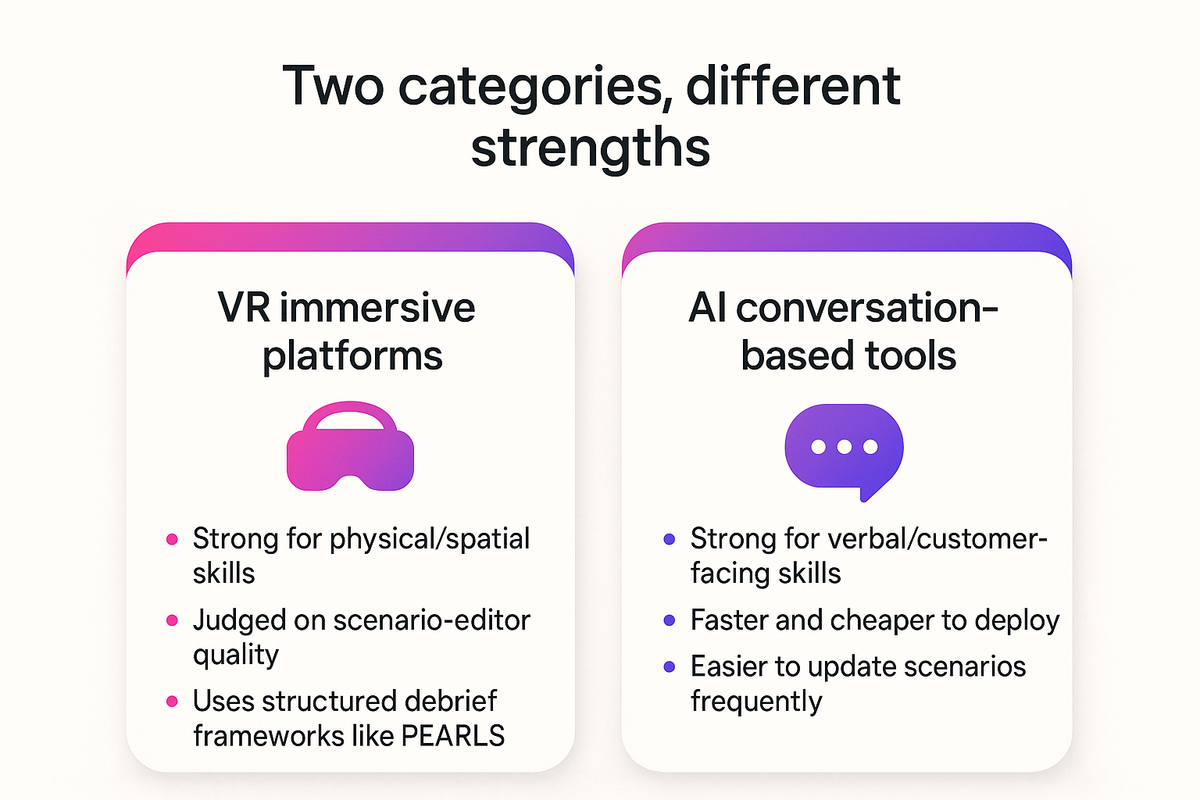
Immersive VR simulation platforms (common in clinical and nursing training) tend to be judged on scenario-editor usability, analytics and debrief tooling, and support for structured debriefing frameworks like PEARLS, which are cited as strengthening how learners integrate the competency afterwards. They're strong where physical environment, equipment handling or spatial judgement genuinely matters to the skill being assessed.
AI conversation-based role-play tools are generally lighter to deploy, cheaper to scale, and better suited to communication-heavy or customer-facing scenarios — sales conversations, difficult client interactions, workplace conflict — where the skill is verbal and situational rather than physical. Neither category is universally "better"; the right choice depends on what the training package assessment conditions actually call for.
The evaluation checklist
Before you sign anything, run the tool against these questions:
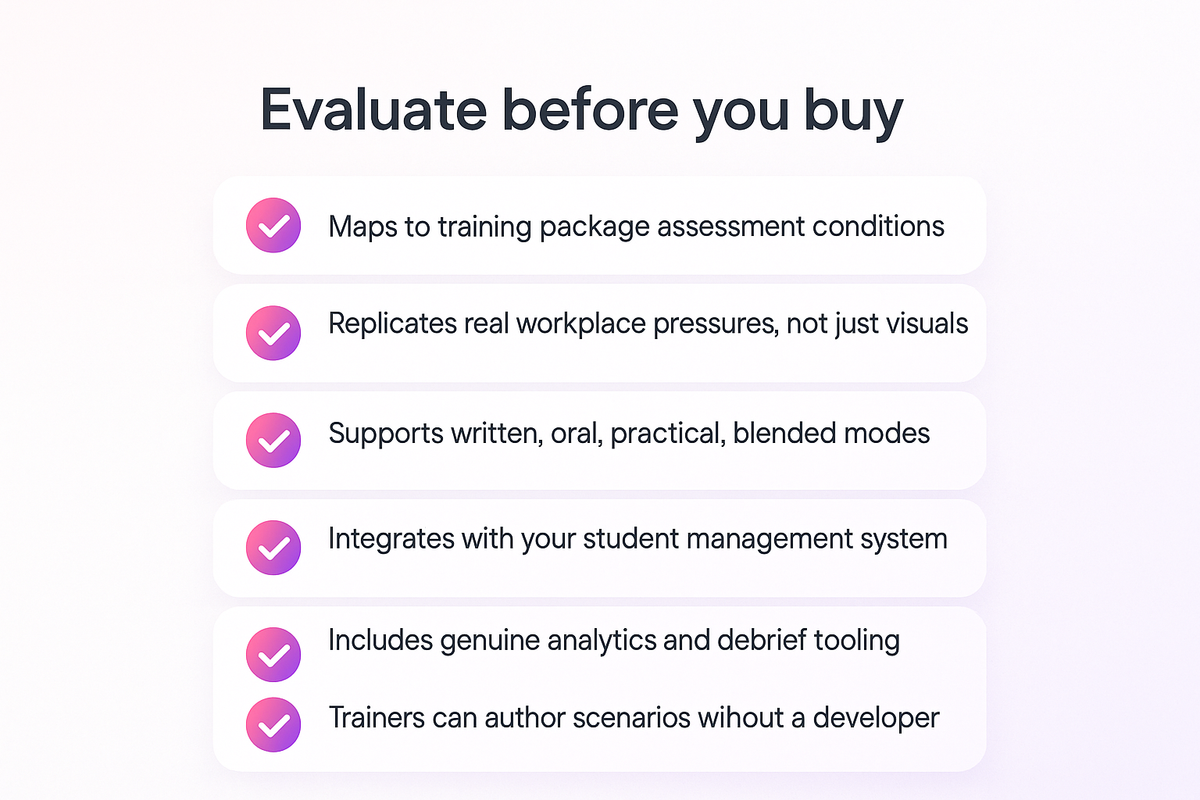
- Can the vendor show how scenarios map to the specific assessment conditions in your training package or accredited course — not just general claims of "realism"?
- Does it demonstrably replicate the resources, environment, time pressures and productivity pressures of the real workplace, as ASQA expects?
- Does it support the delivery and assessment methods your RTO actually uses — written, oral, practical, blended, digital or paper-based — rather than locking you into one fixed format?
- Will it integrate with your existing student management system and reporting workflows, or will it create a second, disconnected evidence trail?
- Does it include genuine analytics and debrief support, or just raw transcripts and scores?
- Can your own trainers and assessors author or update scenarios without needing a developer or instructional designer for every change?
- Does it clearly preserve the assessor's role, supporting their judgement rather than trying to automate it away?
- Is the vendor upfront about what the product actually does — content and assessment creation versus immersive delivery — rather than blurring the two?
These criteria matter more than headset resolution or how lifelike an avatar looks. A tool that nails realism but can't be mapped to assessment conditions, or that leaves your assessor guessing what evidence to trust, isn't ready for regulated use.
Where the compliance paperwork fits in
Whatever simulation or role-play tool an RTO chooses, it still needs to sit inside a documented Training and Assessment Strategy, with assessor guides, rubrics and validation records that show the scenario was mapped to the unit correctly. That documentation layer is separate from the simulation delivery itself, and it's easy to underinvest in it once the exciting part of the purchase — the actual simulation software — is sorted.
This is the layer where a tool like VETos, Supahuman's AI workspace for Australian RTOs, is a reasonable fit: it's built to generate ASQA-aligned assessment instruments, assessor guides with rubrics and exemplar responses, and moderation records across written, oral, practical, blended, digital or paper-based modes. It's not an immersive VR platform or an AI conversation partner, and it doesn't replace one — it's built for the compliance and assessment-documentation work that any new role-play or simulation-based assessment method still needs underneath it.
Key takeaways
- Match the tool to the assessment conditions in the training package first; realism and novelty come second.
- ASQA expects simulated environments to replicate real workplace resources, pressures and time constraints — ask vendors to show this, don't assume it.
- The Standards for RTOs 2025 apply the same bar to simulated and technology-based delivery as to any other mode.
- AI role-play tools address real weaknesses in classroom role-play (social anxiety, inconsistent partners) but they support practice, not assessment sign-off.
- Choose between VR immersive and AI conversation-based tools based on what the assessment conditions actually require, not on which looks more advanced.
- A qualified assessor must still validate every simulation-based assessment outcome — no tool changes that.
Our take
Most buyers in this category get seduced by the delivery technology and treat compliance as an afterthought — that's backwards. The tools worth shortlisting are the ones whose sales conversation starts with assessment conditions and evidence, not headsets or avatars. An RTO that picks a genuinely useful practice tool but skips the documentation work around it will still fail an audit; an RTO that gets the compliance mapping right can use almost any reasonable simulation format on top of it.
FAQ
What should Australian RTOs look for in role-play and simulation training software?
Look for a tool that maps directly to the assessment conditions in your training package, replicates real workplace resources and pressures as ASQA expects, integrates with your student management system, and keeps your qualified assessor in charge of the final judgement rather than trying to automate it.
Does simulation-based training or assessment satisfy ASQA's requirements under the Standards for RTOs 2025?
It can, provided the simulated environment fully replicates the resources, environment and time or productivity pressures of the real workplace, and the assessment conditions specified in the training package are met. The Standards for RTOs 2025 apply the same requirements to simulated delivery as to any other mode — there's no reduced bar.
Can AI-generated role-play replace traditional classroom role-play for VET training and assessment?
AI role-play can address genuine weaknesses in classroom role-play, such as social anxiety and inconsistent human partners, and gives learners more repeatable practice. It can't replace the qualified assessor's judgement — assessment outcomes must still be validated by a human against the unit or module requirements.
How do RTOs choose between immersive VR simulation platforms and AI conversation-based role-play tools?
Base the choice on what the assessment conditions actually call for. VR platforms suit skills involving physical environment or equipment handling and are typically judged on scenario-editor quality and debrief tooling; AI conversation tools suit communication-heavy, verbal scenarios and are generally faster and cheaper to deploy and update.
Does simulation software replace the need for a documented Training and Assessment Strategy?
No. Whatever simulation or role-play tool you use, it still needs to sit inside a documented Training and Assessment Strategy with assessor guides, rubrics and validation records showing how the scenario maps to the unit of competency — that documentation layer is separate from the simulation delivery itself.