Simulation Training Software NZ: A PTE Buyer's Guide
27 July 2026 · 8 min read

There's no such thing as "NZQA-approved" simulation training software — NZQA's Private Training Establishment Rules are technology-neutral, so no vendor carries that badge. What a New Zealand PTE or ITP actually needs is software whose scenario outputs can be retained as auditable assessment records, reviewed by qualified staff, and produced on demand at a validation visit.
What counts as "simulation training software" in this market
The category is broader than it sounds. It spans AI chat or voice roleplay engines built for sales, service and leadership conversations, through branching-scenario e-learning, to full clinical simulation setups with manikins and recorded debriefs. All of them promise practice before the real thing. For a provider, the useful question isn't which looks most polished — it's which type matches the skill being taught, and what happens to the recording or transcript afterwards.
Across vendors in this space, the common features tend to be:
- Branching dialogue that responds to what a learner says, not just a fixed multiple-choice path
- AI-generated scenario content that can be produced quickly rather than built from scratch over weeks
- Scoring or coaching feedback tied to specific skill markers
- Reporting that's meant to feed a learning management system or student management workflow
Does simulation used for assessment need to meet NZQA rules?
NZQA registers and monitors PTEs under sections 342–361 of the Education and Training Act 2020, and under the Private Training Establishment Rules — the 2022 rules currently in force, being replaced by the Private Training Establishment Rules 2026 from 19 January 2026. Neither version names or mandates any simulation, roleplay or AI category. The rules are written to be technology-neutral.
That neutrality doesn't mean simulation output escapes scrutiny once it's tied to grading. NZQA's rules define "assessment materials" to include whatever an assessor uses to make a judgement about a student's performance. If a simulation platform is generating the evidence a tutor marks against, that output becomes part of the PTE's assessment record and needs to be retained accordingly — the same as a written assignment or an observation checklist.
This matters most early on. A newly registered PTE faces a validation visit within six months of its first student enrolment. If a simulation tool feeds into assessment from day one, it needs to produce records that can be pulled up, checked, and matched against the relevant unit standard — not just a completion certificate.
Where delivery is against unit standards, providers are also expected to consult the relevant Standard Setting Body and the Consent and Moderation Requirements document for that qualification. That's a separate step from choosing software, but it shapes what "compliant" assessment evidence actually needs to look like before any tool is signed off.
Health and clinical simulation: a separate professional bar
In nursing and allied health — New Zealand's most developed simulation evidence base — programmes typically also answer to discipline-specific pedagogical standards, such as the NLN/Jeffries simulation framework and INACSL standards. These sit alongside NZQA's institutional rules, not instead of them.
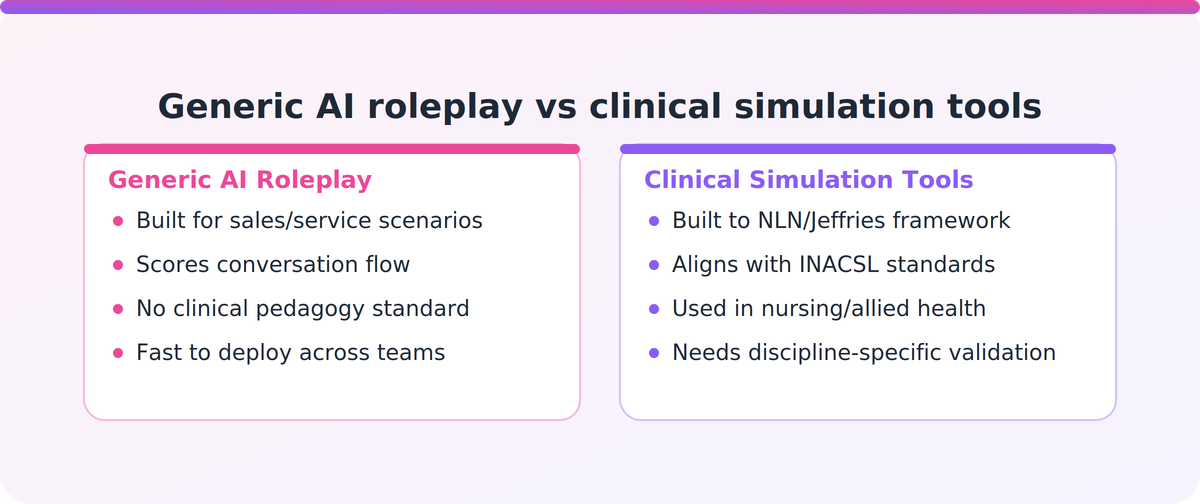
A generic AI roleplay engine built for sales conversations and a clinical simulation platform built around Jeffries or INACSL principles are solving different problems, even though both get called "simulation." A nursing or health programme evaluating simulation software should ask directly whether the vendor understands, or has built to, those frameworks — not assume that a strong corporate-training demo transfers cleanly into a clinical context.
Evaluate the tool against your own scenarios, not the vendor's demo
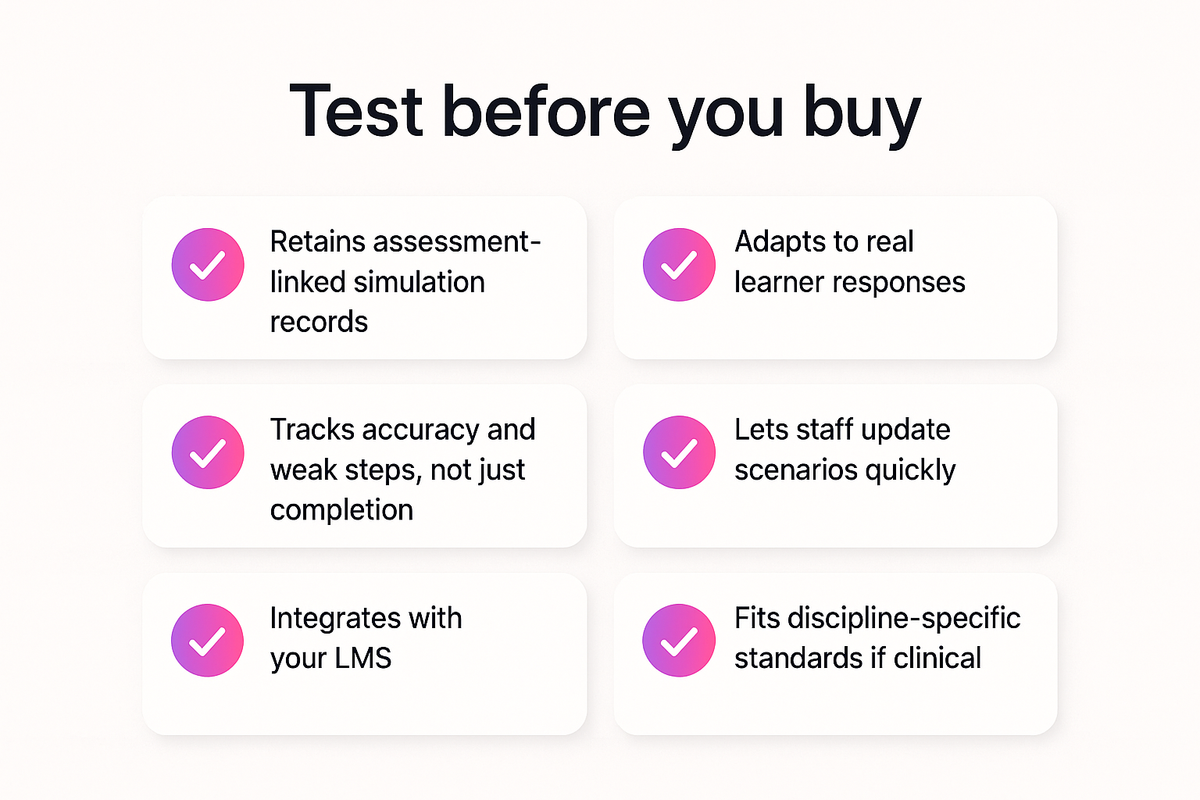
Procurement research on this category makes a recurring point: rollouts rarely fail because the underlying AI is weak. They fail because buyers judge on a polished demo instead of testing scenario realism, adaptivity to real responses, and integration against their own use cases. Before signing anything, run your own material through the tool and check:
- Assessment-linked records: can it retain and produce a transcript or score history in a form a validator could review?
- Genuine adaptivity: does it respond to what a learner actually says, including pushback or a wrong answer, or does it follow one scripted path dressed up as interactive?
- Outcome measurement: does it track accuracy, number of attempts and specific weak steps, or only "completed / not completed"?
- Content governance: how fast can your own staff update a scenario when a policy, product or standard changes, without needing the vendor?
- LMS and reporting integration: does it sit inside your existing student management workflow, or become a second system your team has to reconcile?
- Discipline fit: for regulated or clinical training, does the vendor understand the relevant professional simulation standards?
What to budget for beyond the licence
Total cost of ownership is rarely the sticker price on the quote. Factor in deployment and setup, ongoing support and which channel it comes through, data storage and retention for however long your assessment records need to be kept, and staff time — both to build scenarios and to review AI-generated output before it's used for grading. A tool that's cheap to license but slow to update, or that produces content your assessors have to rewrite before it's audit-ready, can end up costing more in staff hours than a pricier, better-governed alternative.
Key takeaways
- No simulation or AI roleplay tool is "NZQA-approved" — the PTE Rules are technology-neutral, and the responsibility for audit-ready assessment evidence sits with the provider, not the software.
- If a simulation platform's output is used for grading, treat it as an assessment record under the PTE Rules — retrievable, retained, and ready to show at a validation visit from day one.
- Health and clinical programmes carry an extra layer — frameworks like NLN/Jeffries and INACSL — that a generic corporate roleplay vendor may not have been built for.
- Judge on outcome data (accuracy, attempts, weak steps) and testing against your own scenarios, not on completion rates or a vendor demo.
- Total cost of ownership includes support, data retention and staff review time, not just the licence fee.
Our take
Simulation and AI roleplay tools are genuinely useful — they give learners repeated practice they'd otherwise only get from a scarce instructor or actor, and NZ providers shouldn't write off the category just because it's crowded with vendors. But the honest framing is that these tools produce practice material and evidence, not compliance sign-off. We built VETos to help PTEs and ITPs draft NZQA/NZQF-aligned assessments and lesson content faster; as one New Zealand PTE, Mast Academy, found, that's about speeding up the drafting, with educators still reviewing and refining before anything reaches a student. Supahuman's Nova, built to generate contextual roleplay and coached-practice scenarios, sits squarely in the category this guide is about — and like every tool covered here, its output is a starting point for a qualified assessor to check, not a substitute for their judgement.
FAQ
Is there NZQA-approved simulation training software? No. NZQA's Private Training Establishment Rules are technology-neutral and don't name or endorse any simulation, roleplay or AI vendor category. Responsibility for compliant, validated assessment evidence stays with the PTE, whatever software generates it.
Does AI-generated roleplay or simulation content need human review before it's used for assessment? Yes. Where simulation output feeds into grading, NZQA's assessment-materials rules mean that output becomes part of the assessment record — so a qualified assessor needs to review and validate it, the same as any other assessment evidence.
How is clinical simulation software different from a generic AI roleplay tool? Nursing and allied health programmes typically also work to discipline-specific standards such as the NLN/Jeffries framework and INACSL, alongside NZQA's institutional rules. A tool built for corporate sales roleplay isn't necessarily built to those clinical pedagogy standards, so check for that fit rather than assuming it.
What should I test before signing a contract, not just watch in a demo? Run your own real scenarios through the tool and check its adaptivity to unscripted responses, whether it measures accuracy and specific weak steps rather than just completion, how fast staff can update content, and whether it produces retrievable assessment records.
What does simulation software typically cost beyond the licence fee? Budget for deployment and setup, ongoing support, data storage and retention for assessment records, and staff time to build and review scenario content — total cost of ownership is often driven more by these than the licence price itself.
If you're weighing up a simulation or role-play purchase, start with your own validation checklist and your discipline's standards before the first demo call. And if the underlying assessments or lesson plans need work too, it's worth a look at how tools like VETos or Nova handle that — provided your own staff still review and sign off the output.