Simulation Training Software for RTOs: A Buyer's Guide
12 October 2026 · 8 min read
Yes, an Australian RTO can use simulation or AI role-play software, provided it supports realistic practice and produces evidence that matches each unit's Assessment Conditions. ASQA doesn't approve or certify these tools, and it applies the 2025 Standards for RTOs to every delivery mode. So the RTO stays responsible for evidence quality and for a qualified assessor's competency decision.
Can an RTO use simulation software, and what does ASQA expect?
ASQA describes simulation as creating "a realistic practice environment that enables a student to learn while in a controlled environment". It also gives role play scenarios in a real-time, video-based assessment as an example of online assessment (ASQA: Online training and assessment). One caution: ASQA's practical training page still quotes definitions from the older 2015 Standards, so check its current guidance (ASQA: Practical training and assessment).
The 2025 Standards for RTOs are in full effect (ASQA). They sit under the NVR Act 2011 and consist of Outcome Standards, Compliance requirements and a Credential Policy. ASQA says every delivery mode carries the same regulatory requirements.
That shapes how you buy. There's no official definition of this software category, no ASQA certification and no approved-vendor list. Most "best RTO software" roundups cover LMS, SMS and compliance platforms, not simulation. You judge fit against the Standards yourself.
What should you check before buying simulation software?
Treat the tool as a practice and evidence layer inside your training and assessment system. These are the questions that matter.
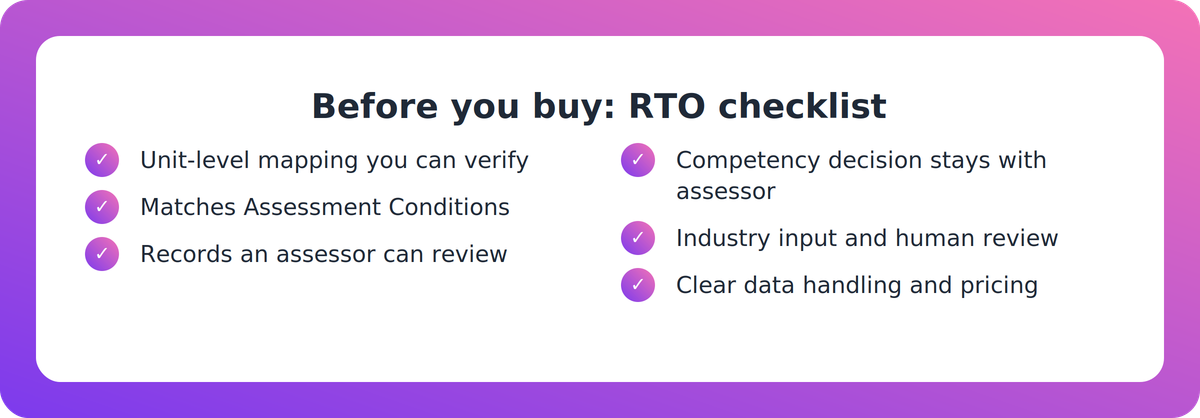
Does it map to units of competency?
Can you see which elements, performance criteria, and knowledge and performance evidence each activity practises? Can you check that against your scope? A tool that says it's "aligned to training packages" without showing the unit-level detail hasn't answered the question.
Does it match the Assessment Conditions?
If practical skills are trained in a simulated environment, the RTO must ensure access to the facilities, resources and equipment found in the contemporary workplace. Units of competency list these in the Assessment Conditions. Students must get the chance to practise with the required materials before assessment. Training package Companion Volumes can help you design workplace-replicating simulations.
Ask the vendor directly whether they accept that some units need real workplace components. A good answer includes the word "no" somewhere.
What evidence and records does it keep?
ASQA asks you to consider how you'll gather valid, sufficient, authentic and current evidence of practical skills. It also notes that records of industry discussions, design decisions and student progress show a simulation operates as designed. Ask what the tool keeps (recordings, transcripts, progress records) and whether an assessor can review it. A commercial IT commentary also notes that recordkeeping and information management are getting closer audit scrutiny (CCP).
Who makes the competency decision?
Feedback inside a simulation should be formative. The decision stays with a qualified assessor. ASQA's 2025 Standards FAQ says there's no "team approach" to assessment, and we found no source suggesting software feedback can stand in for assessor judgement. If a vendor implies otherwise, walk away.
Is there industry input and human review?
The Assessment Practice Guide (v1.0, June 2025) covers Standards 1.3 to 1.5, including reviewing assessment tools before use, for example by consulting industry to confirm content is correct and relevant to the workplace (ASQA Practice Guide: Assessment). If AI generates scenarios, someone qualified must review and approve them before learners see them, and you should be able to show that review.
What about data, delivery and price?
- Where are learner recordings held, and how is privacy handled?
- Does it fit your IT and records obligations?
- Does it work with your LMS (SCORM or LTI) and let learners in without friction?
- Is pricing clear per learner, and is there verifiable Australian customer evidence?
Does simulation replace workplace assessment or the assessor?
No. Some accredited courses require workplace assessment because the environment can't be simulated. Elsewhere, ASQA's Users' guide for VET Accredited Courses allows a simulated environment where assessment can't happen in a workplace for safety or access reasons. Note that guide covers accredited courses, not training packages.
There's also a warning sign. A VET Development Centre summary of ASQA's draft Practice Guides (a secondary source) flags a risk of over-reliance on simulated work environments or virtual observations. Check the final Practice Guide for Standard 1.8 before you design around simulation.
One more gap to be honest about. Independent evidence is thin. We found no independent Australian VET-specific effectiveness studies on this category. The simulation research that exists sits mostly in health education. We also found no authoritative market-size or pricing data. Treat vendor claims as claims.
Where does Supahuman's Nova fit?
In the interest of being straight: we build Nova, so weigh this section accordingly. Supahuman describes Nova 5 as delivering role plays, simulations, interactive video and coached practice contextualised to a learner's industry. It's positioned as the delivery companion to VETos, which designs and validates. Nova isn't an authoring tool or an LMS.
Against the criteria above, here's what the material says, and what to verify:
- Mapping: activities are generated from your training products and mapped to elements, performance criteria, knowledge evidence and performance evidence of units on scope, with a mapping matrix per activity. Verify this in a demo.
- Assessor control: coaching and mock-assessment feedback is formative only. Nova doesn't mark or make competency decisions.
- Records: voice role play recordings and transcripts are kept so an assessor can review tone, clarity and pacing. Whether that meets a given unit's evidence requirements is for your RTO and its assessors to decide.
- Delivery: a single link with no learner accounts, an installable app, and SCORM and LTI 1.3 for LMS users. Pricing is per active learner, ramping down with volume. We haven't found published dollar figures.
- Gap: there are no named Australian customer case studies or quantified outcomes we can point to, so outcome statements are product claims. Ask for evidence from any vendor, us included.
Key takeaways
- Simulation software can suit an RTO when it supports realistic practice and generates evidence aligned to each unit's Assessment Conditions.
- ASQA doesn't approve or endorse the software, and the same 2025 Standards apply to every delivery mode.
- It can't replace mandatory workplace components or a qualified assessor's competency decision.
- Buy on unit-level mapping, the records kept, human review of AI-generated content, and assessor control.
- Independent Australian evidence is scarce, so ask for verifiable proof and treat claims as claims.
Our take
The useful question isn't "which simulation tool is best?". It's "which one lets my assessors see, check and own the evidence?" Practice is where most learners stall, and realistic rehearsal before a real workplace or assessment event is worth having. But the RTO carries the compliance risk, not the vendor. Pick the tool that makes your validation, industry consultation and assessor review easier to show, and be wary of any pitch that makes them sound optional.
FAQ
Can an Australian RTO use AI role-play or simulation software for training and assessment?
Yes, if it supports realistic practice and generates evidence aligned to the unit's Assessment Conditions. ASQA doesn't approve or certify such software, so the RTO remains responsible for valid, sufficient, authentic and current evidence and for a qualified assessor's competency decision.
Does simulation software replace workplace assessment or assessor judgement?
No. Some courses require workplace assessment because the environment can't be simulated, and competency decisions should stay with a qualified assessor. ASQA's FAQ says there's no "team approach" to assessment, and we found no source supporting software feedback as a substitute for assessor judgement.
How do I tell whether a simulation tool is mapped to units of competency and produces usable evidence?
Ask to see, per activity, which elements, performance criteria, and knowledge and performance evidence it practises. Then check what is recorded (recordings, transcripts, progress records) and whether an assessor can review it. Test this in a demo against units on your scope.
Is there an ASQA-approved list of simulation training software?
No. We found no ASQA certification, approval or approved-vendor list for this category, and ASQA doesn't endorse software. Buyers judge fit against the 2025 Standards for RTOs, including industry consultation, validation and recordkeeping.
Is there independent evidence that simulation software works in Australian VET?
Not that we found. No independent Australian VET-specific effectiveness studies turned up, and the simulation research sits mostly in health education. Ask vendors for verifiable Australian customer evidence.
If you'd like to see how Nova handles mapping and assessor review, you can book a demo and test it against a unit on your own scope. If you'd rather run your own shortlist, the checklist above works for any vendor.