Skills England Apprenticeship Standards, One Year On
12 July 2026 · 7 min read

Skills England's first year hasn't answered the question of who owns apprenticeship standards — it has multiplied the answers. Sponsorship of the agency has moved from the Department for Education to the Department for Work and Pensions, the Secretary of State now has statutory power to develop or commission standards directly, and FE Week's reporting shows sector bodies actively forcing delays to centrally-driven reform. For providers, that means the standards a curriculum maps to can shift in governance as well as content, often with little notice.
What actually changed when Skills England took over
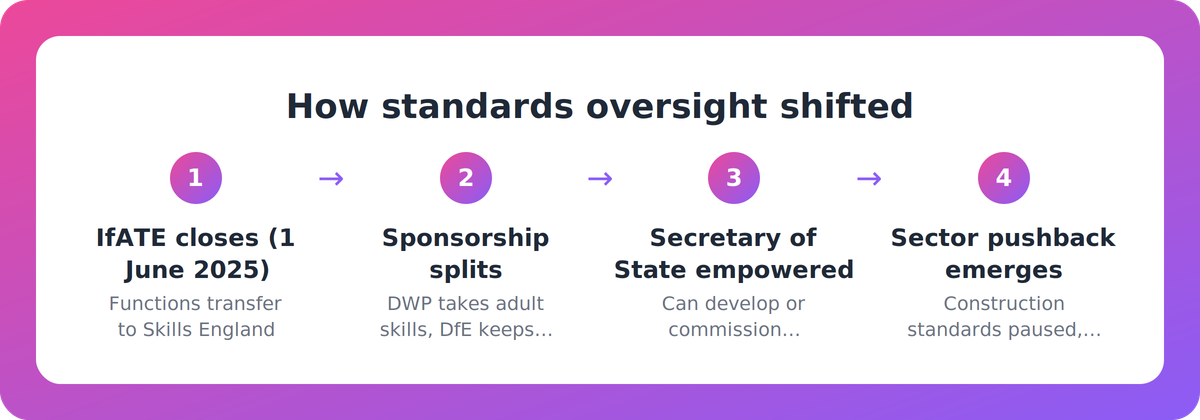
IfATE formally closed on 1 June 2025, and its functions transferred to Skills England. On paper, that looked like a straightforward rename. In practice, the transfer reshaped who has final say.
- Skills England has no independent legal identity of its own. Policy analysis from Wonkhe describes it as an arms-length body operating through a transfer of functions to the Secretary of State — not an independent employer-led regulator in the way IfATE was designed to be.
- Sponsorship of Skills England itself has since moved from the DfE to the DWP, while responsibility for further education and skills for under-19s stays with the DfE. That splits oversight of the standards system across two departments rather than consolidating it under one.
- The Transfer of Functions legislation gives the Secretary of State the power to develop apprenticeship standards directly, or commission others to approve them. Academic commentary from BERA notes this represents materially greater government control than IfATE's employer-led trailblazer model ever allowed.
None of this is hidden. It's set out in the legislation and in Parliamentary and sector commentary. But it's a genuinely different governance shape from the one providers spent a decade learning to navigate.
Who holds the pen on standards now?
Ask a curriculum lead who signs off a standard today and the honest answer is: it depends which route it went through. Skills England's own first Annual Skills Report, published 1 June 2026, insists occupational standards remain the foundation for apprenticeships and technical qualifications, and reaffirms a commitment to employer co-development. That's the official line.
The evidence on the ground tells a slightly different story. FE Week's investigative reporting found that in December 2025, Skills England pushed through a first batch of 93 apprenticeship standards across 10 sectors for a new, centrally-driven assessment reform approach. Employer trailblazer groups weren't the ones setting that pace.
The construction standoff: a live test case
Of those 93 standards, 40 covered construction. Sector bodies pushed back hard enough that those 40 were pulled from immediate scope, pending a new industry taskforce. That's not a footnote — it's direct evidence of an ownership dispute playing out in public, between central government's reform timetable and the sector bodies who used to hold effective control under the trailblazer model.
It's worth noting what this dispute is actually about. It isn't whether construction standards need updating. It's whether the pace and process are set centrally or by the people who employ apprentices on-site. Under IfATE, that balance leant towards employers. Under the new arrangement, it's contestable — and construction won this round only because it pushed back hard.
New layers: apprenticeship units and the accelerated route
On top of the governance split, two new mechanisms add granularity and pace that providers now have to track.
Apprenticeship units are shorter, standalone training products extracted from existing occupational standards, funded through the Growth and Skills Levy. The first ten were published in April 2026. For providers, that's a new layer of sub-standard granularity sitting underneath the full standards curriculum teams already map against.
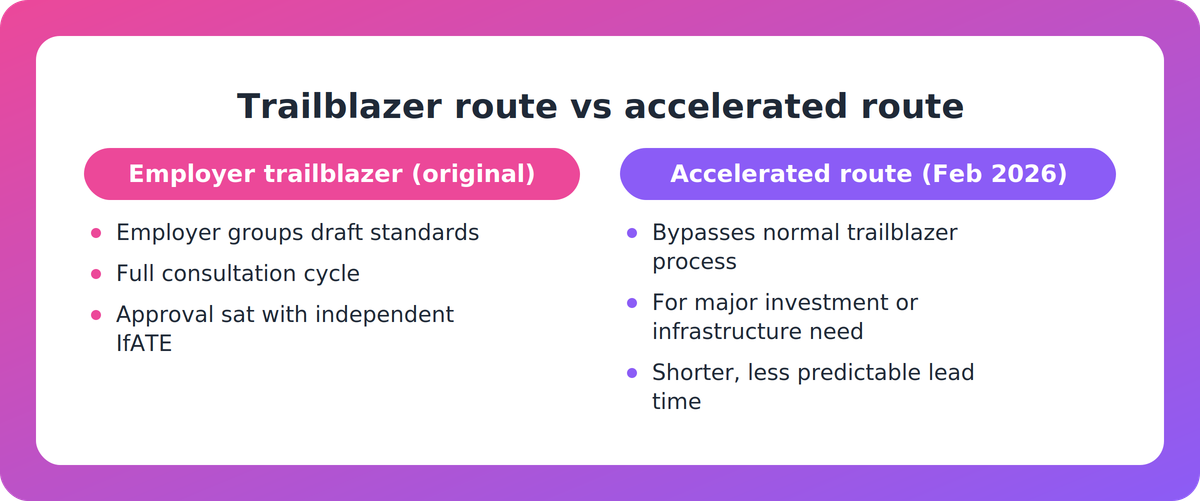
The accelerated route, announced in February 2026, allows standards or units to be developed or updated outside the normal trailblazer process, where employers can demonstrate major investment or infrastructure need. That's a second channel — alongside the ordinary trailblazer cycle — through which a standard a provider is delivering against can change, with less predictable lead time than before.
What this means for curriculum and assessment mapping
Put the pieces together and the practical implication is straightforward: the standards underpinning a provider's curriculum and assessment materials can now change in governance and in substance, through more than one route, sponsored across two departments, with warning periods that vary by which mechanism triggered the change.
That matters most for the teams responsible for keeping training and assessment content mapped to the standard actually in force — usually a small number of experienced staff doing that mapping by hand. When a standard shifts through the ordinary trailblazer cycle, there's usually a consultation window. When it shifts through the accelerated route, or gets superseded by a new apprenticeship unit, that window can be much shorter.
Key takeaways
- Skills England absorbed IfATE's functions on 1 June 2025, but its own sponsorship has since split — DWP for adult skills, DfE for under-19s — spreading oversight across two departments.
- The Secretary of State now has statutory power to develop or commission standards directly, a materially different control model from IfATE's employer-led trailblazers, according to BERA's analysis.
- FE Week's reporting on the December 2025 reform batch, including the construction standards pause, shows the ownership question is being actively contested, not settled.
- Apprenticeship units (first ten published April 2026) and the February 2026 accelerated route both add new channels through which standards can change, often with shorter notice than the trailblazer cycle.
- Skills England's June 2026 Annual Skills Report reaffirms employer co-development in principle, even as its own reform mechanisms concentrate more practical control centrally.
Our take
The rhetoric around Skills England has stayed remarkably consistent — employer-led, co-developed, standards-first. The mechanics have moved in a different direction. A minister with direct power to commission standards, two departments sponsoring one agency, and two new routes for changing standards outside the normal cycle add up to a system with more potential entry points for change, not fewer. For providers, the sensible response isn't to wait for the governance question to settle — it probably won't, not soon. It's to build the capability to detect and absorb a standard change quickly, whichever door it came through, rather than relying on the trailblazer cycle's old rhythm to give fair warning.
FAQ
Did Skills England replace IfATE outright? Yes. IfATE formally closed on 1 June 2025 and its functions transferred to Skills England, but Skills England has no independent legal identity of its own — it operates through a transfer of functions to the Secretary of State, according to Wonkhe's policy analysis.
Which government department is actually responsible for Skills England? Sponsorship has moved from the Department for Education to the Department for Work and Pensions. Responsibility for further education and skills for under-19s stays with the DfE, splitting oversight of the standards system across two departments.
Can ministers now set apprenticeship standards without employer trailblazer groups? The Transfer of Functions legislation gives the Secretary of State power to develop apprenticeship standards directly, or commission others to approve them — a materially greater level of government control than existed under IfATE's employer-led model, per BERA's commentary.
What happened with the construction apprenticeship standards? In December 2025, Skills England pushed through a first batch of 93 standards across 10 sectors for centrally-driven assessment reform. FE Week reported that 40 construction standards were pulled from immediate scope after sector pushback, pending a new industry taskforce.
What are apprenticeship units and how are they different from standards? Apprenticeship units are shorter, standalone training products extracted from existing occupational standards and funded through the Growth and Skills Levy. The first ten were published in April 2026, adding a layer of sub-standard granularity that providers now need to track alongside full standards.